PCU Nurse Interview Questions (2026): Step-Down Sample Answers for New Grads
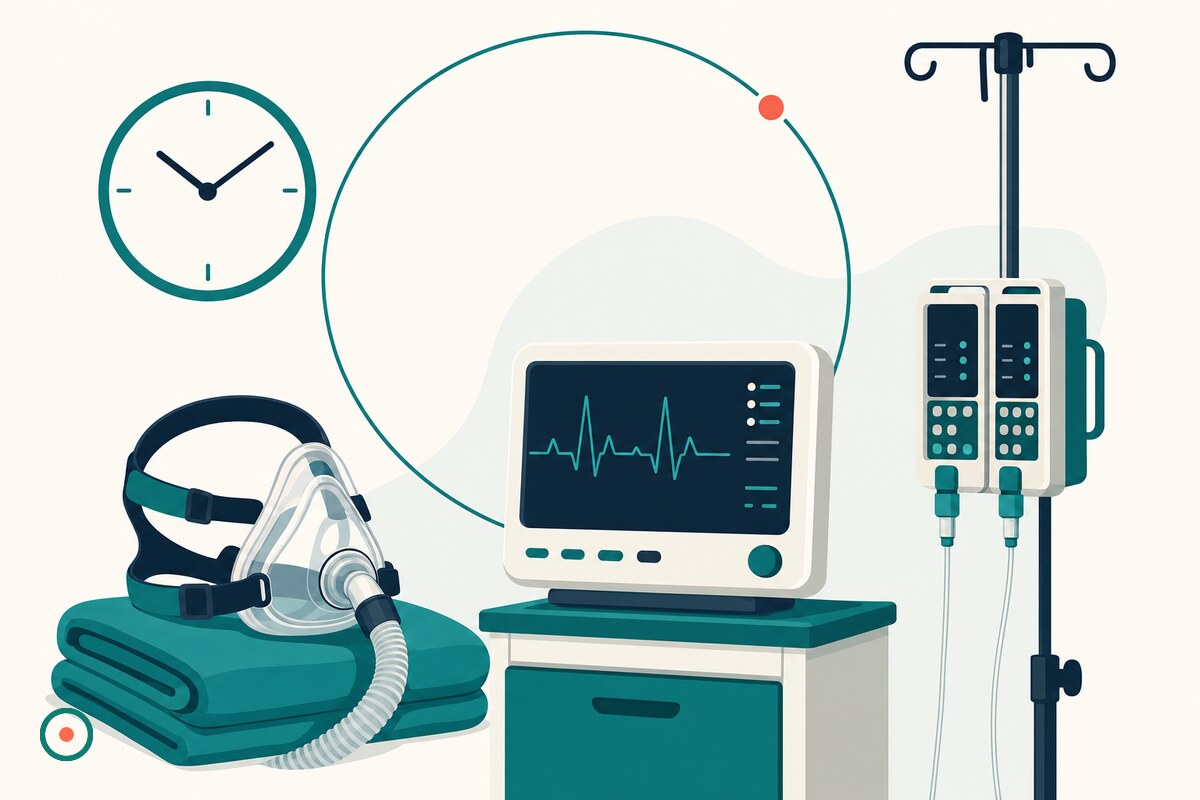
PCU nurse interview questions test four things: can you watch three or four patients who are stable today but could turn by lunch, will you recognize when one of them needs a higher level of care and say so early, can you safely manage the drips and devices your unit allows (heparin, insulin, diltiazem, BiPAP), and can you organize an assignment where every patient is on a monitor. Progressive care (PCU), step-down and intermediate care panels know a new grad hasn’t titrated a drip alone. They’re listening for whether you assess before you act, know your unit’s limits, and escalate in time.
Below are the PCU nurse interview questions step-down and progressive care units actually ask, each with a copy-ready sample answer, plus the PCU-specific scenarios most online lists skip. For the full panel across specialties, start with our nursing interview questions hub.
Quick honesty check: “PCU” means different things at different hospitals. One hospital’s PCU runs cardiac drips and continuous BiPAP; another’s is closer to a busy telemetry floor. The American Association of Critical-Care Nurses (AACN) treats progressive care as its own specialty, between ICU and med-surg. Read the posting, and ask in the interview which drips and devices the unit takes. That question alone shows you understand the job.
What does a PCU nurse do?
A progressive care nurse looks after patients who are too sick for a general floor but don’t need ICU-level life support. California’s staffing rule describes step-down patients as having “moderate or potentially severe physiologic instability.” In practice, a PCU shift usually includes:
- Continuous cardiac monitoring and frequent vital signs and reassessments for every patient.
- Titratable or high-risk drips the unit allows, commonly heparin, insulin, diltiazem, amiodarone or nitroglycerin. Which ones, and at what limits, varies by hospital.
- Respiratory support short of a ventilator: high-flow oxygen and, on many units, BiPAP.
- ICU transfers in (a patient stepping down after a few days) and rapid transfers out when someone gets worse.
- Post-procedure patients: after cardiac catheterization, ablation, or some surgeries.
Ratios are usually tighter than med-surg. California is the only state with fixed ratios for every unit: 1:3 for step-down and 1:4 for telemetry under Title 22. Elsewhere, 1:3 or 1:4 is common on PCU, but ask.
How is PCU different from telemetry?
Panels like this question because it shows whether you read the posting. Telemetry patients are monitored because something might happen with their heart rhythm, and they’re usually stable. PCU patients are already somewhat unstable or recovering from critical illness, so they need more frequent assessment, more drips and devices, and more judgment about when they’ve outgrown the unit. Many hospitals blend the two (“tele/step-down”), which is why our telemetry nurse interview questions are worth reading too, especially for rhythm questions.
How do I prepare for a PCU nurse interview?
- Find out what the unit takes. Cardiac? Pulmonary? Mixed medical? Which drips? Does it run BiPAP? The posting, the unit’s page or a shadow shift will tell you.
- Review basic rhythms: sinus, sinus tachycardia and bradycardia, atrial fibrillation and flutter, SVT, heart blocks, VT and VF. You don’t need to be fast; you need to know what you’d do next.
- Know your early warning signs: rising respiratory rate, new confusion, falling urine output, rising oxygen need, a narrowing blood pressure trend. Respiratory rate is the vital sign new grads skip most.
- Review three drips in plain terms: what they do, what you monitor, and what makes you call. Heparin (bleeding, aPTT or anti-Xa per nomogram), insulin (hourly glucose, potassium), diltiazem (heart rate and blood pressure).
- Prepare three stories: a time you noticed a change early, a time you managed several patients at once, and a time you asked for help or spoke up.
- Be ready to explain “why PCU and not ICU or med-surg.” Have a real answer.
What are the most common PCU nurse interview questions and answers?
”Why do you want to work in progressive care?”
Sample answer: “On my capstone on a step-down unit I had a patient two days out of the ICU after a heart failure exacerbation. Over my shift I watched her go from high-flow oxygen to nasal cannula, and in the afternoon I helped teach her daily weights before she moved to the floor. I liked being the nurse in the middle: close enough to catch a patient getting worse, and also part of getting them home. PCU will make me really good at assessment and at managing several sick patients at once, which I want as my foundation. And I’d rather learn drips and BiPAP on a unit with strong support than guess later.”
Why it works: a specific patient, an honest reason, and it shows you know what PCU actually is.
”How do you prioritize three or four PCU patients at the start of a shift?”
Sample answer: “During report I’d flag anyone on a titratable drip, anyone on BiPAP or a rising oxygen need, anyone who just transferred from ICU, and anyone with a change in the last few hours. I’d lay eyes on all of them quickly, starting with the least stable, before I sit down with the computer. Then I’d check drip rates and pump settings against the orders, look at the monitor and the latest labs, and set my reassessment times. If two things land at once, airway and breathing come first, then the drip that needs a dose change, then routine meds."
"What would make you think a patient is too sick for PCU?”
Sample answer: “I’d be worried if I’m needing to increase support again and again: oxygen going up, BiPAP not helping, blood pressure that stays low despite what we’ve done, a heart rate I can’t control with what the unit allows, or a drip that is at our unit’s maximum. New confusion or a falling level of consciousness also worries me. I wouldn’t wait for one dramatic number. I’d call the provider and the charge nurse with the trend, and if the patient meets rapid response criteria I’d call that. I’d say it directly: ‘I’m concerned this patient needs a higher level of care.’"
"How do you receive a patient transferred from the ICU?”
Sample answer: “I’d get a full handoff: why they were in the ICU, what’s changed, what drips were stopped and when, current oxygen and lines, and what the team is worried about. When they arrive I’d do a head-to-toe assessment with the ICU nurse if possible, check every line and drain, confirm the monitor is on and alarms are set, check the pumps against the new orders, and make sure there are no orders left over from the ICU that don’t apply. I’d set my own baseline in the first hour, because that’s what I’ll compare to all shift."
"Tell me about a time you had to manage several things at once.”
Use STAR (situation, task, action, result) and keep it about 90 seconds. Sample answer: “On my capstone I had three patients. At 0900 one needed a pain reassessment, one had a scheduled IV antibiotic, and the third called saying she felt short of breath. My task was to decide who came first. I went to the patient who was short of breath, got her sitting up, checked her oxygen saturation and respiratory rate, and told my preceptor right away. While my preceptor called the provider, I asked a classmate to tell my pain patient I’d be back within 15 minutes. The antibiotic went in about 20 minutes late, within the hospital’s window. The short-of-breath patient got a diuretic and improved. I learned to say out loud what I’m doing first and to hand off what I can."
"How do you handle alarm fatigue?”
Sample answer: “Every alarm gets checked, but not every alarm is the same. I look at the patient before the screen. I make sure leads and the pulse oximeter probe are placed well, change electrodes when needed, and talk with the provider about alarm limits that fit the patient, following unit policy. I never turn off or silence an alarm I haven’t checked. If a patient alarms constantly and I can’t fix the cause, I tell the charge nurse, because that’s a safety issue for the whole unit.”
What scenario questions do PCU nurse interviews ask?
This is where most online lists stop and where PCU panels actually decide. Answer in the same order every time: what I see, what worries me, what I do first, who I tell. Then close with an SBAR.
”Your patient’s monitor shows new atrial fibrillation with a heart rate of 150. What do you do?”
Sample answer: “I go to the patient first. I ask how they feel and check for chest pain, shortness of breath, dizziness or confusion, and get a blood pressure and oxygen saturation, because the main question is whether they’re stable. I’d get a 12-lead ECG to confirm the rhythm. If they’re hypotensive, confused, or having chest pain, that’s unstable and I’d call a rapid response. If they’re stable, I’d call the provider with an SBAR and expect orders for rate control and labs, and I’d look for causes like pain, fluid status, or low potassium or magnesium. SBAR: ‘This is Jordan on PCU about Mr. Lee in 12, admitted with pneumonia. He’s in new AFib, rate 150, BP 118/70, SpO2 94% on 2 liters, no chest pain, mildly short of breath. His morning potassium was 3.4. I’m concerned about rapid AFib. Can you come assess him, and would you like a 12-lead, electrolytes and rate control?’"
"Your patient on BiPAP is getting harder to wake up. What are you thinking?”
Sample answer: “Increasing drowsiness on BiPAP worries me, because it can mean carbon dioxide is building up and the BiPAP isn’t working well enough. A patient who can’t stay awake also can’t protect their airway or take the mask off if they vomit. I’d check their responsiveness, respiratory rate and pattern, oxygen saturation and the mask fit and leak, call respiratory therapy, and call the provider urgently. I’d expect a blood gas. If they’re getting worse quickly I’d call a rapid response, because they may need intubation and the ICU. I’d stay with them until help arrives."
"Your patient on a heparin drip has a new headache and blood in his urine.”
Sample answer: “Those could be signs of bleeding, and a headache on an anticoagulant could mean bleeding in the brain. I’d stop the heparin, assess right away (neuro check, vital signs, look for other bleeding), and call the provider immediately. I’d check the latest aPTT or anti-Xa level and when the next one is due, and I’d expect orders for labs and possibly imaging. I wouldn’t restart it until the provider decides. I’d follow the hospital’s heparin protocol for anything about reversal; that’s the provider’s call."
"You’re giving an insulin drip for DKA. What do you watch?”
Sample answer: “I’d check glucose at the interval the protocol sets, usually hourly, and adjust only by the protocol. Potassium is the big one: insulin moves potassium into the cells, so it can drop fast. Most DKA protocols require a potassium level before insulin starts and hold insulin if it’s too low. I’d watch for signs of low glucose and low potassium, track intake and output, follow the protocol for adding dextrose to the fluids as glucose falls, and make sure the provider knows the anion gap trend. I’d also make sure the transition to subcutaneous insulin overlaps correctly, because stopping the drip too early is a common cause of DKA coming back."
"Your ICU transfer from this morning now has a respiratory rate of 28 and is newly confused. His blood pressure is 96/58, down from 120s.”
Sample answer: “That pattern of fast breathing, new confusion and a dropping pressure worries me for sepsis or another serious deterioration, and he only left the ICU this morning. I’d assess him fully, check oxygen saturation, temperature and urine output, and call a rapid response or the provider immediately, depending on the criteria. I’d have the sepsis protocol in mind: blood cultures, lactate, fluids and antibiotics as ordered. In the SBAR I’d give the trend, not just the latest numbers: ‘Respiratory rate 18 at 0800, now 28; BP 124/70 at 0800, now 96/58; oriented at 0800, now not sure where he is.’”
For more scenario practice across units, see nursing interview questions and answers scenarios.
Can a new graduate work in PCU?
Yes. Many hospitals hire new grads into progressive care, often through a nurse residency with a longer orientation than med-surg. Some PCUs prefer a year of experience first; others build their own nurses from day one. If you’re also applying to residencies, read our nurse residency interview questions. What helps your case:
- A step-down, telemetry, cardiac or ICU clinical or capstone. Name the unit and one patient.
- ACLS if you have it, or a plan to get it during orientation. Many PCUs require it; check the posting.
- Rhythm basics you can explain out loud.
- A realistic plan: “Master assessment and the unit’s drips in my first year, then work toward PCCN.”
On certification, AACN’s PCCN (Progressive Care Certified Nurse) requires an RN license and either 1,750 hours of direct care of acutely ill adults in the past two years (875 in the most recent year) or 2,000 hours over five years (144 in the most recent year). Orientation hours only count when you are the assigned nurse. A new grad should present PCCN as a goal, not something you have. If ICU is your long-term plan, say that you want a strong PCU foundation first, and look at our ICU nurse interview questions for what comes next.
What questions should you ask in a PCU interview?
- “Which drips and devices does this unit manage, and what are the limits before a patient goes to the ICU?”
- “Does the unit run BiPAP or high-flow oxygen?”
- “What is the typical ratio on days and nights?”
- “How long is orientation for new grads, and is there a residency?”
- “Who responds when a patient is getting worse? Is there a rapid response team or an ICU liaison?”
- “Do you support ACLS and, later, PCCN?”
More ideas: questions to ask the interviewer in a nursing interview.
Mistakes that weaken a PCU interview answer
- Looking at the monitor before the patient. Assess the patient first, every time.
- Saying “I’d monitor” without a trigger. Name the change that makes you call.
- Adjusting a drip outside the order or protocol. Panels want to hear “per the protocol.”
- Waiting for one dramatic number instead of reporting the trend.
- Treating ICU as “where the real nursing is.” PCU managers hear that and worry you’ll leave in six months.
- Claiming skills or certifications you don’t have. Panels check.
How to prepare for PCU nurse interview questions in one evening
- Write down what you’d watch for heparin, insulin and diltiazem drips.
- Say the new-AFib-at-150 answer out loud with an SBAR, timed.
- List five signs a patient needs a higher level of care.
- Practice your “Why PCU?” answer until it’s under 90 seconds.
- Prepare two questions about the unit’s drips and orientation.
For behavioral structure, see nursing behavioral interview questions. If the unit is mostly cardiac, our CVICU nurse interview questions show the critical-care side of the same patients.
PCU nurse interview FAQ
Is PCU the same as step-down or intermediate care?
Mostly, yes. Hospitals use “progressive care,” “step-down,” “intermediate care” and “IMCU” for similar units. The details (drips, BiPAP, ratios) vary more between hospitals than between names.
Is a PCU interview a panel interview?
Often. Expect the nurse manager plus an educator, a charge nurse or a staff nurse. Most of it is behavioral, with one or two clinical scenarios.
Will they quiz me on rhythms?
Some will show you a strip or describe one. As a new grad, name it if you can, but focus on what you’d do: assess the patient, check stability, get help.
How long should my answers be?
About 60 to 90 seconds for behavioral stories and one to two minutes for scenarios. It’s fine to say, “I’d follow the unit’s protocol here, and these are the steps I’d expect.”
Practice saying the scenario out loud
Reading a good new-AFib answer is one skill. Saying it calmly, in order, while a panel scores you is another. The candidates who do well have practiced the same pattern until it’s automatic: “here’s what I see, here’s what worries me, here’s what I do first, and here’s who I tell.” Pick two scenarios tonight and say them out loud, timed.
“Tell me about a time you had to manage several things at once”
You just read a strong answer to that. Saying one to three people who are deciding whether to hire you is a different skill — Roundly asks this exact question in a mock PCU panel, listens, and scores the clinical reasoning underneath.
Answer this one out loud →You've read the answers. Now say one out loud.
Reading a sample answer and delivering it to a panel that's deciding whether to hire you are two different skills. Roundly runs a mock PCU panel that asks these exact questions, listens to your answer, and scores your clinical reasoning and structure — not just how confident you sounded.
Start a mock PCU panelTakes about two minutes to set up. Finish 15 panels without an offer and we refund you.