Cath Lab Nurse Interview Questions (2026): Copy-Ready Sample Answers
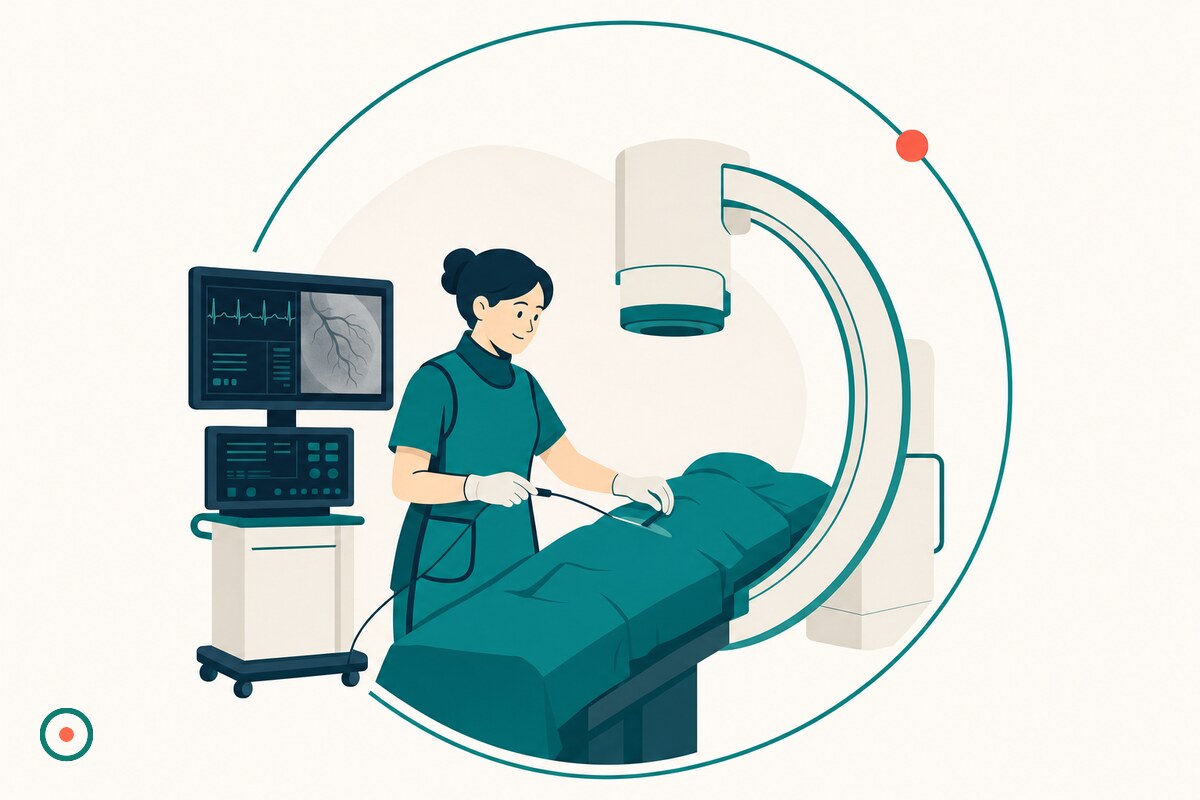
Cath lab interviews test five things: can you think in a sterile, radiation-heavy room when hemodynamics change mid-case, do you understand scrub vs circulate roles, will you take STEMI call without flinching, can you escalate cleanly with SBAR, and are you honest about whether you already have ICU/ED experience — or need a realistic onboarding path. Panels already know you care. They’re scoring whether your reasoning out loud would keep a patient safe when the screen looks ugly and the room gets loud.
Below are the cath lab nurse interview questions panels actually ask, each with a copy-ready sample answer — including hypotension during a case, vasovagal on sheath pull, radiation safety, sterile-field breaks, and the honest new-grad conversation most competitor guides skip. Want the whole panel on one page? Grab our nursing interview cheat sheet.
Quick honesty check: Many cath labs prefer RNs with ICU, ED, or telemetry experience. Direct new-grad hires exist but are uncommon — often via residency or internal transfer. This guide prepares both paths without pretending every lab runs a new-grad pipeline.
What should you know for a cath lab nurse interview?
Be fluent in procedural vocabulary so your answers sound like a cath lab RN, not a floor nurse who watched one diagnostic angiogram on clinicals.
Day-in-the-life building blocks:
- Case flow — pre-procedure assessment and consent check, access (radial vs femoral), diagnostic cath vs intervention (PCI), closure / sheath management, recovery handoff.
- Roles — scrub (sterile field, wires/catheters/balloons as handed, anticipating the operator) vs circulate (meds, documentation, hemodynamics, non-sterile support, runner for blood/products). Many RNs cross-train both.
- Hemodynamics + rhythm — watching arterial pressure, recognizing hypotension, bradycardia, VT/VF, and knowing ACLS in a procedural room is different from a med-surg code.
- Radiation safety — ALARA, lead apron / thyroid shield, distance, time, shielding; you protect the patient and the team.
- Call culture — STEMI activations, nights/weekends, arrival time expectations. Call willingness is often a hard filter.
- Team — interventional cardiologist, scrub tech / RT, circulate RN, anesthesia when present, holding / recovery, ICU for transfers.
Tools to name: SBAR, ACLS, sterile technique, sheath removal / hemostasis basics, contrast / allergy screening, antiplatelet awareness (without inventing dose lists), radiation badges, crash cart location.
Carry SBAR (clinical), STAR (behavioral), and “call early, narrate the room” into every answer.
How do I prepare for a cath lab nurse interview?
Prepare in four layers: (1) procedural fundamentals cold — scrub vs circulate, radiation, access-site complications; (2) pre-script “Why cath lab?” (panels screen for adrenaline-chasers who hate call); (3) rehearse 4–5 STAR stories — advocacy, conflict, sterile break, calm under pressure; (4) say SBAR out loud for hypotension, vasovagal, and STEMI so you don’t freeze mid-scenario.
A simple game plan:
- Research the lab: diagnostic vs interventional mix, radial vs femoral preference, STEMI call model, orientation length.
- Review ACLS, basic coronary anatomy language, and what you’d do for access-site bleeding — not a fake board exam.
- Know the philosophy: cath lab is high-stakes teamwork under radiation and sterility, not “easy days between cases.”
- Bring 2–3 thoughtful questions (see questions to ask the interviewer).
- Plan your outfit (see what to wear to a nursing interview).
If you’re coming from critical care, skim our ICU nurse interview questions and CVICU nurse interview questions so you can translate floor skills into procedural language. For the full new-grad panel arc, use our new-grad RN interview guide.
What are the most common cath lab nurse interview questions and answers?
”Why do you want to work in the cath lab?”
Have two layers: the honest pull, and the hard parts you already see.
“I’m drawn to the combination of acute cardiac decision-making and a true team procedure — you see a problem on the screen, the room moves together, and the patient can look completely different an hour later. I like assessment under pressure, clean communication, and learning the technical side of access, devices, and recovery. I also know the hard parts: radiation, call, long STEMI nights, and days that rearrange when the board lights up. I’m not looking for quieter shifts — I’m looking for procedural cardiac nursing where composure and anticipation matter."
"Why this lab / this hospital?”
Never invent insider details. Use what you actually researched.
“Because of [STEMI volume / radial program / orientation length / teaching culture you actually looked up]. I want structured onboarding where I earn scrub and circulate competence with a preceptor — not a sink-or-swim first week alone on call."
"Explain scrub vs circulate. Which are you more comfortable with?”
“Scrub stays sterile — managing the table, anticipating wires, catheters, balloons, and keeping the field clean. Circulate is the non-sterile RN brain of the room: meds, documentation, hemodynamics, runner roles, family updates when appropriate, and making sure the crash cart and products are ready. I’m more experienced in [honest answer], and I’m ready to cross-train the other role. Good labs need both — not one hero scrub who can’t circulate."
"How do you practice radiation safety?”
“ALARA — as low as reasonably achievable. I wear properly fitted lead and a thyroid shield, keep my badge where policy says, maximize distance when I can, minimize time in the beam, and use shielding. I don’t turn my back on the source if I can help it, and I speak up if someone’s habit is putting the team at unnecessary exposure. Protecting the patient and the crew is part of the job, not optional etiquette."
"Are you willing to take STEMI / call?”
“Yes — and I understand call isn’t theoretical. When a STEMI activates, arrival time matters, fatigue is real, and the room still has to be sharp. I’d clarify your call expectations — response time, how often, backup — during orientation, and I’d build a life that can support it. If I weren’t willing, I wouldn’t be interviewing for this role.”
What clinical scenario questions do cath lab interviews ask?
This is where cath lab interviews are won. Recognize → stay with the patient → escalate with SBAR → support the intervention.
”Mid-case the arterial pressure drops and the patient looks pale. Walk me through it.”
Signature procedural emergency — don’t freeze waiting for someone else to name it.
Situation: “During the case, arterial pressure falls and the patient looks pale / diaphoretic — I’m concerned for hypotension that may be bleeding, vagal, arrhythmia, tamponade, or medication-related.”
Background: “I’d know access site, what stage of the case we’re in, recent meds (sedation, nitrates, contrast load), rhythm, and whether this is diagnostic or intervention.”
Assessment: “I’d call it out loud to the room, check the patient — airway, responsiveness, rhythm, pulse — confirm the arterial waveform is real (not a damped line), glance at access sites for hematoma, and watch for tamponade clues if instrumentation warrants it. I’d support ABCs and be ready for fluids, pressors, pacing, or ACLS per order / protocol.”
Recommendation: “SBAR to the operator / team lead: ‘Arterial pressure down to X, patient diaphoretic, rhythm is Y, access site soft/firm — I need eyes on hemodynamics now; ready for fluids/pressors/products.’ I narrate so the whole room shares one mental model."
"You’re pulling a femoral sheath and the patient becomes bradycardic, nauseated, and hypotensive. What do you do?”
Classic vasovagal — panels love this because it separates calm RNs from panic.
Situation: “Sheath pull — sudden bradycardia, nausea, hypotension; suspect vasovagal response.”
Background: “Pain, anxiety, and femoral manipulation commonly trigger it; I’d already have baseline vitals and atropine / fluids awareness per protocol.”
Assessment: “Stay with the patient, maintain hemostasis pressure as trained, open the airway / position per protocol, check rhythm and pressure, and call for help early if they’re not responding to first maneuvers.”
Recommendation: “Escalate: ‘Post-sheath pull vasovagal — HR 38, BP low, nauseated — need atropine / fluids / provider now.’ Document times and response. Don’t abandon pressure to chase meds alone if policy says two-person response."
"STEMI activates at 2 a.m. You’re on call. What does ‘ready’ look like?”
“Ready means I can arrive within the expected window, clear-headed enough to function, and oriented to the room setup. I’d confirm the activation details, help open the lab, check emergency equipment, support access and meds as assigned, and keep communication tight with the cardiologist and EMS/ED handoff. Door-to-device culture is a team sport — my ego isn’t the point; the clock and the patient are."
"You notice a break in sterile technique. What do you do?”
“I speak up immediately — calmly, specifically, and without humiliation. ‘We contaminated the wire end — need a replacement.’ Sterile conscience protects the patient more than protecting someone’s feelings. If I were the one who broke it, I’d own it the same way. Cath lab culture dies when people stay quiet to be polite."
"The radial site looks fine but the patient reports severe forearm pain and pallor in the hand. What are you thinking?”
“I’m thinking vascular complication until proven otherwise — possible spasm, hematoma, or ischemic concern. I’d stop and assess pulses, capillary refill, pain, and swelling; notify the provider immediately; and follow site-management orders. I wouldn’t dismiss ‘just pain’ after radial access. Assessment plus early escalation beats hoping it settles in recovery."
"Patient has a contrast allergy history. How do you handle pre-case?”
“I’d verify what ‘allergy’ meant — rash vs anaphylaxis — check the chart and the patient story, confirm premed / protocol with the provider, ensure emergency meds are available, and document clearly. I don’t freelance a regimen I wasn’t ordered to give. Safety is verification plus readiness, not assuming someone else already handled it.”
What behavioral / teamwork / call questions come up?
Use STAR. Soft skills without a clinical spine won’t carry a cath lab panel. More practice patterns: nursing behavioral interview questions.
”Tell me about a time you spoke up on a team.”
“Situation: On clinicals / prior unit, I saw a safety issue others were moving past. Task: Protect the patient without blowing up the room. Action: I used a calm, specific challenge — named the risk and the ask — and offered a fix. Result: The plan paused, the issue was corrected, and the team moved on. I’d do the same with a sterile break or a missed allergy in the lab."
"Tell me about a conflict with a coworker.”
“Situation: Disagreement about priorities during a busy stretch. Task: Keep the patient safe and the relationship workable. Action: I pulled the conversation private when possible, stayed on the clinical facts, and agreed on who owned what. Result: Clearer handoff and less friction next time. Cath lab rooms are small — direct and respectful beats silent resentment."
"How do you handle a loud or stressed operator?”
“I don’t take tone personally in an emergency, and I don’t return fire. I clarify the ask, repeat critical orders, and keep my piece of the room organized. After the case, if the pattern is disrespect rather than urgency, I’d address it through the right channel. Performance under stress includes emotional regulation."
"Tell me about a mistake or near-miss.”
“I’d pick a real near-miss: caught a wrong assumption, stopped, verified, and reported through the safety process. In a procedural environment, the habit I want is early ownership — including my own almost-errors — because silence compounds risk."
"How do you stay sharp on heavy call weeks?”
“Sleep when I can, protect recovery days, limit stacking exhaustion on top of exhaustion, and use the team — I’m not a martyr. Fatigue is a safety issue. I’d rather flag that I need backup than pretend I’m fine in a STEMI at 3 a.m.”
Can a new grad get a cath lab nurse job?
Honest answer: sometimes — not usually as a cold walk-in. Many labs want 1–2 years of ICU, ED, or busy telemetry first because the room assumes cardiac rhythm comfort, pressor familiarity, and calm in crises. Some systems run residencies or hire new grads who show exceptional teachability; others almost never do. Don’t invent a path that isn’t on the posting.
What panels still want to hear from a new grad:
- Cardiac / ACLS fundamentals and willingness to drill them
- Sterile conscience + radiation respect
- Call willingness that sounds real, not performative
- Humility — you’ll ask early; you won’t guess on wires and meds
- Transferable skills from clinicals: prioritization, SBAR, teamwork in codes
Sample “Why cath lab as a new grad?” answer
“I know many cath labs prefer ICU or ED experience, and I’m not going to pretend a student rotation equals circulating a complex PCI. What I bring is strong rhythm recognition from clinicals, ACLS readiness, calm communication, and a real pull toward procedural cardiac care — including call. I want a preceptor-backed orientation where I learn holding-area assessment, circulate first, then scrub skills, and earn independence. If your pathway is ‘ICU first, then transfer,’ I’m open to that honesty too — I’d rather build the right foundation than force a mismatched hire.”
Lean on new grad RN interview questions for classic openers, and ICU nurse interview questions if the realistic next step is critical care first.
What questions should you ask the interviewer?
Pick three to four:
- “What does orientation look like for someone new to the lab — how long until independent circulate / scrub / call?”
- “What’s your STEMI call model — response time, frequency, and backup?”
- “How do you cross-train scrub vs circulate, and which role do new hires start in?”
- “What’s your radial vs femoral mix, and how do you teach access-site complication recognition?”
- “How does the team handle radiation safety culture and speaking up on sterile breaks?”
- “What does success look like in the first 90 days?”
More phrasing: questions to ask the interviewer. Send a thank-you within 24 hours, and dress the part with what to wear to a nursing interview.
Cath lab vs CVICU vs ICU — don’t mix the answers
Search results blur cardiac worlds. Cath lab is procedural: sterile field, radiation, scrub/circulate, sheaths, STEMI call. CVICU is continuous critical care after cardiac surgery — drips, Swans, tamponade surveillance (see CVICU nurse interview questions). ICU is broader critical care. If the posting is cath lab, lead with procedural scenarios — not open-chest recovery — unless they ask how your ICU experience transfers.
A printable cath lab nurse cheat sheet
- STAR behavioral, SBAR clinical.
- Why cath lab: acute cardiac teamwork + hard parts (radiation, call).
- Scrub vs circulate: know both; say which you’ll learn first.
- Hypotension mid-case: call it out → verify waveform/patient → escalate → support.
- Vasovagal on sheath pull: stay, pressure, rhythm/BP, atropine/fluids per protocol, don’t abandon the site.
- Radiation: ALARA, lead, distance, time, speak up.
- Sterile break: immediate specific challenge.
- STEMI call: willingness + logistics, not bravado.
- New grad: rare direct hire; sell teachability + cardiac basics; ICU/ED path is valid.
How to actually practice
Cath lab answers sink candidates when they freeze on the order: recognize the change → narrate to the room → escalate with SBAR → support the next intervention — or when “Why cath lab?” sounds like “I want adrenaline” with no respect for call and radiation. The fix is reps out loud until procedural scenarios sound steady.
That’s what Roundly does — realistic mock panels that ask these cath lab, STEMI-call, and behavioral questions and score your clinical reasoning, SBAR structure, and delivery, built with real nurse recruiters and hiring managers. Practice your cath lab panel out loud →
“Tell me about a time you spoke up on a team”
You just read a strong answer to that. Saying one to three people who are deciding whether to hire you is a different skill — Roundly asks this exact question in a mock Cath Lab panel, listens, and scores the clinical reasoning underneath.
Answer this one out loud →You've read the answers. Now say one out loud.
Reading a sample answer and delivering it to a panel that's deciding whether to hire you are two different skills. Roundly runs a mock Cath Lab panel that asks these exact questions, listens to your answer, and scores your clinical reasoning and structure — not just how confident you sounded.
Start a mock Cath Lab panelTakes about two minutes to set up. Finish 15 panels without an offer and we refund you.