Clinic Nurse Interview Questions (2026): Copy-Ready Sample Answers
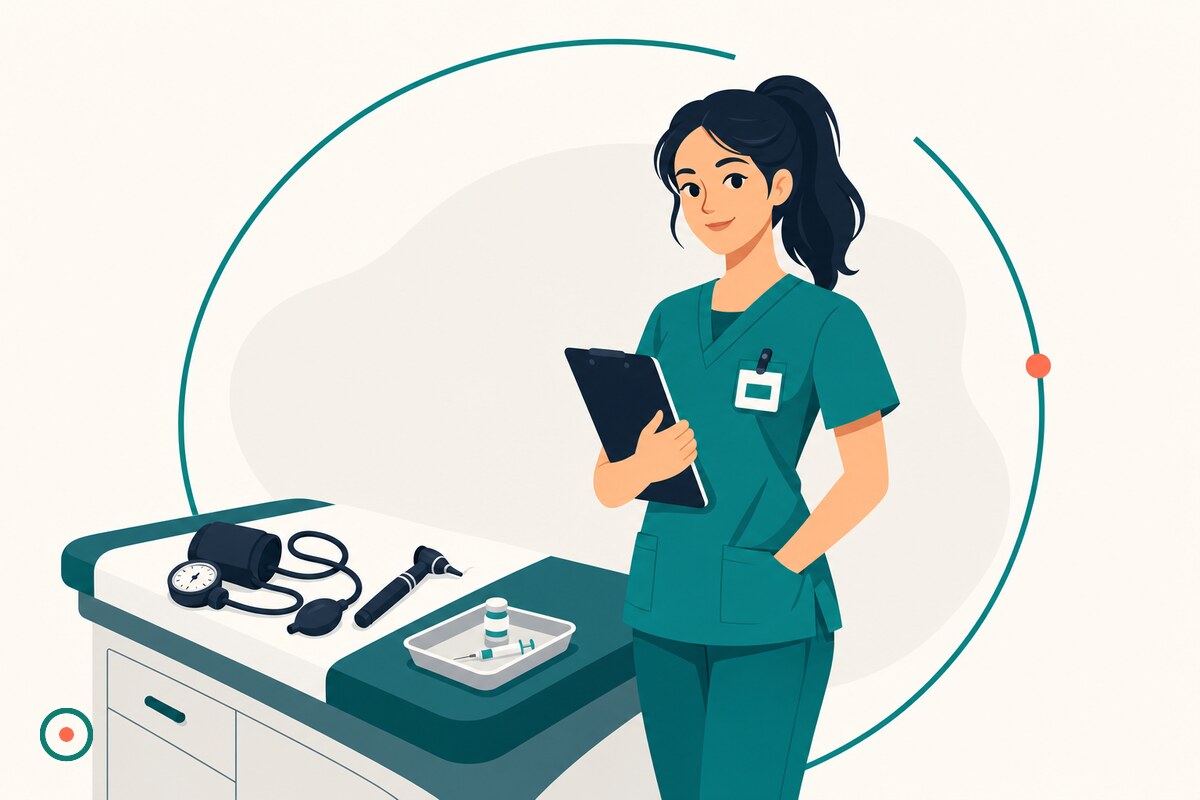
Clinic (outpatient / ambulatory) interviews test four things: can you keep a high-volume schedule moving without missing red flags, teach patients so they actually leave knowing what to do, de-escalate frustration in the waiting room, and partner cleanly with providers and MAs. Panels lean on scenarios that look “simple” until someone crashes in Room 3 while the lobby is full — and they’re scoring your reasoning out loud, not a memorized policy.
Below are the clinic nurse interview questions panels actually ask, each with a copy-ready sample answer — including the triage, vaccine, telephone, and chronic-disease scenarios that decide most outpatient interviews. New grad with mostly inpatient clinicals? There’s a dedicated section for you. Want the whole panel on one page? Grab our nursing interview cheat sheet.
What should you know for a clinic nurse interview?
Be fluent in outpatient vocabulary so your answers sound like a clinic RN, not a med-surg transplant.
Day-in-the-life building blocks:
- Roaming / rooming workflow — vitals, med reconciliation, chief complaint, screenings (PHQ-9, fall risk, SDOH), standing orders, and getting the chart ready before the provider walks in.
- Triage acuity — who needs a same-day slot, who can wait, who needs ED/911 now. Clinics don’t have continuous telemetry; your judgment is the early-warning system.
- Throughput vs. safety — panels want both. Saying “I’d slow everything down” without a plan sounds naive; saying “I’d keep moving” without naming red flags sounds reckless.
- Scope + standing orders — vaccines, point-of-care tests, refills within protocol, when you must loop in the provider.
- Team — MAs, front desk, providers, care coordinators, pharmacists, interpreters. Clinic nursing is a relay race.
- Tools to name: EHR inbox / portal messages, telephone triage protocols, teach-back, SBAR, CDC vaccine screening, crash cart / AED location, emergency action plan for anaphylaxis.
Carry SBAR (escalation), STAR (behavioral), and ABCs + red-flag screening into every clinical answer.
What are the most common clinic nurse interview questions and answers?
”Why do you want to work in a clinic / outpatient setting?”
“I want longitudinal relationships and the chance to catch problems early — before they become admissions. In clinic you see the same patients over months: med adherence, A1C trends, blood pressure follow-up, vaccine catch-up. I like high-volume teamwork with MAs and providers, clear standing orders, and patient education that actually changes what someone does at home. Inpatient taught me acute assessment; outpatient is where I want to use that judgment to keep people healthy in the community."
"Walk me through how you room a patient.”
“I’d greet them, confirm identity with two identifiers, and get a focused set of vitals plus weight if it’s indicated. Then med reconciliation — what they actually take, including OTCs and inhalers — allergies, and the chief complaint in their words. I’d run the clinic’s required screenings, review outstanding orders or labs, and flag anything urgent for the provider before they enter: chest pain, SpO2 drop, hypertensive urgency, suicidal ideation on PHQ-9. I’d document cleanly so the provider isn’t hunting, and I’d set expectations with the patient about wait time if the schedule is backed up."
"How do you prioritize when the schedule is overbooked and walk-ins keep coming?”
“Acuity first, then time-sensitivity, then fairness. A patient with chest pain or acute distress jumps the line — every time. Next are time-critical treatments: antibiotics that can’t wait, wound checks with spreading redness, kids with fever who look toxic. Stable follow-ups and refills get slotted or rescheduled with a clear explanation. I’d huddle with the provider and front desk early: ‘We have three extras and one possible ED divert — here’s my proposed order.’ I don’t silently drown; I make the prioritization visible so the whole team owns it."
"How do you handle an angry patient about wait times?”
“I don’t argue the clock — I acknowledge the frustration, apologize for the wait, and give a real update. ‘You’re right to be frustrated; Dr. Lee is running about 25 minutes behind because of an urgent add-on. Can I get you water, and do you need to reschedule?’ If they’re escalating in the lobby, I move the conversation to a quieter space when it’s safe, stay calm, and avoid promising a time I can’t hit. If there’s a clinical reason they can’t wait — worsening symptoms — I escalate to the provider immediately. De-escalation plus a safety check beats winning the argument."
"Describe your experience with vaccines and standing orders.”
“I’m comfortable with screening for contraindications, verifying the right vaccine/right patient/right site, and documenting lot number and VIS. Before I give anything under a standing order, I confirm it fits the protocol — age, indication, interval, allergies, pregnancy status when relevant. After administration I observe for immediate reactions per clinic policy and know where epinephrine and the AED are. If a patient refuses or has questions, I use teach-back and loop in the provider rather than pressure them.”
What clinical scenario questions do clinic interviews ask?
This is where clinic interviews are won. Red flags first, then escalate with SBAR.
”A patient in the waiting room grabs their chest and looks diaphoretic. What do you do?”
Signature outpatient emergency — don’t room them like a routine visit.
“I’d go to them immediately, stay with them, and call for help — another RN or MA plus the provider — while I start a rapid assessment: ABCs, pulse, BP, SpO2, pain quality and radiation, shortness of breath, neuro status. I’d get them to a private area or treatment room if they can move safely, apply oxygen if indicated by protocol, and prepare for ECG / aspirin / EMS per clinic emergency plan. SBAR to the provider or EMS: ‘Mr. Ruiz, 58, sudden crushing chest pain 8/10 radiating to left arm, diaphoretic, BP 158/94, HR 110, SpO2 94% on room air — I’m concerned for ACS, I need you now and I’d anticipate activating EMS.’ I never leave them alone in the lobby ‘to finish rooming someone else.’"
"You give a vaccine and the patient develops hives and throat tightness. Walk me through it.”
“Anaphylaxis until proven otherwise. I’d call for help, stay with the patient, and follow the emergency protocol: assess airway and breathing, get them flat with legs elevated if hypotensive and airway allows, give epinephrine IM per standing order / emergency kit immediately, and activate EMS. I’d monitor vitals continuously, be ready for a second epi dose if needed, and document times. SBAR: ‘Post-influenza vaccine, developed urticaria and throat tightness within minutes — epi given IM at 10:42, EMS activated.’ Afterward I’d debrief, file the report, and make sure the allergy is documented so it never happens again."
"Telephone triage: a parent calls — child has fever 103°F after a visit yesterday. What do you ask?”
“I’d follow the clinic’s telephone triage protocol and get a structured history: age, how long the fever’s lasted, what meds and doses they’ve given, oral intake, urine output, breathing effort, color, lethargy or inconsolability, rash, neck stiffness, immunocompromise, and whether they look ‘not themselves.’ Red flags — respiratory distress, blue lips, seizure, stiff neck, petechiae, under-2-months with fever — mean ED/EMS guidance, not ‘wait for tomorrow.’ If they’re stable, I’d give protocol-based advice, set a clear return-call or portal follow-up, and document the call. If I’m unsure, I escalate to the provider rather than guess."
"A patient’s A1C is 12.5 and they admit they stopped their meds. How do you respond?”
“Curiosity, not shame. I’d ask what got in the way — cost, side effects, confusion about dosing, depression, food access — because non-adherence is usually a barrier problem. Then I’d use teach-back on why the med matters in plain language, check understanding of hypo signs if relevant, and partner with the provider and possibly a pharmacist or care coordinator on a realistic plan: simpler regimen, samples, discount programs, diet starting points. My goal isn’t a lecture; it’s one change they’ll actually do before the next visit."
"The provider’s inbox is slammed and a portal message looks urgent. What do you do?”
“I’d read it fully, check the chart for context, and triage: true urgent clinical concern gets a same-day call or walk-in guidance and a prompt to the provider; routine refills or admin questions follow standing workflows. I wouldn’t leave a chest-pain portal message sitting until Friday. If protocol lets me start orders or schedule, I do; if not, SBAR to the covering provider: ‘Portal message from Ms. Chen — new unilateral leg swelling and pain since last night — I’d like you to review; I’m concerned for DVT and recommend same-day evaluation.’"
"Two exam rooms need you at once — one for a vaccine, one for a patient who feels lightheaded after blood work. Who first?”
“Lightheaded / possible syncope first — ABCs and fall risk beat a routine vaccine. I’d get eyes on that patient, seat or lay them down, check vitals and glucose if indicated, and call for help if they’re not improving. The vaccine patient gets a clear ‘I’ll be right with you’ from me or an MA. I narrate the priority so the team isn’t guessing.”
What behavioral STAR answers work in a clinic interview?
”Tell me about a time you educated a difficult or overwhelmed patient.”
“Situation: A newly diagnosed hypertensive patient was quitting meds because of cost and confusion. Task: Improve adherence without shaming them. Action: I asked about barriers, used teach-back with a simple daily routine, looped in the provider about a lower-cost option, and wrote the plan on a single sheet. Result: They returned with a home BP log and said they finally understood why the pill mattered. Clinic nursing is education plus systems, not just information."
"Tell me about a time you advocated for a patient.”
“Situation: A patient was booked as a ‘quick follow-up’ but reported new neurologic symptoms at rooming. Task: Make sure they weren’t rubber-stamped out. Action: I stopped the routine flow, flagged the provider with SBAR before they entered, and asked for a fuller eval. Result: The visit was expanded; imaging was ordered same day. Protecting the schedule never beats protecting the patient."
"Tell me about a conflict with a coworker or MA.”
“Situation: An MA and I disagreed about whether a walk-in should wait. Task: Keep the patient safe and the working relationship intact. Action: I pulled us aside, named the clinical concern (shortness of breath), proposed we get vitals and a provider eyes-on now, and thanked them for owning the lobby flow. Result: The patient was seen promptly; we agreed on a clearer walk-in escalation rule afterward. Direct, private, patient-first."
"Tell me about a mistake.”
“I once almost gave a vaccine before catching an interval problem on the record. I stopped, verified with the protocol and the provider, and documented the near-miss in our safety process. Speaking up early — including about my own almost-error — is the habit I want in a busy clinic.”
How should a new grad answer clinic nurse interview questions?
Panels know most new grads have more inpatient clinical hours than ambulatory ones. Own the transferrable skills:
- Assessment + prioritization from acute care rotations
- Med safety, aseptic technique, patient teaching
- Willingness to learn clinic-specific workflows (inbox, standing orders, telephone triage)
Sample “Why clinic as a new grad?” answer
“My clinicals were mostly inpatient, but the moments I loved most were teaching and watching patients stabilize enough to go home. Clinic is where that continuity lives. I know I’ll need orientation on your EHR inbox, standing orders, and telephone triage protocols — I’m not pretending I’ve run a full ambulatory pod solo. What I bring on day one is solid assessment, med safety, calm communication, and the humility to ask early. I want a preceptor-backed onboarding where I earn independence on rooming and vaccines before telephone triage.”
Lean on our new grad RN interview questions and RN interview questions guides for the classic panel openers.
What are the 6 C’s of nursing interview questions?
A common framing: Care, Compassion, Competence, Communication, Courage, and Commitment. Some panels use 5 C’s: Confidence, Communication, Competence, Character, Culture-fit. In clinic, courage is stopping a rubber-stamp visit when red flags appear; competence is triage judgment; communication is teach-back and clean SBAR to the provider.
What are the 10 most common interview questions for nurses?
You’ll still get the classics — tell me about yourself, why nursing, strengths/weaknesses, conflict, a mistake, stress, why this clinic, where in 5 years, prioritization, and questions for us. Answer them with clinic examples when you can. Build strengths/weaknesses properly with our strengths and weaknesses nursing interview guide.
What questions should you ask the clinic panel?
Pick three to four:
- “What’s a typical patient volume per nurse per day, and how are MAs paired with rooms?”
- “What standing orders do RNs work under — vaccines, refills, triage protocols?”
- “What does orientation look like for a new graduate or nurse new to ambulatory care?”
- “How is telephone / portal triage staffed, and what decision support do you use?”
- “Where’s the emergency equipment, and when did the team last drill anaphylaxis or waiting-room emergencies?”
- “What does success look like in the first 90 days?”
More ideas: questions to ask the interviewer. Send a thank-you within 24 hours, and dress the part with what to wear to a nursing interview.
Clinic vs. “clinical nurse” vs. ambulatory — quick clarification
Search results mix three things: clinic / outpatient RN (this article), clinical nurse specialist (CNS) (advanced practice / systems role), and generic “clinical nurse” wording (especially UK). If you’re interviewing for an ambulatory care, primary care, specialty clinic, or urgent-care RN role, prepare the outpatient scenarios above — not CNS leadership questions.
How to actually practice
Clinic scenarios sink candidates when they freeze on the order: safety → assessment → escalate → document. The fix is reps out loud until SBAR and red-flag screening are automatic.
That’s what Roundly does — realistic mock panels that ask these clinic and behavioral questions and score your clinical reasoning, SBAR structure, prioritization, and delivery, built with real nurse recruiters and hiring managers. Practice your clinic panel out loud →
“Tell me about a time you educated a difficult or overwhelmed patient”
You just read a strong answer to that. Saying one to three people who are deciding whether to hire you is a different skill — Roundly asks this exact question in a mock Clinic Nurse panel, listens, and scores the clinical reasoning underneath.
Answer this one out loud →You've read the answers. Now say one out loud.
Reading a sample answer and delivering it to a panel that's deciding whether to hire you are two different skills. Roundly runs a mock Clinic Nurse panel that asks these exact questions, listens to your answer, and scores your clinical reasoning and structure — not just how confident you sounded.
Start a mock Clinic Nurse panelTakes about two minutes to set up. Finish 15 panels without an offer and we refund you.