Flight Nurse Interview Questions (2026): Copy-Ready Sample Answers
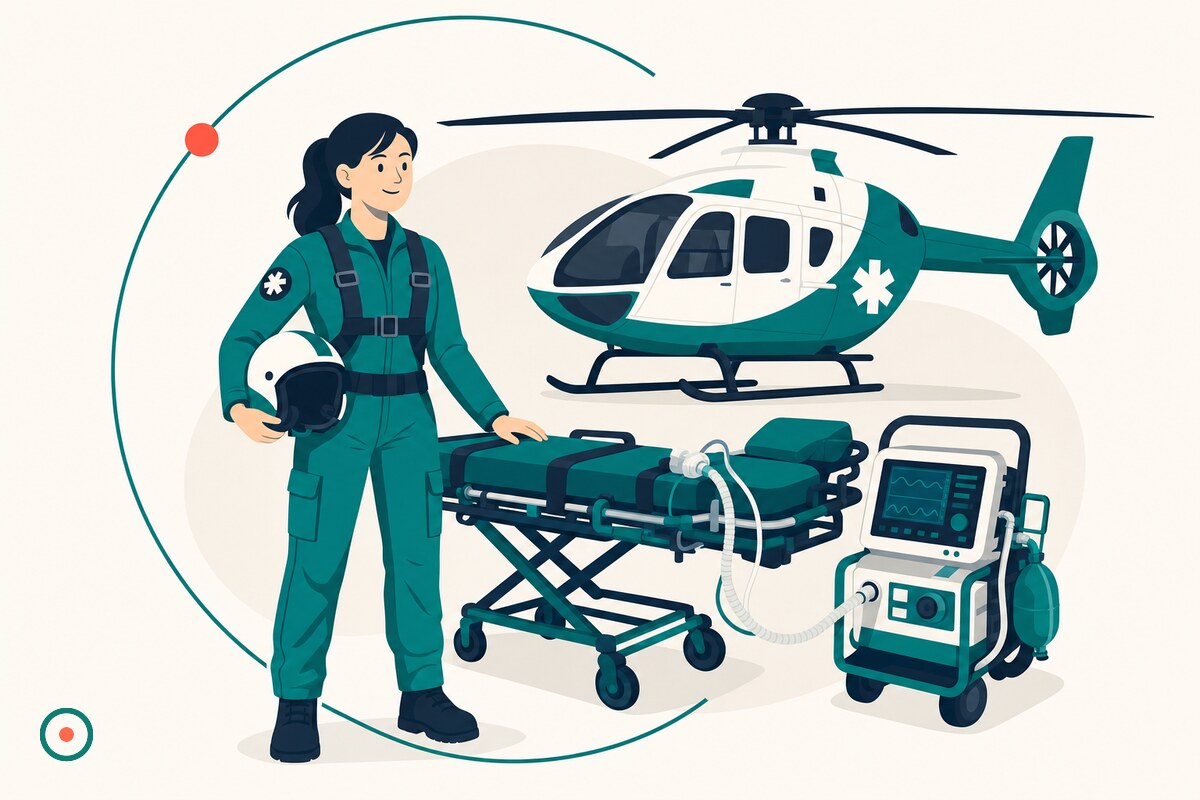
Flight nurse interview questions test five things: can you deliver autonomous critical care in a loud, confined airframe when the patient changes mid-transport, do you understand scene vs interfacility (IFT) realities, will you put aviation safety and crew resource management ahead of ego, can you escalate cleanly with SBAR when options are limited, and are you honest about ICU/ED experience, fitness, and whether flight is a realistic next step — or a longer runway. Panels already know the job looks exciting. They’re scoring whether your reasoning out loud would keep a patient and a crew safe when weather shifts, the vent alarms, or someone on scene wants to climb aboard.
Below are the flight nurse interview questions (and closely related flight RN interview questions / air ambulance nurse interview questions / critical care transport nurse interview questions) panels actually ask, each with a copy-ready sample answer — including unstable patients mid-transport, weather divert, family on scene, and the honest new-grad conversation most competitor guides skip. Want the whole panel on one page? Grab our nursing interview cheat sheet.
Quick honesty check: Most U.S. flight and critical care transport programs prefer RNs with solid ICU and/or ED experience, ACLS/PALS (and often TNCC or equivalent trauma grounding), and comfort with vents, pressors, and high-acuity decision-making. Direct new-grad flight hires are rare. Weight, fitness, and height/reach constraints are real for many helicopter programs — ask the program; don’t invent numbers. This guide prepares ICU/ED transitioners and ambitious new grads without pretending every program runs a cold new-grad pipeline.
What should you know for a flight nurse interview?
Be fluent in transport vocabulary so your answers sound like a critical care transport RN, not a floor nurse who watched one helicopter land on clinicals.
Day-in-the-life building blocks:
- Mission mix — scene (EMS request, packaging under time pressure, landing-zone awareness) vs interfacility transport / IFT (ICU-to-ICU, specialty destination, device-heavy patients). Know which the program flies most.
- Airframe + team — helicopter and/or fixed-wing; typical crew is pilot + flight nurse + flight paramedic (models vary). You share one small workspace and one shared mental model.
- Critical care skills — airway assessment and advanced airway readiness (including RSI where program-authorized), transport ventilator management, vasoactive drips, trauma/burn packaging, shock recognition, pediatric emergencies, blood products when in scope.
- Flight physiology awareness — altitude effects (hypoxia risk, gas expansion conceptually), vibration/noise/temperature, securing everything that can become a projectile.
- Safety culture — preflight brief, weight and balance cooperation, sterile cockpit when required, any crew member can decline a flight, weather and fatigue as safety issues — not heroics.
- Accreditation language — knowing CAMTS (or equivalent accreditation) exists and asking how the program maintains education/proficiencies is smart. Do not invent specific CAMTS hour requirements or claim every program must be accredited.
Tools to name: SBAR, ACLS/PALS, transport vent basics, capnography mindset, CRM (crew resource management), checklist discipline, medical control / standing orders, CFRN as a future credential many RNs pursue — not a fake prerequisite you invent on the spot.
Carry SBAR (clinical), STAR (behavioral), and “safety first, narrate the cabin, decide out loud” into every answer.
How do I prepare for a flight nurse interview?
Prepare in four layers: (1) critical care fundamentals cold — airway, vents, shock, trauma priorities; (2) pre-script “Why flight?” (panels screen for adrenaline tourists who freeze on weather/safety); (3) rehearse 4–5 STAR stories — advocacy, conflict, mistake ownership, calm under pressure; (4) say SBAR out loud for mid-transport deterioration and weather divert so you don’t freeze mid-scenario.
A simple game plan:
- Research the program: scene vs IFT mix, helicopter vs fixed-wing, base model, orientation length, education culture, safety posture, whether they mention CAMTS or similar accreditation.
- Review airway/RSI thinking, vent troubleshooting language, and “what can kill this patient now vs later” — not a memorized fake dose board. Reddit and hiring nurses repeatedly say rationale > perfect mcg/kg recall.
- Know the philosophy: flight nursing is autonomous critical care + aviation teamwork, not “cool flights between ICU shifts.”
- Bring 2–3 thoughtful questions (see below).
- Plan your outfit (see what to wear to a nursing interview).
If you’re coming from hospital critical care, skim our ICU nurse interview questions and ER nurse interview questions so you can translate unit skills into transport language. For the full new-grad panel arc, use our new-grad RN interview guide.
What are the most common flight nurse interview questions and answers?
”Why do you want to be a flight nurse?”
Have two layers: the honest pull, and the hard parts you already see.
“I’m drawn to autonomous critical care in a true team environment — assessing a crashing patient with limited backup, packaging thoughtfully, and delivering them to the right destination with a pilot and partner who share one plan. I like high-acuity thinking, clean communication, and the idea that safety culture is part of the clinical job, not separate from it. I also know the hard parts: weather, night ops, fitness expectations, confined spaces, emotional scene work, and the reality that not every flight goes. I’m not chasing Instagram helicopters — I’m chasing transport nursing where composure and judgment matter."
"Why this program / this base?”
Never invent insider details. Use what you actually researched.
“Because of [scene vs IFT mix / education model / CAMTS or safety culture language / orientation length you actually looked up]. I want structured onboarding where I earn aircraft, protocol, and partner competence with a preceptor — not a sink-or-swim first week alone on a night scene."
"What critical care experience do you bring?”
“I bring [honest unit: ICU / ED / mixed] experience with [vents / pressors / trauma / airways / pediatrics — pick what’s true]. I’m comfortable recognizing shock and respiratory failure early, running ACLS with a team, and escalating before the patient declares disaster. I don’t claim I’ve already done every flight skill — RSI, chest decompression, or program-specific devices — if I haven’t. What I bring is a critical care brain and humility about what your protocols will teach me."
"Scene flight vs interfacility transport — what’s the difference in your mind?”
“Scene work is time-compressed packaging with EMS, environment hazards, and incomplete information — ABCs, hemorrhage control mindset, rapid decisions, and protecting the landing zone culture. IFT is often device- and drip-heavy: vents, multiple infusions, specialty destinations, and handoffs that must be airtight. Both need the same composure; the tempo and information quality differ. I’d clarify your actual mix so I prep the right scenarios."
"Are you comfortable with weight, fitness, and working in a confined aircraft?”
Honesty beats bravado. Programs vary — ask theirs.
“Yes — and I treat that as a safety topic, not a vanity topic. I’m willing to meet your program’s fitness and weight expectations, train for the physical parts of the job, and speak up early if something about the airframe or my readiness is a mismatch. Confined spaces don’t bother me; uncontrolled ego in a small cabin does. I’d rather be a safe crew member than force a fit that puts the mission at risk."
"What does aviation safety / CRM mean to you as a nurse?”
“It means the patient doesn’t get safer care if the aircraft or crew is unsafe. I brief, I use checklists, I respect sterile cockpit when the pilot needs it, I secure equipment, and I believe any crew member can say no — weather, fatigue, aircraft concern, or a patient we can’t safely fly. Clinical courage includes stopping a bad mission. I’d rather divert or decline than become a second patient."
"Would you decline a flight? When?”
“Yes. Unsafe weather or conditions beyond what the pilot and program accept, aircraft or equipment problems, crew fatigue including my own, a patient packaging problem we can’t solve for that airframe, or weight-and-balance limits we can’t meet safely. I wouldn’t need a dramatic speech — a clear ‘I’m not go’ is enough. Safety culture only works if the newest nurse will actually use it.”
What clinical scenario questions do flight interviews ask?
This is where flight interviews are won. Recognize → stabilize what you can → communicate with partner/pilot → escalate with SBAR / medical control → decide destination or divert.
”Your patient becomes unstable mid-transport. Walk me through it.”
Signature transport emergency — don’t freeze waiting for a hospital code team that isn’t there.
Situation: “En route, the patient is deteriorating — [hypotension / desat / rhythm change / rising peak pressures] — I’m concerned for [shock / airway failure / tension physiology / equipment issue] until proven otherwise.”
Background: “I’d know the mission type, last vitals, access, vent settings, drips, known injuries/history, and time/distance to destination.”
Assessment: “I’d stay with the patient, confirm real data (pulse, waveform, EtCO2 mindset, bilateral chest rise), troubleshoot the obvious (tube, O2 source, connections, vent alarms), support ABCs with my partner, and think ‘what kills them now.’ I narrate out loud so the paramedic and I share one plan.”
Recommendation: “SBAR to partner / medical control as needed: ‘Pressure down to X, sat Y, rhythm Z — intervening with A/B, consider divert vs continue to destination.’ I’d rather arrive alive at a closer appropriate facility than protect a perfect ETA."
"Weather deteriorates and the pilot is concerned. What do you do?”
Situation: “Weather is changing; pilot flags concern — this is an aviation decision with clinical consequences.”
Background: “We have a critical patient, a destination plan, and a crew safety obligation.”
Assessment: “I don’t argue meteorology. I ask for options — delay, alternate route, divert, return — and I update the clinical plan for each option (oxygen, vent, drips, packaging). If any crew member is a ‘no,’ we respect it.”
Recommendation: “Communicate clearly to dispatch/receiving as the plan changes. My job is clinical readiness for the new plan, not pressuring the pilot to ‘just try.’"
"Family wants to ride along or is distraught on a scene. How do you handle it?”
Situation: “High emotion on scene; family requesting to board or blocking packaging.”
Background: “Policy, weight, space, and safety usually limit passengers; the patient still needs packaging.”
Assessment: “I stay calm, assign clear roles with EMS, give brief honest updates, and don’t negotiate aircraft safety. Empathy isn’t the same as saying yes to an unsafe ask.”
Recommendation: “‘We need a clear path to package and fly safely — here’s how you’ll get updates / where to meet us.’ If policy allows a passenger, that’s a program decision after safety checks — not a guilt decision mid-scene."
"Walk me through a difficult airway / possible RSI on transport.”
“I’d assess predicted difficulty, oxygenation, indications, and whether this patient’s best airway plan is now vs after a short packaging delay. I’d plan with my partner — roles, meds per protocol, backup airway, confirmation with EtCO2 — and I wouldn’t invent doses I don’t know. If I’ve never performed RSI, I’d say exactly that and describe basic airway maneuvers, BVM skill, and how I’d partner with the medic / medical control rather than bluff a laryngoscopy. Screwing up an RSI to look experienced is worse than honest scope.”
What behavioral / teamwork questions come up?
Use STAR. Soft skills without a clinical spine won’t carry a flight panel. More practice patterns: nursing behavioral interview questions.
”Tell me about a time you spoke up on a team.”
“Situation: I saw a safety or clinical risk others were moving past. Task: Protect the patient without blowing up the room. Action: Calm, specific challenge — named the risk and the ask. Result: Plan paused, issue corrected. In flight that habit maps to sterile breaks in thinking, wrong destination assumptions, or equipment not secured."
"Tell me about a conflict with a coworker.”
“Situation: Disagreement about priorities under time pressure. Task: Keep the patient safe and the partnership workable. Action: Private when possible, clinical facts first, clear ownership. Result: Cleaner next handoff. Aircraft cabins are tiny — direct and respectful beats silent resentment."
"Tell me about a mistake or near-miss.”
“I’d pick a real near-miss: caught a wrong assumption, stopped, verified, reported through the safety process. In transport, the habit I want is early ownership — including my own almost-errors — because silence compounds risk when backup is a radio call away."
"How do you handle stress and fatigue on long or night shifts?”
“I treat fatigue as a safety issue. I protect sleep when I can, use the team, eat/hydrate like an adult, and I’ll say if I’m not safe to fly. Martyr culture doesn’t impress flight panels — honest readiness does.”
Can a new grad get a flight nurse job?
Honest answer: almost never as a cold walk-in. Most programs want years of ICU and/or ED experience because the aircraft assumes independent critical care judgment with a partner — not a charge nurse down the hall. Some systems grow internal talent from ICU/ED; a few training pathways exist, but don’t invent one that isn’t on the posting.
What panels still want to hear from a new grad or early-career RN:
- Critical care hunger with a realistic runway (ICU/ED first)
- Safety humility — you’ll say what you don’t know
- Team communication under stress
- Physical readiness conversation without defensiveness
- Transferable skills from clinicals: prioritization, SBAR, code composure
Sample “Why flight as a new grad / early career?” answer
“I know most flight programs want ICU or ED experience first, and I’m not going to pretend one clinical rotation equals packaging a multi-system trauma at night. What I bring is a real pull toward autonomous critical care and transport teamwork — including safety culture — and a plan to build the foundation in [ICU/ED]. If your pathway is ‘critical care first, then apply internally,’ I want that honesty. I’d rather become hireable the right way than force a mismatched flight seat.”
Lean on new grad RN interview questions for classic openers, and ICU/ER guides if the realistic next step is hospital critical care first.
What questions should you ask the interviewer?
Pick three to four:
- “What’s your scene vs IFT mix, and what does a typical orientation look like before independent flying?”
- “How do you teach and maintain critical care skills — sims, OR airways, competency cycles — and do you pursue CAMTS or similar accreditation?”
- “What does your safety culture look like in practice — weather minima, fatigue, and ‘any crew member can decline’?”
- “What fitness / weight / lift expectations should candidates know upfront?”
- “What’s your RN/paramedic crew model, and how do partners share airway and decision ownership?”
- “What does success look like in the first 90 days — and what’s your retention like at one and five years?”
More phrasing: questions to ask the interviewer. Send a thank-you within 24 hours.
Flight vs ICU vs ER — don’t mix the answers
Search results blur critical care worlds. Flight / air ambulance / critical care transport is autonomous care in motion: packaging, airframe constraints, CRM with a pilot, destination decisions. ICU is continuous bedside critical care with a broader team and more equipment depth (see ICU nurse interview questions). ER is rapid triage-to-disposition chaos and undifferentiated patients (see ER nurse interview questions). If the posting is flight, lead with transport scenarios and safety — not “I like adrenaline” ICU stories — unless they ask how your unit experience transfers.
A printable flight nurse cheat sheet
- STAR behavioral, SBAR clinical.
- Why flight: autonomous critical care + crew safety — not helicopter tourism.
- Scene vs IFT: know the difference; ask the program’s mix.
- Unstable mid-transport: confirm data → ABCs with partner → troubleshoot → SBAR / divert vs continue.
- Weather: pilot owns aviation; you adapt the clinical plan; anyone can say no.
- Family on scene: empathy + clear boundaries; don’t trade aircraft safety for guilt.
- Airway/RSI: rationale and backups; never bluff experience you don’t have.
- Fitness/weight: honest safety conversation.
- New grad: rare direct hire; sell ICU/ED runway + teachability.
How to actually practice
Flight answers sink candidates when they freeze on the order: recognize the change → narrate to the partner → escalate with SBAR → adapt to aviation constraints — or when “Why flight?” sounds like thrill-seeking with no respect for weather and fatigue. The fix is reps out loud until transport scenarios sound steady.
That’s what Roundly does — realistic mock panels that ask these flight, critical care transport, and behavioral questions and score your clinical reasoning, SBAR structure, and delivery, built with real nurse recruiters and hiring managers. Practice your flight nurse panel out loud →
“Tell me about a time you spoke up on a team”
You just read a strong answer to that. Saying one to three people who are deciding whether to hire you is a different skill — Roundly asks this exact question in a mock Flight panel, listens, and scores the clinical reasoning underneath.
Answer this one out loud →You've read the answers. Now say one out loud.
Reading a sample answer and delivering it to a panel that's deciding whether to hire you are two different skills. Roundly runs a mock Flight panel that asks these exact questions, listens to your answer, and scores your clinical reasoning and structure — not just how confident you sounded.
Start a mock Flight panelTakes about two minutes to set up. Finish 15 panels without an offer and we refund you.