Labor and Delivery Nurse Interview Questions (2026): 23 Q&A With Sample Answers
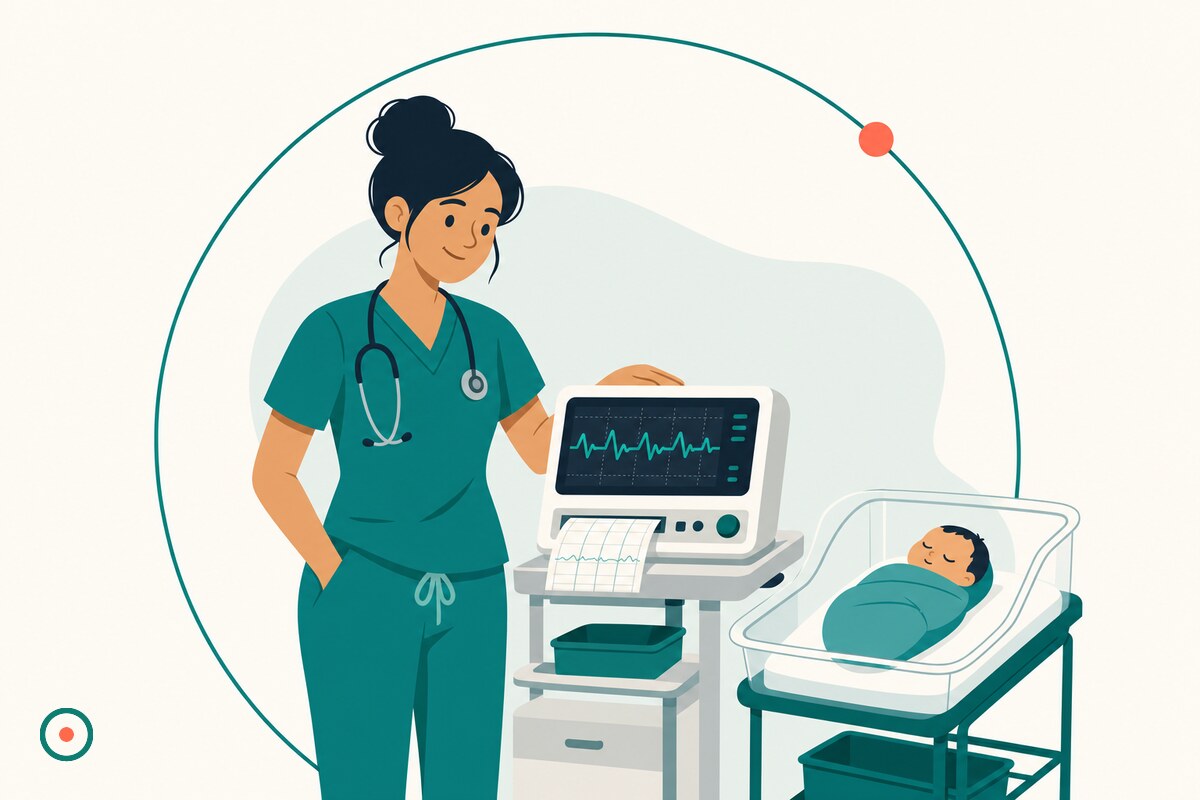
Labor and delivery interviews test four things: can you recognize an obstetric emergency early, keep two patients safe at once, communicate fast with the OB/anesthesia team, and hold steady through joy and loss. Panels lean hard on clinical scenarios — fetal decels, postpartum hemorrhage, a prolapsed cord — and they’re listening for your reasoning, not a memorized protocol.
Below are 23 labor and delivery nurse interview questions panels actually ask, each with a sample answer you can adapt — including the clinical scenarios that decide most L&D interviews. New grad with no L&D experience yet? That’s the norm for residency hires. Lean on your OB rotation, capstone, and sim lab, and answer honestly — panels know you’re new and are scoring how you think, not what you’ve already done.
Two frameworks to carry every answer
- SBAR — Situation → Background → Assessment → Recommendation. Use it for every clinical scenario; it’s how you show structured reasoning and exactly how you’ll call the provider on the floor.
- STAR — Situation → Task → Action → Result. Use it for behavioral questions (“tell me about a time…”).
Build every answer on one of these and you’ll sound organized under pressure — which is the whole point of an L&D interview.
Clinical scenario questions (where L&D interviews are won)
This is the section competitors skip and the section panels weight most. Say the why at each step — that’s what they’re scoring.
”You see late decelerations on the fetal monitor. What do you do?”
Late decels suggest uteroplacental insufficiency. Walk the panel through intrauterine resuscitation, in SBAR:
“My first move is intrauterine resuscitation while I call for help. I’d reposition the mom to left lateral, give an IV fluid bolus, apply oxygen by non-rebreather, and stop oxytocin if it’s running. Then I’d do a vaginal exam to check for cord or rapid progress and reassess the strip. I’d notify the provider with SBAR: ‘Dr. X, room 4, G2 at 39 weeks, I’m seeing recurrent late decels with minimal variability. I’ve repositioned, bolused, given O2, and stopped the Pit — baseline is 140, but I’m concerned about uteroplacental insufficiency and would like you to evaluate.’ My priority is restoring fetal oxygenation and getting the provider there before it becomes a category III tracing."
"What about variable decelerations?”
“Variables usually mean cord compression, so my first thought is positioning. I’d reposition the mother — side to side, or knees-to-chest — to take pressure off the cord, do a vaginal exam to rule out a prolapsed cord, and consider an amnioinfusion if they’re recurrent and ordered. I’d keep oxytocin in mind and reassess. If they resolve with position change, I document and keep watching; if they don’t, I escalate."
"You do a vaginal exam and feel a pulsating cord — a prolapsed cord. What now?”
This is a true emergency and panels love it because the answer is reflexive and physical:
“I don’t remove my hand. I keep my fingers in the vagina and elevate the presenting part off the cord to relieve compression, and I call for emergency help — push the call light, call out for the team and provider. I’d put the mom in knees-to-chest or steep Trendelenburg, give oxygen, stop oxytocin, and the rest of the team preps for an emergency C-section. I stay with my hand elevating the head the whole way to the OR. The baby’s oxygenation depends on me keeping that pressure off the cord."
"Walk me through how you’d manage a postpartum hemorrhage.”
The classic L&D escalation question. Show the stepwise ladder:
“My first step is fundal massage and assessing the cause — for atony, a boggy uterus, I massage and have someone get help. I’d quantify the blood loss, get a second IV and fluids going, draw labs and a type-and-cross, and put the patient on monitors. Then I’d anticipate uterotonics in order — more oxytocin, then methergine if she’s not hypertensive, hemabate if she’s not asthmatic, misoprostol. I’d call the provider with SBAR and stay ahead of it: ‘Room 2, two hours postpartum, estimated 1,200 mL and counting, boggy uterus not responding to massage, two large-bore IVs in, I’ve given the standby oxytocin — I need you here now.’ I keep reassessing for shock and I’m thinking about blood products and the OR if it doesn’t turn around. The four T’s — tone, trauma, tissue, thrombin — guide what I’m ruling out."
"A patient on a magnesium sulfate drip for preeclampsia is suddenly lethargic with absent reflexes. What’s happening?”
“That’s magnesium toxicity until proven otherwise. I’d stop the mag drip immediately, assess her airway, breathing, reflexes, and respiratory rate, and check a mag level. I keep calcium gluconate on hand because it’s the antidote, so I’d notify the provider and prepare to give it per order. I’m watching her respiratory rate and urine output closely — a rate under 12 or absent deep tendon reflexes are my red flags. The whole time on mag I’d be monitoring reflexes, resps, and output every hour so I catch it before it gets to this point."
"You have a shoulder dystocia at delivery. What’s your role?”
“My job is to call for help fast, note the time, and run the maneuvers with the team. I’d call out for additional staff and the provider, document the time of delivery of the head, and start McRoberts — sharply flexing the mother’s legs onto her abdomen — and apply suprapubic pressure when asked. I would not apply fundal pressure. I’d be ready to help with the other maneuvers, keep the parents informed, and have neonatal resuscitation and NICU ready because the baby may need it. Clear roles and a timekeeper are what get a baby out safely."
"Three patients need you at once. How do you prioritize on an L&D floor?”
ABCs and fetal-maternal acuity, out loud:
“I prioritize by acuity and what’s time-sensitive for both patients. A non-reassuring fetal tracing or a hemorrhaging postpartum mom comes before a stable laboring patient who wants an epidural update. I’d assess what each truly needs, delegate what I safely can to the tech or another nurse, and loop in my charge nurse. I’d rather flag that I’m stretched early than miss a deteriorating strip.”
Patient advocacy & birth plan questions
”A patient has a detailed birth plan, but a complication means it can’t be followed. How do you handle it?”
“I honor the birth plan as much as it’s safe to, and when safety and the plan collide, safety wins — but how I communicate it is everything. I’d explain calmly and honestly what’s changed and why, give her choices wherever there still are any, and keep her feeling respected and in control even when the plan shifts. I’d loop in the provider for the medical conversation. Most patients can accept a change in plan; what they can’t forgive is feeling steamrolled or unheard."
"How would you support an anxious first-time mom asking about pain management?”
“I’d sit down, acknowledge that the anxiety is completely normal, and give her clear, unhurried information about her options — non-pharmacologic measures like position changes, the birthing ball, breathing, and a doula, plus IV meds and the epidural, with honest pros and timing for each. Then I’d support whatever she chooses without judgment. Feeling informed and in control is itself a huge part of managing pain and fear."
"How do you work with a midwife, doula, or anesthesia during a delivery?”
“Collaboratively and with clear communication. I see the doula as an extension of the patient’s support — I make space for her — and I keep the midwife, OB, and anesthesia looped in with concise SBAR updates so everyone’s working off the same picture. In L&D things change in seconds, so closed-loop communication with the whole team is non-negotiable.”
Behavioral & teamwork questions (answer in STAR)
“Tell me about a time you worked as part of a team.”
“During my OB rotation (Situation), we had a patient progress to delivery much faster than expected and the room got hectic (Task). I took the role of getting the warmer and resuscitation equipment ready and kept the patient calm and informed while my preceptor and the provider focused on the delivery (Action). The baby was delivered safely and my preceptor said I’d anticipated the team’s needs without being told (Result). I learned that on L&D, knowing your role in a fast situation matters as much as clinical skill."
"Tell me about a time you disagreed with a provider or coworker about a patient’s care.”
“In a clinical, I felt a patient’s pain and a change in her vitals weren’t being taken seriously (Situation/Task). I didn’t argue — I went back to the provider with specifics in SBAR and asked, ‘Given these changes, can we reassess?’ (Action) They re-evaluated and adjusted the plan (Result). I learned that advocacy is clear data plus a respectful question, not winning an argument."
"Describe a time you made a mistake or felt overwhelmed.”
“As a student I once realized I’d charted on the wrong patient’s flowsheet (Situation). I immediately told my preceptor, corrected the record per policy, and double-checked nothing clinical had been affected (Action). Nothing reached the patient, and I built a habit of verifying two identifiers every single time (Result). I’d rather own a near-miss out loud than hide it — that’s how units stay safe."
"How do you handle stress and avoid burnout in such an emotional specialty?”
Concrete habits, not platitudes — L&D panels genuinely worry about retention:
“I prioritize by acuity so I’m not carrying everything in my head, I communicate early when I’m stretched, and I lean on my team. Off the clock I protect sleep and decompress with people who get the work. I also let the good deliveries fill the tank — that’s a real part of how I stay grounded in this specialty.”
The hard ones panels save for the end
”How do you cope with a fetal demise or a loss?”
This question separates rehearsed candidates from real ones. Be honest and human:
“I’d be fully present for the family — give them space, time, and whatever they need, like holding the baby or keepsakes, and never rush them. I’d communicate gently and honestly, and I’d lean on the team, chaplain, and bereavement resources. I also know I have to care for myself after, so I’m not carrying it alone — I’d use debriefs and support so I can keep showing up for the next family. Loss is part of this work, and being a steady, compassionate presence is the care I can give in that moment.”
Don’t claim it won’t affect you — that reads as naive. Panels want to hear that you’ll grieve and function.
”What is your greatest weakness?” (best answer for L&D nurses)
Pick a real, fixable weakness — and for a new grad, your honest gap is your hands-on L&D experience, which you turn into a plan:
“My biggest weakness is that I don’t have hands-on L&D experience yet, so I know my skills will be slower at first than an experienced nurse’s. I’m addressing it head-on — I sought out extra OB clinical time, I did my capstone on a labor unit, and I study the protocols on my own. I ask questions early instead of guessing, and I learn hands-on skills fast with support. I’d rather over-prepare and ask than pretend I know something I don’t, especially in this specialty.”
That converts the new-grad fear — “I’ve never worked L&D” — into evidence of self-awareness and drive. (More on this in our strengths and weaknesses guide.)
”Why labor and delivery?”
One genuine reason beats a rehearsed speech:
“I’m drawn to L&D because it’s one of the few places in nursing where you’re caring for two patients at once and walking a family through one of the biggest moments of their life — and it can flip from joyful to critical in seconds. My OB rotation confirmed it: I loved the mix of high-acuity vigilance on the monitor and the human side of supporting a laboring patient. That blend of fast clinical thinking and deep patient connection is exactly the nurse I want to be.”
Avoid “I love babies” as your only reason — L&D is high-acuity, and panels are screening for someone who understands that.
How do you answer L&D experience questions as a new grad?
You almost certainly don’t have L&D experience yet, and that’s expected for residency and new-grad hires. The move is to answer honestly and bridge to the closest real experience you have:
“I haven’t worked L&D as an RN yet, but I sought out my OB rotation and capstone specifically on a labor unit, where I cared for laboring patients, learned to read fetal monitoring strips with my preceptor, and assisted at deliveries. I’ve practiced the emergency scenarios in sim lab — postpartum hemorrhage and shoulder dystocia — so I know the protocols and the team roles. I’m comfortable with the concepts, I learn hands-on skills quickly with support, and I’ll ask early rather than guess on anything that affects a mom or baby.”
Three rules for every new-grad “experience” answer:
- Name the real experience — OB rotation, capstone, preceptorship, sim lab, externship. Be specific about what you actually did.
- Show the concept is solid even if the hands aren’t fast yet — “I know the protocol and the why; I’ll be quicker with reps.”
- Promise safety over ego — “I ask early instead of guessing.” Panels hire the humble, coachable new grad over the overconfident one every time.
For more on this, see our new-grad RN interview guide.
What are the 6 C’s of nursing interview questions?
The 6 C’s are Care, Compassion, Competence, Communication, Courage, and Commitment. Panels won’t always name them, but they’re scoring for them — so weave them into your stories. On L&D: Care and Compassion show up in how you support a frightened first-time mom; Competence and Communication in your SBAR escalations; Courage in advocating with a provider; Commitment in coping with loss and still showing up.
What are the 5 C’s of an interview?
A common framing: Confidence, Communication, Competence, Character, and Culture-fit. It’s a quick self-check before you walk in — are you projecting all five? L&D panels weight Communication and Competence highest because both patients’ safety depends on them.
What are the 7 most common nursing interview questions and answers?
These come up in nearly every nursing interview, L&D included. Pre-script all seven:
- Tell me about yourself. — A tight 60-second story: who you are as a nurse, why L&D, where you’re headed. (See our tell me about yourself guide.)
- Why do you want to work here / in L&D? — One genuine reason + something specific about the unit.
- What’s your greatest strength? — Pick one and back it with a quick STAR example.
- What’s your greatest weakness? — Real, fixable, with a plan (see above).
- Tell me about a time you handled conflict / a difficult patient. — STAR, calm, advocacy-focused.
- How do you handle stress? — Concrete habits.
- Where do you see yourself in 5 years? — Growth on the unit; honest if it includes further specialization.
What are the 5 hardest interview questions?
The five that trip people up most — script these word-for-word: Tell me about yourself · Why should we hire you? · What’s your greatest weakness? · Describe a time you failed or made a mistake · Where do you see yourself in five years? For L&D, add a sixth: How do you cope with loss? (answered above). The “hardest” questions are only hard if you improvise them — they’re 100% predictable.
What questions should you ask at a labor and delivery nurse interview?
Asking sharp questions flips the interview and signals you know what a safe L&D unit looks like. Have 3–4 ready:
- “What are your nurse-to-patient ratios on labor, in triage, and on postpartum / couplet care?”
- “Is anesthesia and an OB in-house 24/7, or on call? What’s the response time for an emergency C-section?”
- “How long is orientation and the residency for a new grad, and who precepts me?”
- “What support is there after a difficult outcome — do you debrief as a team? Is there bereavement support?”
- “What does the path from labor to circulating in the OR or to charge look like here?”
Those four about ratios, in-house coverage, orientation, and debrief support tell a panel you’re thinking like an L&D nurse already. (More in our questions to ask the interviewer guide.)
Before you go in
Review the unit’s basics (fetal monitoring categories, the PPH and mag protocols, neonatal resuscitation roles), bring your questions, dress the part (see what to wear to a nursing interview), and send a thank-you email within 24 hours. Want everything in one scannable place? Grab our nursing interview cheat sheet.
How to actually practice
L&D scenarios sink new grads not because they don’t know the medicine — but because they freeze saying it out loud with a panel watching. You can know the PPH ladder cold and still blank when three people are staring at you. The fix is reps: say your SBAR answers aloud, get feedback on whether the reasoning is right and the order is correct, and run them again until they’re automatic.
That’s what Roundly does — realistic mock L&D panels that ask these exact clinical and behavioral questions and score your clinical reasoning, SBAR/STAR structure, and delivery, built with real nurse recruiters and hiring managers. Practice the late-decel walkthrough, the prolapsed-cord reflex, and “why L&D” out loud before the panel does. Start practicing with Roundly →
“Tell me about a time you worked as part of a team”
You just read a strong answer to that. Saying one to three people who are deciding whether to hire you is a different skill — Roundly asks this exact question in a mock L&D panel, listens, and scores the clinical reasoning underneath.
Answer this one out loud →You've read the answers. Now say one out loud.
Reading a sample answer and delivering it to a panel that's deciding whether to hire you are two different skills. Roundly runs a mock L&D panel that asks these exact questions, listens to your answer, and scores your clinical reasoning and structure — not just how confident you sounded.
Start a mock L&D panelTakes about two minutes to set up. Finish 15 panels without an offer and we refund you.