Neuro Nurse Interview Questions (2026): New-Grad Sample Answers
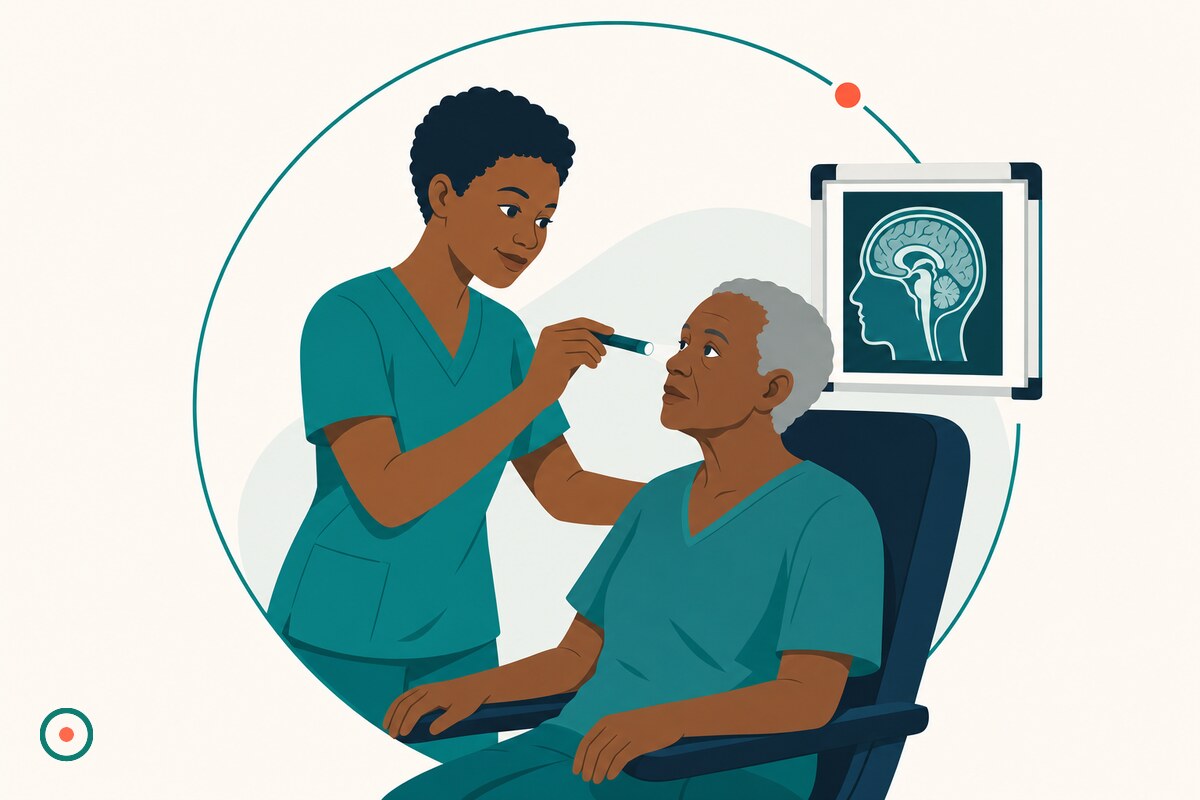
Neuro nurse interview questions test four things: can you do a real neuro assessment (level of consciousness, GCS, pupils, speech, motor strength) and compare it to the last one, will you recognize a subtle change early and escalate it fast, do you know what happens in a code stroke and after a clot-busting drug, and can you keep a confused, impulsive or seizing patient safe. Neuro panels know a new grad hasn’t managed an external ventricular drain or titrated a nicardipine drip alone. They’re listening for whether you notice change, act in the right order, and call for help at the right moment.
Below are the neuro nurse interview questions stroke units, neuroscience floors and neuro step-down units actually ask, each with a copy-ready sample answer, plus the neuro-specific scenarios most online lists skip. For the full panel across specialties, start with our nursing interview questions hub.
Quick honesty check: Many neuroscience and stroke units hire new graduates, often through a nurse residency. But neuro is not “med-surg with more vitals.” The core skill is trending: a patient who was a GCS 15 and is now a 13 may look “a bit sleepy” to someone who doesn’t know the baseline. Read the posting carefully. A neuro ICU role is very different from a neuro med-surg or stroke floor role, and the interview will be too.
What does a neuro nurse do?
Know the unit before you walk in. “Neuro” can mean a stroke unit, a neuroscience med-surg floor, a neuro step-down (progressive care) unit, an epilepsy monitoring unit, a neurosurgery floor, or a neuro ICU. Across them, a neuro nurse’s shift usually includes:
- Scheduled neuro checks (often hourly or more often in the first day): level of consciousness, orientation, Glasgow Coma Scale, pupils, speech, facial symmetry, limb strength and drift, and comparison to the last exam.
- Stroke care: NIH Stroke Scale (NIHSS) exams, blood pressure targets, swallow screening before anything by mouth, and teaching about risk factors.
- Post-procedure care after thrombectomy, aneurysm coiling, or spine and brain surgery: access-site checks, drains, positioning, pain.
- Seizure precautions and seizure response, often with EEG monitoring.
- Safety for impaired patients: fall prevention, delirium, impulsivity, aspiration risk, and hard conversations with families.
If you can name the patient population on the unit you’re interviewing for (for example, “mostly ischemic strokes and post-thrombectomy patients”), you already sound more prepared than most applicants.
How do I prepare for a neuro nurse interview?
- Practice a neuro assessment out loud, in order, in under a minute. Panels often ask, “Walk me through your neuro check.”
- Know GCS cold: eye (1–4), verbal (1–5), motor (1–6), total 3–15. A drop of 2 or more points is a change you report right away, and a GCS of 8 or less raises concern about the patient’s ability to protect their airway.
- Know the code stroke basics: last known well, fingerstick glucose, NIHSS, a non-contrast CT, and the thrombolysis window (generally within 4.5 hours of last known well for eligible adults).
- Know the blood pressure numbers: under the 2026 AHA/ASA acute ischemic stroke guideline, BP should be below 185/110 before IV thrombolysis and kept at or below 180/105 for 24 hours afterward.
- Prepare three stories: a time you noticed a subtle change, a time you kept a confused or agitated patient safe, and a time you handled an upset family.
- Consider NIHSS certification. Many stroke units expect it within your first months. Doing it before the interview is a strong signal of interest. Ask your school or the hospital which provider they use.
What are the most common neuro nurse interview questions and answers?
”Why do you want to work in neuro nursing?”
Sample answer: “On my medical floor rotation I had a patient whose only early sign of a stroke was that he couldn’t find the word ‘fork’ at lunch. My preceptor caught it, and I watched how fast the team moved after that. That’s what pulls me to neuro: the exam matters, small changes matter, and the nurse is usually the one who sees them first. I like structured assessment, and I want to get very good at comparing one exam to the next. I also know neuro patients and families go through frightening changes, and I want to be a calm, clear presence for them.”
Why it works: a specific moment, a real reason (assessment and trending), and an understanding that neuro is emotional for families.
”Walk me through your neuro assessment.”
Sample answer: “I start by looking at the patient before I touch them: are they awake, how are they breathing, are they moving all four limbs. Then level of consciousness and orientation, and I score the GCS: eye opening, best verbal response, best motor response. I check pupils for size, shape, equality and reaction to light. I check speech and whether they follow commands, facial symmetry, grip and arm drift, and leg strength. On a stroke unit I’d do the NIHSS the way I was trained. Most important, I compare everything to the last documented exam and the handoff baseline, because one exam alone doesn’t tell me much. If anything is new, I recheck it, and then I escalate."
"What does a change in GCS tell you, and when do you call?”
Sample answer: “GCS is a trend tool. Going from 15 to 14 because a patient is newly confused is worth a recheck and a conversation with the charge nurse; a drop of two or more points, a new one-sided weakness, or a new pupil change is something I report to the provider right away, following the unit’s parameters or a rapid response if they meet criteria. If the GCS falls toward 8, I’m thinking about the airway and I want help at the bedside. I’d also check the simple causes in parallel: glucose, oxygen saturation, sedating meds, but I wouldn’t delay the call to do it."
"How do you keep a confused or impulsive patient safe without restraints?”
Sample answer: “I start with why they’re confused: a new change gets assessed and reported, not just managed. For safety, I use the bed alarm, low bed, call light and urine bottle within reach, scheduled toileting, and I room them close to the station if possible. I reorient them often, keep glasses and hearing aids on, keep lights on during the day and dim at night, and ask family to sit with them when they can. If they’re pulling at lines, I cover or reposition them. If none of that works, I talk to the charge nurse and provider about a sitter or other options. Restraints are a last resort and follow the order and monitoring policy."
"How would you explain a stroke to a scared family?”
Sample answer: “I’d sit down, ask what they already know, and use plain words: ‘A blood vessel to part of the brain was blocked, so that part didn’t get enough blood, which is why her right arm is weak and her words are hard to find.’ I’d tell them what the team is doing right now and what we watch for, and I wouldn’t guess about long-term recovery; I’d say the doctor and therapy team will talk with them about that, and I’d make sure that conversation happens. Then I’d ask, ‘What questions do you have?’ and check what they took away."
"How do you prioritize four neuro patients at the start of a shift?”
Sample answer: “After report I’d see the patient with the least stable neuro picture first, for example someone less than 24 hours after thrombolysis whose neuro checks are every 15 or 30 minutes, then anyone with a recent change, then the patient with a scheduled time-critical med, like an anti-seizure medication. I’d cluster care and set timers for neuro checks so they don’t drift. If two things collide, such as a due neuro check and a patient asking for pain meds, the neuro check on the high-risk patient comes first, and I’d tell the other patient when I’ll be back or ask a teammate."
"Tell me about a time you noticed a subtle change in a patient.”
Use STAR (situation, task, action, result) and keep it about 90 seconds. Sample answer: “In clinicals I had an older patient on a medical floor who was chatty in the morning. After lunch she was quiet and kept answering ‘yes’ to every question. My task was to decide if that was just tiredness. I asked her name and where she was, and she couldn’t answer, so I told my preceptor immediately. We did a full set of vitals and a fingerstick, and her glucose was very low. We treated it per protocol and she was back to herself within the hour. What I took away is: never chart ‘sleepy’ without checking orientation against the baseline.”
What scenario questions do neuro nurse interviews ask?
This is where most online lists stop and where neuro panels actually decide. Answer in the same order every time: what I see, what worries me, what I do first, who I tell. Then close with an SBAR.
”Your patient’s right hand grip was strong at 0800. At 0900 she’s dropping her cup and her speech is slurred. What do you do?”
Sample answer: “That’s a new focal deficit, so I treat it as a possible stroke right now. I stay with her, check airway and breathing, note the exact time I last saw her normal, which is 0800, and call a stroke alert or rapid response per the hospital’s process. While the team comes, I get a fingerstick glucose, a full set of vitals, and I keep her NPO because I don’t know if she can swallow safely. I make sure she has IV access and is ready for CT. SBAR: ‘This is the nurse on 5 West calling about Ms. Lee in room 12. She has new right-hand weakness and slurred speech since 0900, last known well 0800. BP 178/96, glucose 134, sats 97%. I’m concerned about an acute stroke. I’ve called the stroke alert and she’s NPO. Can you come evaluate her now?’"
"Your patient received IV thrombolysis two hours ago. He now has a severe headache and is vomiting.”
Sample answer: “After a clot-busting drug, a new severe headache, vomiting, rising blood pressure or a worse neuro exam can mean bleeding in the brain, so this is an emergency. If the alteplase infusion is still running, I stop it. I do a full neuro check and vitals, protect his airway by turning him to the side if he’s vomiting, and call the provider and stroke team immediately. I’d expect an emergency head CT. I keep up the close neuro checks and blood pressure checks, which after thrombolysis are every 15 minutes for the first two hours, then every 30 minutes for six hours, then hourly to 24 hours."
"Your post-thrombolysis patient’s blood pressure is 192/108.”
Sample answer: “After thrombolysis the goal is to keep BP at or below 180/105, so 192/108 is above target. I’d recheck it right away, make sure the cuff fits and the patient isn’t in pain or needing to void, do a neuro check, and then call the provider, or follow the existing order set for antihypertensives if there is one. I’d increase how often I check BP until it’s back in range, and document the time, the value, what I gave and the response."
"A patient with a seizure history starts having a generalized tonic-clonic seizure.”
Sample answer: “I note the time, call for help, and stay with him. I protect his head, turn him on his side to keep the airway clear, move anything he could hit, and loosen anything tight at the neck. I don’t restrain him and I don’t put anything in his mouth. I have suction and oxygen ready, and I watch what the seizure looks like so I can describe it. If it lasts five minutes or more, or he has another one without waking up in between, that’s status epilepticus and needs emergency treatment, usually a benzodiazepine per order, so I’d make sure the provider or rapid response team is already on the way. Afterward I check airway, vitals, glucose and a neuro exam, keep him on his side, and document."
"Your patient with a brain bleed is harder to wake, his heart rate has dropped into the 50s, and his blood pressure is climbing.”
Sample answer: “Decreasing consciousness with bradycardia and rising blood pressure can be a late sign of rising pressure inside the skull (Cushing’s triad is rising blood pressure, a slowing heart rate and irregular breathing), so this is a call-for-help-now situation. I’d call a rapid response or the provider immediately, raise the head of the bed to about 30 degrees with the head midline unless that’s contraindicated, check pupils and GCS, make sure oxygen and suction are ready, and stay at the bedside. I’d give a short SBAR with the trend, not just the latest numbers: ‘GCS was 14 at 1000, now 10; heart rate 58 from 80; BP 182/90 from 140s; right pupil sluggish.’"
"A stroke patient’s daughter brings him a milkshake. He hasn’t had his swallow screen yet.”
Sample answer: “I’d kindly stop it and explain why: after a stroke the muscles for swallowing can be weak, and food or liquid can go into the lungs without obvious coughing. Patients should have a swallow screen before anything by mouth. I’d tell her I’ll check where the screen is, do it if I’m trained and it’s ordered, or get speech therapy involved, and I’d let her know what he can have once he’s cleared. I’d make the NPO status visible at the bedside so the next visitor knows too."
"Your patient after a spine surgery says his legs feel numb and heavy and he can’t lift them the way he could this morning.”
Sample answer: “A new loss of strength or sensation after spine surgery could mean a hematoma or swelling pressing on the cord, and timing matters. I’d do a focused motor and sensory exam of both legs, check the dressing and drain, ask about bladder control, compare to the post-op baseline, and call the surgeon or provider immediately with the findings. I wouldn’t wait for the next scheduled check or assume it’s just the anesthesia wearing off.”
For more scenario practice across units, see nursing interview questions and answers scenarios.
Can a new graduate become a neuro nurse?
Yes. Many stroke and neuroscience units hire new grads, often with a residency and an extended orientation. Neuro ICUs hire new grads less often, but some do through critical care residencies; if that’s your goal, also read our ICU nurse interview questions. What helps your case:
- A neuro or stroke clinical rotation or capstone, or any clinical where you did neuro checks. Name it.
- NIHSS certification done on your own initiative.
- Strong med-surg fundamentals. Neuro patients also have diabetes, heart failure and infections. If telemetry is part of the role, look at our telemetry nurse interview questions too.
- A realistic plan: “Master the neuro exam, get comfortable with stroke protocols, then pursue certification.”
On certification, the American Board of Neuroscience Nursing offers the CNRN (Certified Neuroscience Registered Nurse) and the SCRN (Stroke Certified Registered Nurse). Both require at least one year of full-time experience (2,080 hours) in neuroscience or stroke nursing within the past three years, so a new grad should present it as a goal, not something you have.
What questions should you ask in a neuro nurse interview?
- “What’s the typical patient mix: strokes, post-thrombectomy, neurosurgery, seizures?”
- “How often are neuro checks on your highest-acuity patients, and what’s a typical ratio?”
- “How long is orientation for new grads, and is there a residency?”
- “Do you support NIHSS certification and, later, CNRN or SCRN?”
- “How does the unit handle a stroke alert on the floor? Who responds?”
- “What do your strongest new grads do differently in their first six months?”
More ideas: questions to ask the interviewer in a nursing interview.
Mistakes that weaken a neuro interview answer
- Saying “I’d monitor” without a number or a trigger. Say what change makes you call.
- Treating a new deficit as something to recheck later. A new focal deficit is a time-critical call now.
- Forgetting the baseline. Every neuro answer should include “compared to the last exam.”
- Giving anything by mouth before a swallow screen in a stroke patient.
- Holding a seizing patient down or putting something in their mouth.
- Claiming certifications or experience you don’t have. Panels check.
How to prepare for neuro nurse interview questions in one evening
- Say your neuro assessment out loud, timed, under a minute.
- Write the GCS components and scores from memory.
- Memorize three numbers: 4.5 hours, BP below 185/110 before thrombolysis and at or below 180/105 after, 5 minutes for status epilepticus.
- Practice two scenarios above with an SBAR at the end.
- Say your “Why neuro?” answer until it’s under 90 seconds.
For more behavioral structure, see nursing behavioral interview questions. If the unit also does a lot of post-stroke recovery work, our rehab nurse interview questions cover mobility, swallowing and discharge teaching in more depth.
Neuro nurse interview FAQ
Is a neuro nurse interview a panel interview?
Often. Many hospitals use a panel of the nurse manager, an educator or charge nurse, and sometimes a staff nurse. Expect a mix of behavioral questions and one or two clinical scenarios.
Will they quiz me on stroke medications?
Some panels ask what you know about thrombolytics such as alteplase and tenecteplase. As a new grad, you don’t need doses memorized. Know the time window, the blood pressure targets, the bleeding warning signs and the close neuro checks afterward.
Is “neuro nurse” the same as “neuroscience nurse” or “neurology nurse”?
Mostly, yes. Job postings use all three, along with “stroke unit RN” and “neuro step-down RN.” The questions overlap heavily; neuro ICU interviews add more critical-care content such as ICP monitoring and drains.
How long should my answers be?
About 60 to 90 seconds for behavioral stories and one to two minutes for scenarios. It’s fine to say, “I’d follow the unit’s stroke protocol here, and these are the steps I’d expect.”
Practice saying the scenario out loud
Reading a good code stroke answer is one skill. Saying it calmly, in order, while a panel scores you is another. The candidates who do well have practiced the same pattern until it’s automatic: “here’s what I see, here’s what worries me, here’s what I do first, and here’s who I tell.” Pick two scenarios tonight and say them out loud, timed.
“Tell me about a time you noticed a subtle change in a patient”
You just read a strong answer to that. Saying one to three people who are deciding whether to hire you is a different skill — Roundly asks this exact question in a mock Neuro panel, listens, and scores the clinical reasoning underneath.
Answer this one out loud →You've read the answers. Now say one out loud.
Reading a sample answer and delivering it to a panel that's deciding whether to hire you are two different skills. Roundly runs a mock Neuro panel that asks these exact questions, listens to your answer, and scores your clinical reasoning and structure — not just how confident you sounded.
Start a mock Neuro panelTakes about two minutes to set up. Finish 15 panels without an offer and we refund you.