NICU Nurse Interview Questions (2026): Sample Answers for New Grads
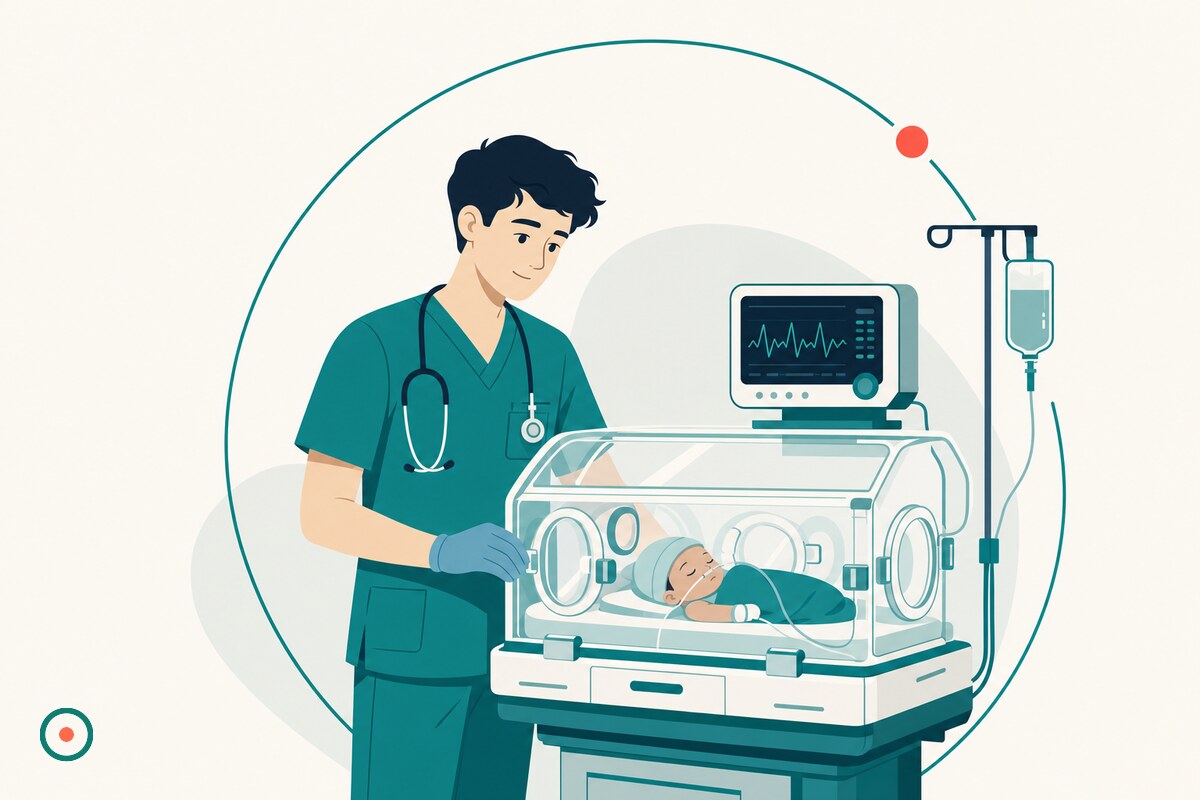
NICU interviews test four things: can you handle the emotional weight (including infant loss), support frightened and grieving families, work as a tight team while advocating for a patient who can’t speak, and think clearly through a neonatal clinical scenario. Panels lean hard on behavioral and “fit” questions — and for new grads, they’re scoring coachability and why you want this, not whether you already know how to run a vent on a 26-weeker.
Below are the NICU nurse interview questions panels actually ask, each with a full sample answer you can adapt — including the question new grads fear most (“why NICU / why babies?”) with two ready templates. No NICU experience? Most units hire new grads for fit and coachability, then train the clinical skills. Lean on clinical rotations, capstone, your “why,” and how you handle stress. Want one page to review? Grab our nursing interview cheat sheet.
Two frameworks to carry every answer
- STAR — Situation → Task → Action → Result. Use it for every behavioral question (“tell me about a time…”). Tell a specific story.
- SBAR — Situation → Background → Assessment → Recommendation. Use it for clinical scenarios; it’s how nurses actually escalate.
Master these two and you can answer almost anything they throw at you.
How to prepare for a NICU nurse interview
- Script your “why NICU” answer first. It’s the most likely question and the one new grads fumble. Have two versions ready (next section).
- Pre-write 5–6 STAR stories from clinical, capstone, school, or work — resilience under stress, compassion with a scared family, teamwork, catching a mistake, and handling feedback.
- Review neonatal basics a new grad should know — normal newborn vitals (HR 120–160, RR 40–60), why preemies are fragile (thermoregulation, immature lungs/immune system), skin-to-skin and family-centered care, and NICU levels (I–IV). You’re not expected to know vent settings; you’re expected to be curious and safe.
- Prepare an honest answer about emotional resilience. They will ask how you’d cope with a baby who doesn’t make it. Don’t pretend it won’t affect you — show you have a plan.
- Write 3–4 questions to ask them. Showing up with none reads as low interest.
- Practice out loud with a timer or a person — not in your head.
- Logistics: know the hospital’s Magnet/values, plan your outfit (what to wear), and send a thank-you within 24 hours.
Pair this with our new-grad RN interview guide and RN interview questions.
Why do you want to be a NICU nurse? (how to answer “why babies”)
This is the NICU question. Panels ask it because the unit is emotionally demanding and they want nurses who chose it on purpose. A good answer is specific, genuine, and shows you understand the job — families in crisis, fragile patients, and loss — not just “I love cuddling babies.”
Template 1 — clinical-rotation spark (best if you had NICU/peds/postpartum exposure):
“During my clinical rotation I spent time on mother-baby and special care nursery, and I was drawn to how much detail and patience neonatal care takes — tiny assessments that make a huge difference, and nurses who cared for the whole family, not just the baby. I love that the NICU combines high-acuity, precise clinical work with that family-centered piece. I know it’s emotionally hard, and I’ve thought carefully about that — I want a specialty where I can build deep expertise and be present for families on the worst and best days of their lives. That’s why I’m pursuing the NICU specifically and not just any new-grad spot.”
Template 2 — values “why babies” (best if you have no NICU exposure):
“Two things pull me here. First, I’m calm and detail-oriented under pressure, and neonatal care rewards exactly that — small, careful interventions on very fragile patients. Second, the family-centered side matters deeply to me; supporting parents through the scariest moment of their lives is the kind of nursing I want to do. I went in clear-eyed about the hard parts, including loss, and I still chose this. I’d rather commit to a specialty I’m passionate about and grow into the clinical skills than land somewhere I’m only lukewarm about.”
Don’ts: don’t say “babies are cute” as your only reason, don’t say “it seems less hectic than adult floors,” and don’t make it only about your resume. Tie it to patients and families.
Behavioral questions — emotional resilience & coping
”How would you cope with the death of a baby in your care?”
“I’d be honest that it would affect me — caring deeply is part of why I want this work. In the moment, my focus would be on the family: dignity, privacy, time with their baby, clear gentle communication, and looping in chaplain, social work, and the bereavement team. Afterward, I’d debrief with my team and charge nurse, use EAP or peer support if I needed it, and decompress off the clock. I know I can’t be a good NICU nurse for the next family if I bottle it up."
"Tell me about a time you handled a high-stress or emotional situation.”
“During my final clinical, a patient I’d cared for all week declined suddenly and the family was terrified. I stayed calm, kept them informed in plain language, and made sure my preceptor and the provider had what they needed. I focused on one step at a time, then talked it through with my preceptor afterward. The family thanked me for staying steady — I learned I can keep my composure when things get intense, which is essential in the NICU."
"How do you handle stress and avoid burnout?”
“I prioritize by acuity so I’m not spinning, I ask for help early instead of drowning, and I protect my time off — sleep, exercise, and people I can debrief with. In a unit with this much emotional weight, I’d also use team debriefs and EAP without hesitation. I’d rather build sustainable habits now than burn out.”
Behavioral questions — family-centered care
”How would you support a distraught or grieving parent?”
“I’d meet them where they are — slow down, acknowledge the fear: ‘I know this is terrifying, and I’m right here with you.’ I’d give honest information at their pace, encourage involvement where safe (touch, voice, skin-to-skin when appropriate), and bring in the provider, chaplain, or social work. Often the most important thing is being a steady, honest presence."
"A parent wants to do something for their baby that isn’t safe. How do you handle it?”
“I’d never just say ‘no.’ I’d acknowledge the love behind it — ‘I can tell how much you want to help’ — then explain the why in plain terms and offer a safe alternative. If it’s a genuine safety conflict I can’t resolve, I’d involve the charge nurse or provider. The goal is to keep the parent as a partner, not shut them down.”
Behavioral questions — teamwork & advocating for a non-verbal patient
”Your patient can’t communicate. How do you advocate for them?”
“My assessment is their voice — tone changes, color, feeding behavior, vitals trending the wrong way — and I speak up early. If something feels off, I escalate with specifics rather than waiting, because a neonate can decompensate fast. Advocating for a non-verbal patient means trusting my assessment and being persistent and clear."
"Tell me about a time you disagreed with a coworker or provider about patient care.”
“During clinical, I felt a patient’s change wasn’t being acted on. I didn’t argue — I went back with specifics using SBAR and asked, ‘Given these changes, can we reassess?’ The provider ordered a further look. I learned advocacy is clear data and a respectful question, not winning.”
Clinical & technical scenario questions (answer with SBAR)
New grads aren’t expected to know advanced neonatal management — but you are expected to show safe thinking and escalate appropriately.
”Walk me through how you’d assess a newborn.”
“I’d start with a quick look — color, work of breathing, tone, activity — then go head-to-toe: airway and respiratory effort (rate, retractions, grunting, nasal flaring), heart rate and perfusion, temperature and thermoregulation, abdomen, skin/cord, and neuro tone. I’d compare against normal newborn ranges — HR roughly 120–160, RR 40–60 — and escalate anything trending the wrong way."
"Your baby’s oxygen saturations are dropping. What do you do?”
(SBAR) “First I’d assess the baby directly, not just the monitor — probe placement, color, work of breathing. Situation: sats dropping into the low 80s and not recovering. Background: gestational age and current support. Assessment: increased work of breathing, possible airway or oxygenation issue. Recommendation: call for help/charge, optimize airway and oxygen per protocol, notify the provider while I keep reassembling. As a new grad I’d get help early — a neonate can deteriorate quickly."
"How do you ensure accuracy with neonatal medication doses?”
“Doses are weight-based and the margins are tiny, so I follow the rights of medication, double-check the math, and use independent double-checks for high-alert meds. If a dose ever looks off for the weight, I stop and verify before giving it. With neonates, slowing down to be right is the fast way."
"A parent is demanding your attention while another baby needs urgent care. How do you prioritize?”
“Patient safety comes first — the baby who needs urgent care gets me. I’d say kindly, ‘I need to take care of something right now, and I’ll be back with you very soon,’ and get a teammate or charge to support them if I can. Acuity decides order; I communicate so they don’t feel abandoned.”
What questions should I ask in a neonatal nurse interview?
Always have 3–4 ready:
- “What does orientation and the new-grad residency look like for the NICU here, and how long is preceptorship?”
- “What’s your nurse-to-patient ratio across the different acuity levels?”
- “How does the unit support staff after a difficult loss — debriefs or bereavement resources?”
- “What level NICU is this, and what’s the typical patient population?”
- “What does the team do really well, and what’s a challenge you’re working on?”
Avoid leading with salary/PTO. More phrasing: smart questions to ask the interviewer.
What are the 5 hardest NICU interview questions?
- “Why NICU / why babies?” — covered above; have two versions.
- “How would you cope with an infant’s death?” — honesty + a real coping plan.
- “Tell me about yourself.” — 60–90 seconds, not your life history (guide).
- “What’s your biggest weakness?” — a real one + how you’re working on it (strengths and weaknesses).
- “Why should we hire you with no NICU experience?"
"Why should we hire you with no NICU experience?”
“You’d be hiring my attitude and trainability. I’m coachable, I ask questions instead of guessing, I’m calm and meticulous under pressure, and I’m genuinely committed to this specialty — I’m not using it as a stepping stone. I know I’ll need a strong orientation, and I’ll show up early, ask, and absorb everything. You can teach a motivated new grad the clinical skills; what I bring is the work ethic, the fit, and a real reason for being here.”
What is your best answer for weaknesses in a NICU interview?
Pick a real weakness that isn’t a dealbreaker, then show your fix:
“As a new grad, my biggest area to grow is confidence with high-acuity neonatal skills I haven’t done independently yet — vents, lines, the technical side. I’m honest about that: ask early, use my preceptor, double-check rather than assume, and build reps with support. I’d rather flag what I don’t know than risk a tiny patient.”
Avoid the fake “I’m a perfectionist” answer.
What are the 6 C’s in a nursing interview?
Care, Compassion, Competence, Communication, Courage, and Commitment. In the NICU these map cleanly — compassion for grieving families, competence with fragile patients, communication with parents and the team, courage to advocate for a non-verbal baby, and commitment to a hard specialty. Show them in your stories rather than reciting them.
A printable NICU cheat sheet
- Frameworks: STAR for behavioral, SBAR for clinical.
- “Why NICU”: specific + genuine + you understand the hard parts. Have two versions.
- Resilience: honest it affects you + a real coping plan + family-first in the moment.
- Family-centered: meet them where they are, honest info at their pace, keep parents as partners.
- Non-verbal advocacy: “my assessment is their voice” — escalate early with specifics.
- Clinical scenario: assess the baby (not the monitor) → SBAR → get help early.
- Weakness: real technical-skill gap + concrete plan.
- Your questions: orientation length, ratios, bereavement support, NICU level.
- New-grad mindset: they hire fit + coachability and train the skills.
Comparing critical-care units? See ICU nurse interview questions and ER nurse interview questions.
How to actually practice
NICU answers sink new grads not because they don’t care — but because they freeze saying “why babies” and “how would you handle a loss” out loud for the first time. The fix is reps: say your STAR and SBAR answers aloud until the reasoning and the “why” land.
That’s what Roundly does — realistic mock NICU panels that ask these behavioral, family, and clinical-scenario questions and score your clinical reasoning, STAR/SBAR structure, and delivery, built with real nurse recruiters and hiring managers. Practice your NICU panel out loud →
“Tell me about a time you handled a high-stress or emotional situation”
You just read a strong answer to that. Saying one to three people who are deciding whether to hire you is a different skill — Roundly asks this exact question in a mock NICU panel, listens, and scores the clinical reasoning underneath.
Answer this one out loud →You've read the answers. Now say one out loud.
Reading a sample answer and delivering it to a panel that's deciding whether to hire you are two different skills. Roundly runs a mock NICU panel that asks these exact questions, listens to your answer, and scores your clinical reasoning and structure — not just how confident you sounded.
Start a mock NICU panelTakes about two minutes to set up. Finish 15 panels without an offer and we refund you.