Orthopedic Nurse Interview Questions (2026): New-Grad Sample Answers
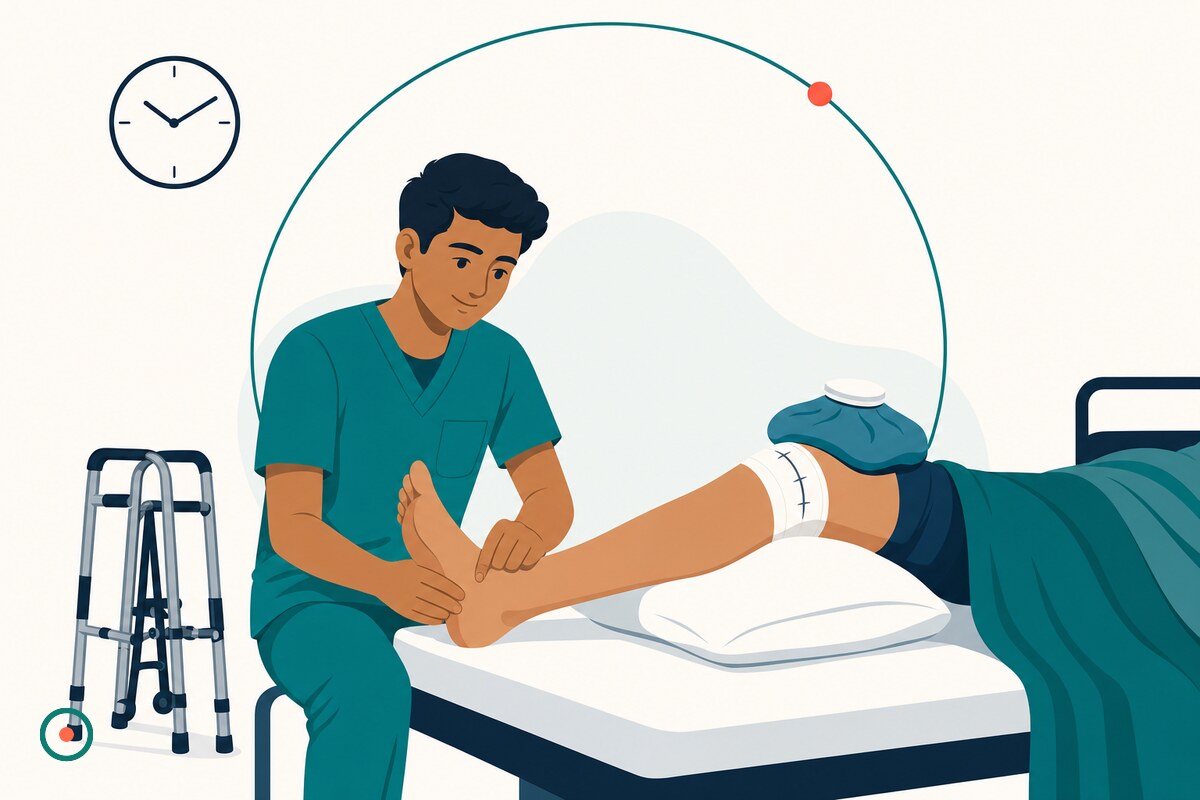
Orthopedic nurse interview questions test four things: can you do a neurovascular check and know which finding is an emergency, will you catch bleeding, a clot or compartment syndrome early, can you get a patient in pain out of bed safely, and can you teach a patient and family enough to go home on day one or two. Ortho managers know a new grad has never run a joint-replacement assignment. They’re listening for whether you assess before you medicate, take pain seriously as a sign and not just a number, and call the surgeon’s team without waiting.
Below are the orthopedic nurse interview questions ortho floor and joint-center panels actually ask, each with a copy-ready sample answer, plus the post-op scenarios most online lists skip. For the full panel across specialties, start with our nursing interview questions hub.
Quick honesty check: “ortho” covers very different units. An elective joint center is mostly planned hip and knee replacements and spine cases with fast discharges. A trauma ortho floor is hip fractures in older adults, long-bone fractures after accidents, external fixators and traction. Read the posting and ask which kind of unit it is. That question alone shows you understand the job.
What does an orthopedic nurse do?
An orthopedic RN on an inpatient unit cares for patients before and after bone, joint, spine and soft-tissue surgery, and for patients with fractures who may or may not go to the OR. A typical shift includes:
- Neurovascular checks on the operative or injured limb: pain, color, warmth, capillary refill, pulses, sensation and movement, compared with the other side.
- Pain management with a mix of scheduled medications, PRN opioids, nerve blocks or PCA, ice and positioning, timed around therapy.
- Early mobility with physical therapy: getting patients up the day of surgery or the next morning, with the right weight-bearing status and assistive device.
- Preventing complications: bleeding, blood clots, infection, constipation and urinary retention, pneumonia, falls and delirium.
- Teaching: hip precautions, anticoagulant injections, incision care, the signs that mean “call us,” and how to use a walker at home.
- Coordinating discharge with case management and therapy, often within one to three days of a joint replacement.
How is ortho different from a general med-surg job?
Panels ask this to see whether you’ve thought about the unit. Ortho is still med-surg, so prioritization and time management matter the same way. The difference is that your patients are mostly surgical, they hurt, and the most dangerous problems show up in the limb before they show up in the vital signs. You’ll do a lot of neurovascular assessment, a lot of mobility and a lot of teaching, and many patients are older adults with heart disease, diabetes or dementia, so a “simple” hip replacement can turn medical fast. If you’re comparing units, our med-surg nurse interview questions and rehab nurse interview questions cover the two jobs ortho nurses most often move between.
How do I prepare for an orthopedic nurse interview?
- Find out the case mix. Elective joints, spine, trauma, or all three? How many patients per nurse on days and nights?
- Review the neurovascular check and the early sign of compartment syndrome: pain out of proportion to the injury, worse with passive stretch of the muscle.
- Know the big post-op complications: bleeding and a falling hemoglobin, DVT and PE, fat embolism after long-bone fractures, infection, delirium and falls.
- Know hip precautions for a posterior approach, and that the surgeon’s order sets the rules.
- Prepare three stories: a time you noticed a small change, a time you helped a patient in pain do something hard, and a time you taught a patient or family member.
- Be ready to explain “why ortho.” Have a real reason, not “it’s what’s hiring.”
What are the most common orthopedic nurse interview questions and answers?
”Why do you want to work in orthopedics?”
Sample answer: “On my med-surg clinical rotation I had a patient two days after a hip replacement who was scared to stand. We worked with PT, timed her pain medication before therapy, and by the end of my shift she walked to the door with her walker and cried because she hadn’t done that without pain in two years. I liked seeing a patient’s function come back that fast. I also want a first job that builds strong post-op assessment and teaching skills, and ortho gives me both. I know the patients are often older and medically complex, and I’d rather learn that with a good orientation here than avoid it.”
Why it works: a specific patient, an honest reason, and it shows you know ortho is more than healthy knees.
”Walk me through a neurovascular assessment.”
Sample answer: “I compare the operative limb to the other side every time. I ask about pain, including whether it’s getting worse or feels different, and whether it hurts more when I gently move the toes or fingers. I look at color and feel temperature, check capillary refill and the distal pulses, then ask about numbness or tingling and have the patient move the toes or fingers. I check that the dressing, splint or cast isn’t too tight. I document it so the next nurse can see the trend, and I check as often as the order or unit policy says, which is usually more often in the first 24 hours. If anything is new or worse than last time, I don’t just chart it, I tell the surgeon’s team.”
Why it works: it’s in order, it compares sides, and it ends with action, not documentation.
”How do you manage pain for a patient after joint replacement?”
Sample answer: “I’d start by finding out what’s ordered and what the patient expects, because many ortho patients get a mix of scheduled non-opioids, a nerve block and PRN opioids. I’d assess the pain with the scale the patient understands, and also look at what it stops them doing, like standing with PT. I’d time PRN medication so it’s working before therapy, and use ice, elevation and positioning. After opioids I’d watch sedation and breathing, especially in older patients or anyone with sleep apnea, and stay on top of bowels because constipation sets in fast. And if pain is much worse than I’d expect or not responding to medication, I’d assess the limb before I give more, because that can be a complication, not just pain."
"How would you help a patient who doesn’t want to get out of bed?”
Sample answer: “I’d find out why first. Often it’s pain, fear of falling, nausea or feeling dizzy. I’d treat what I can, explain in simple words that getting up early lowers the risk of clots and pneumonia and helps them go home sooner, and check their weight-bearing status and precautions before we start. I’d get them up with PT or a second person, dangle first, check for dizziness, and use the walker and gait belt. I’d set one small goal, like the chair or the bathroom, and celebrate it. If they still refuse, I’d document it, try again later, and tell PT and the provider."
"How do you teach a patient going home on anticoagulants?”
Sample answer: “I’d teach in short pieces, starting the day before discharge if I can, and include the person who’ll be helping at home. I’d cover why they take it, the dose and timing, how to give an injection if it’s one, and the bleeding signs to watch for, like blood in urine or stool or bruising that keeps spreading. I’d also teach the clot signs, like a swollen, painful calf or sudden shortness of breath, and when to call 911. Then I’d use teach-back: I’d ask them to show me the injection and tell me in their own words when they’d call. If they can’t, we’re not done."
"Tell me about a time you advocated for a patient.”
Sample answer (STAR): “On clinical, my patient was an older man one day after a hip fracture repair. In the afternoon he was suddenly pulling at his IV and didn’t know where he was, which his daughter said wasn’t like him. Staff thought it was ‘sundowning.’ I checked his vitals and his oxygen, which had dropped to 90 percent on room air, and I asked my preceptor to look with me. She called the provider with SBAR, and they ordered labs and a chest X-ray. He turned out to have a urinary infection and early pneumonia. I learned that new confusion is a finding, not a personality, and that a daughter who says ‘this isn’t him’ is usually right.”
For more structure on these, see our nursing behavioral interview questions.
What scenario questions do orthopedic nurse interviews ask?
These are where new grads lose points, because the safe answer is in the order, not just the content. Answer out loud: what I see, what worries me, what I do first, and who I tell.
”Your patient with a casted tibia fracture says the pain is getting worse even after his opioid. What do you do?”
Sample answer: “I’d go see him right away instead of giving more medication. Pain out of proportion to the injury that isn’t relieved by opioids is the earliest sign of compartment syndrome, and it gets worse when you gently stretch the muscle, so I’d check whether moving his toes increases the pain. I’d do a full neurovascular check and compare with the other leg. I wouldn’t wait for numbness, a cold foot or a missing pulse, because those are late signs. I’d keep the leg at heart level rather than raising it high, loosen anything constrictive I’m allowed to, like the elastic wrap, and call the ortho team immediately with SBAR: ‘This is the nurse for Mr. R, day 1 after a tibia fracture, casted. His pain is a 9 and rising despite IV morphine an hour ago, it’s worse with passive toe movement, and his calf feels tight. I’m concerned about compartment syndrome and I need you to see him now.’ Then I’d stay with him, keep checking, and tell my charge nurse.”
Why it works: it names the condition, the early versus late signs, and doesn’t leave the bedside to chart. Compartment syndrome is a surgical emergency, often treated with a fasciotomy, so the call is the most important step.
”Post-op day one after a knee replacement, your patient’s hemoglobin dropped from 11.8 to 8.1 and she’s lightheaded. What do you do?”
Sample answer: “I’d see her first: vital signs, including whether her heart rate is up or her blood pressure is down, how she looks, and her dressing and drain for active bleeding. I’d lay her down, keep her in bed and make sure she has fall precautions on, and check her IV access. I’d look at whether she’s on an anticoagulant and when the next dose is due, and I wouldn’t give it until I’ve talked to the provider. Then I’d call with SBAR, give the trend and her symptoms, and ask whether they want a repeat level, fluids, a transfusion, or to hold the anticoagulant. If her pressure drops or she becomes confused, I’d call a rapid response."
"A patient two days after hip surgery suddenly says he can’t breathe and feels anxious. His oxygen saturation is 88 percent.”
Sample answer: “I’d stay with him, raise the head of the bed, put on oxygen per protocol and call for help, including a rapid response if that’s our policy for sudden shortness of breath. After hip or knee surgery I’d be thinking about a pulmonary embolism first. I’d get full vitals, listen to his lungs, ask about chest pain and look at his legs for a swollen calf. If he has a long-bone fracture, like a femur, I’d also think of fat embolism, which usually shows up 24 to 72 hours after the injury with low oxygen, confusion and sometimes a pinpoint rash on the chest, neck or armpits. Either way, my job is the same: oxygen, help, a clear SBAR, and not leaving him alone."
"Your patient after a posterior hip replacement is trying to get out of bed by herself and crossing her legs.”
Sample answer: “I’d stop her gently and help her back to a safe position first, because after a posterior approach the risk is dislocation, and the main precautions are no bending the hip past 90 degrees, no crossing the legs and no turning the knee and foot inward. I’d check the hip for new pain, a shortened or rotated leg, or a change in her neurovascular check. Then I’d find out why she was getting up, often it’s the bathroom, and make sure the call light is close and she has a bed alarm if she’s at risk. I’d re-teach the precautions in plain words and use the abduction pillow if it’s ordered. The surgeon’s order decides the exact precautions, because some approaches have different ones."
"Two patients need you at once: one has a new fever of 101.3 two days after spine surgery, and the other is a post-op patient asking for pain medication before PT.”
Sample answer: “I’d see the fever first, because it could be an infection, a pneumonia or a clot, and it needs an assessment and a call, while the pain medication request is real but not dangerous to delay a few minutes. I’d tell the second patient I’ll be there shortly, or ask a teammate or my charge nurse if they can help, and let PT know therapy may start a little later. For the fever, I’d get full vitals, look at the incision and drain, listen to the lungs, check the legs and urine, and call the provider with SBAR. Then I’d go straight to the pain medication.”
For more scenario practice across units, see nursing interview questions and answers scenarios.
Can a new graduate work in orthopedics?
Yes. Many hospitals hire new grads onto ortho and ortho/neuro units, often through a nurse residency program, because the unit teaches strong post-op assessment and time management. What helps most:
- A clinical rotation or capstone on a surgical unit, even if it wasn’t ortho. Talk about the post-op patients you cared for.
- Skills you can describe honestly: post-op assessment, safe patient handling, wound and drain care, SCDs, incentive spirometry, teaching.
- Patience with older adults. Hip fracture patients are often in their 80s and many get confused after surgery. Show you know that.
- A realistic picture of the work. Ortho is physical: turning, transferring and walking patients all shift.
If you’re comparing first jobs, our new grad nurse interview questions cover what every unit asks, and nurse residency interview questions help if ortho is one of your residency choices.
The orthopaedic nursing certification (ONC®) from the Orthopaedic Nurses Certification Board isn’t for new grads. It requires two full years as an RN and at least 1,000 hours of orthopaedic nursing in the past three years. Saying you’d like to work toward it in a few years is a good answer to “where do you see yourself.”
What questions should you ask in an orthopedic interview?
- “What’s the case mix here: elective joints, spine, trauma, or a combination?”
- “How long is orientation, and will I have the same preceptor most shifts?”
- “What’s the patient ratio on days and on nights?”
- “How do nurses and PT share mobility here? Do nurses get patients up on their own?”
- “What lift equipment does the unit have?”
- “What do your strongest new grads do in their first six months?”
More ideas: questions to ask the interviewer in a nursing interview.
Mistakes that weaken an orthopedic interview answer
- Treating rising pain as “just pain.” In ortho, pain that’s out of proportion is an assessment finding. Assess the limb before you give more medication.
- Waiting for a missing pulse. A pulse can still be there in compartment syndrome. Pain, especially with passive stretch, comes first.
- Raising a limb with suspected compartment syndrome high above the heart. Keep it at heart level and call.
- Skipping the surgeon’s order. Weight-bearing status and hip precautions come from the order, not from memory.
- Calling new confusion in an older patient “sundowning.” Check oxygen, vitals, pain, bladder and infection first.
- Giving answers with no “who I tell.” Every scenario answer should end with a call, a hand-off or an escalation.
How to prepare for orthopedic nurse interview questions in one evening
- Practice one neurovascular check out loud, start to finish, in under a minute.
- Write SBAR for two calls: possible compartment syndrome and a falling hemoglobin.
- Learn posterior hip precautions well enough to teach them in plain words.
- Prepare your “why ortho” with a real patient in it.
- Write two questions about orientation and the case mix.
For behavioral structure, see nursing behavioral interview questions, and polish your opener with tell me about yourself in a nursing interview.
Orthopedic nurse interview FAQ
Is ortho a good first job for a new grad?
It can be, if orientation is real and the unit has enough staff and lift equipment. It builds post-op assessment, mobility and teaching skills that transfer to almost any unit.
Who interviews you for an ortho nurse job?
Usually the unit manager, often with a charge nurse or a staff nurse, and sometimes an educator. Joint centers may also include a nurse navigator.
Will they ask clinical questions?
Usually two or three scenarios: rising pain in a casted limb, bleeding or a falling hemoglobin, sudden shortness of breath, a fall risk. Answer in order and name who you’d call.
Do I need to know specific surgeries?
Know the basics: total hip and knee replacement, hip fracture repair, spinal fusion and fracture fixation. You don’t need surgical details, but you should know what to watch for after each.
Practice saying the scenario out loud
Reading a good compartment syndrome answer is one skill. Saying it calmly, in order, while a charge nurse waits for the point is another. The candidates who do well have practiced the same pattern until it’s automatic: “here’s what I see, here’s what worries me, here’s what I do first, and here’s who I tell.” Pick two scenarios tonight and say them out loud, timed.
“Walk me through a neurovascular assessment”
You just read a strong answer to that. Saying one to three people who are deciding whether to hire you is a different skill — Roundly asks this exact question in a mock Orthopedic panel, listens, and scores the clinical reasoning underneath.
Answer this one out loud →You've read the answers. Now say one out loud.
Reading a sample answer and delivering it to a panel that's deciding whether to hire you are two different skills. Roundly runs a mock Orthopedic panel that asks these exact questions, listens to your answer, and scores your clinical reasoning and structure — not just how confident you sounded.
Start a mock Orthopedic panelTakes about two minutes to set up. Finish 15 panels without an offer and we refund you.