PACU Nurse Interview Questions (2026): Copy-Ready Sample Answers
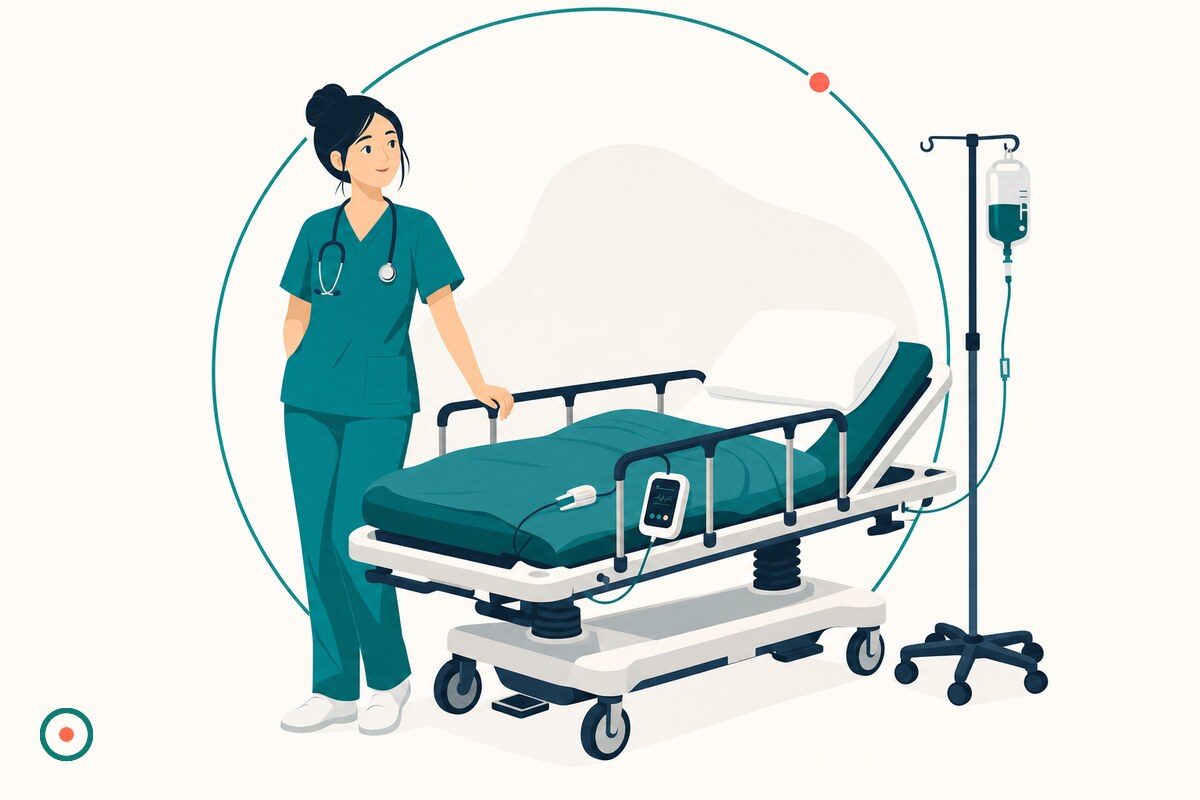
PACU (post-anesthesia care unit / recovery room) interviews test four things: can you recognize a deteriorating airway fast, prioritize when two patients roll in at once, advocate calmly for a confused or panicking patient, and work shoulder-to-shoulder with anesthesia and surgeons. Panels lean heavily on clinical scenarios — and they’re scoring your reasoning out loud, not a memorized protocol.
Below are the questions PACU panels actually ask, each with a copy-ready sample answer — including the airway, hemodynamic, sedation, and emergence-delirium scenarios that decide most recovery-room interviews. New grad or no PACU experience? There’s a dedicated section for you. Want it on one page? Grab our nursing interview cheat sheet.
What should you know for a PACU nurse interview?
Be fluent in the vocabulary the panel will use so your answers sound like a recovery nurse, not a textbook.
Aldrete / Phase 1 vs Phase 2 — memorize this:
- Aldrete score — discharge-readiness (0–2 each for activity, respiration, circulation, consciousness, and O2 saturation; 10 = ideal). Drop it naturally: “I wouldn’t transfer until the Aldrete supports it — airway protected, sats stable on room air or baseline O2, hemodynamically stable, and arousable.”
- Phase 1 — immediate intensive recovery: 1:1 or 1:2, continuous monitoring, airway and hemodynamic emergencies happen here.
- Phase 2 — step-down toward discharge: teaching, ambulation, PONV control, ride-home readiness.
- Bread-and-butter risks: post-extubation airway obstruction/laryngospasm, hypoventilation from residual anesthesia or opioids, hypo/hypertension, arrhythmias, PONV, emergence delirium, hypothermia/shivering, pain vs. over-sedation.
- Name these tools: EtCO2, pulse ox, jaw thrust/chin lift, oral/nasal airway, naloxone, flumazenil, sugammadex/neostigmine context.
Also know the ASA hand-off / SBAR from anesthesia and OR, anesthesia-stat process, and the unit’s case mix. Carry SBAR (escalation), STAR (behavioral), and ABCs first into every answer — say the why at each step.
What are the most common PACU nurse interview questions and answers?
”What’s your experience receiving a hand-off from anesthesia and OR?”
“I treat the hand-off as the safest moment to catch problems early, so I want a structured report — procedure and any complications, anesthesia type, airway and extubation status, last meds and reversals, fluids and EBL, lines and drains, allergies, and the post-op plan including pain and PONV orders. I read back anything safety-critical and I lay eyes on the airway, monitor, and dressing before the OR team leaves. If something doesn’t add up, I ask before they walk away."
"Tell me about your monitoring experience — what are you watching in recovery?”
“Continuously: airway and respiratory effort, EtCO2 if available, SpO2, ECG rhythm, blood pressure, level of consciousness, and pain. I’m trending, not just glancing — a sat sliding from 99 to 92 with shallow breathing tells me residual sedation before the alarm does. I’m also watching the surgical site for bleeding, temperature for hypothermia, and nausea, because a vomiting patient with a borderline airway is an emergency."
"How do you manage post-op nausea and vomiting (PONV)?”
“Prevention first — I check what antiemetics they already got and their risk factors. If they’re nauseated I position them to protect the airway, give the ordered antiemetic, consider a second agent from a different class if it persists, keep suction ready, and watch for aspiration. I also treat pain and hypotension, since both drive nausea. And I escalate if it’s not controlled, because intractable PONV delays discharge and threatens the airway."
"Why should we hire you for PACU?”
“Because PACU rewards exactly what I’m good at — staying calm and systematic when a patient is most vulnerable, and catching the subtle change before it becomes a code. I work cleanly with anesthesia and surgeons, I communicate with SBAR, and I’m honest about asking for help fast rather than guessing. I’m here to build a long-term home in recovery, not pass through.”
Pre-script openers with our RN interview questions guide and strengths and weaknesses guide.
How do you answer “Why do you want to work in PACU?” (including as a new grad)
Give one genuine reason — and avoid making CRNA school your only motive.
Experienced nurse / ICU or ER transfer:
“I love the intensity of the immediate post-op window — that’s when small things move fast, and I’m at my best assessing, anticipating, and acting before a patient destabilizes. Coming from [ICU/ER], I’m used to airway, drips, and rapid changes, and I want to apply that to the recovery phase where vigilant 1:1 attention actually changes outcomes.”
Comparing units? See ICU nurse interview questions.
Answering “Why PACU?” as a new grad with no PACU experience
Don’t apologize. Translate clinicals into recovery-relevant strengths.
“I know PACU is usually an experienced-nurse unit, so I want to be upfront: I’m a new grad, and I’ve chosen this deliberately. In my med-surg and OR/peri-op rotations I was drawn to the post-op window — assessing airway and respiratory status, watching for bleeding and hemodynamic changes, managing pain and nausea, and using the Aldrete score to gauge readiness. I’m strong on the fundamentals PACU is built on: focused ABC assessment, SBAR communication, and recognizing a change early. I learn hands-on skills fast with a preceptor, and I’d rather ask one question early than miss something on a patient who can’t yet protect their own airway. I’m looking for a unit with a real orientation where I can grow into a long-term PACU nurse.”
Then ask about orientation. New to interviews overall? Start with new-grad RN interview questions.
What clinical scenario questions do PACU interviews ask?
This is where PACU interviews are won. ABCs first, then escalate with SBAR.
”Your patient’s O2 sat drops and they sound stridorous right after extubation. What do you do?”
Signature scenario — post-extubation obstruction or laryngospasm.
“Airway first. I’d stimulate the patient and tell them to take a deep breath, reposition the head with a jaw-thrust/chin-lift, and apply 100% O2 with a tight-seal mask, often with positive pressure. I’d suction if there are secretions. If I hear stridor with a worsening sat, I’m thinking laryngospasm — so I call for anesthesia immediately and stay at the bedside applying continuous positive pressure. I’d anticipate propofol to break the spasm, and if it doesn’t resolve, succinylcholine and possible re-intubation per anesthesia. SBAR: ‘Mr. X is two minutes post-extubation, stridorous, sat dropped to 86 despite jaw-thrust and 100% O2 with positive pressure — I need you now.’ My focus is opening that airway and getting anesthesia there before it becomes a code."
"A patient is hypotensive with tachycardia in recovery. Walk me through it.”
“I’d stay with the patient and run ABCs first, then think through the differential out loud. BP 80/45, HR 125 post-op — my top concerns are hemorrhage and hypovolemia, then residual anesthesia/vasodilation, pain, and less commonly cardiac or anaphylaxis. I’d check the surgical site and drains for active bleeding, assess mental status and skin, recheck the BP on the other arm, raise the legs, ensure a patent IV, and increase fluids per protocol. Then SBAR: ‘Bed 3 is one hour post-op lap chole, BP 80/45, HR 125, dressing’s saturating — I’m concerned about bleeding, I’ve got fluids running and the legs up, I need you to assess and I’d anticipate a type and screen and labs.’ I keep reassessing and escalate to rapid response if she’s not responding to fluids."
"How do you balance post-op pain control against over-sedation?”
“I treat it as a safety problem, not just a comfort one. I assess pain and respiratory status together — rate, depth, EtCO2 if available, and sedation level using POSS or RASS. I titrate opioids in small increments and reassess before redosing, use multimodal analgesia when ordered, and never chase a pain score by pushing a sedated patient into respiratory depression. If respirations drop or they’re hard to arouse, I stop, stimulate, support the airway and oxygenate, and have naloxone ready. A comfortable patient who’s hypoventilating is not a stable patient."
"A patient wakes up agitated and combative — emergence delirium. What’s your approach?”
“Safety first — for the patient and for me. I’d protect the airway and lines, prevent self-harm and falls, and stay calm with a low, reassuring voice and reorientation. Then I rule out treatable causes immediately, because agitation in PACU is hypoxia until proven otherwise — so I check the sat and airway, then pain, full bladder, and hypothermia. I’d get extra hands rather than restrain reflexively, keep family informed if appropriate, and notify anesthesia. Most emergence delirium is self-limiting; my job is to keep them safe and rule out hypoxia or pain while it resolves."
"Two fresh post-op patients arrive at the same time. How do you prioritize?”
“ABCs and acuity, out loud. I take the patient with the bigger airway or hemodynamic threat first — the one who’s harder to arouse, hypoxic, or unstable beats the awake, stable one. I’d get a fast safety snapshot on both, delegate what I safely can to a tech or charge, and tell the team I’ve got two fresh recoveries and may need a hand. I never leave an unprotected airway to chart on a stable patient.”
What behavioral STAR answers work in a PACU interview?
”Tell me about a time you stayed calm under pressure.”
“Situation: Two post-op patients needed attention at once — one nauseated and desatting, one stable but yelling in pain. Task: Keep both safe. Action: I stayed at the desatting patient’s airway, called for help for the pain patient, applied oxygen and a jaw thrust, and gave a clear SBAR to my preceptor. Result: Sats recovered, the pain patient got timely meds from a teammate — asking early was the right call. That’s the reflex I’d bring to Phase 1."
"Tell me about a time you advocated for a patient.”
“Situation: A patient was cleared for discharge on paper but still sleepy, nauseated, and had no responsible adult at the bedside. Task: Protect a safe discharge. Action: I used SBAR with the provider — residual sedation, PONV, no ride-home support — and asked to hold until Aldrete and ride-home criteria were met. Result: They stayed longer, got another antiemetic, and went home safely with family."
"Tell me about a mistake or a time something went wrong.”
“During a clinical I charted a med as given but realized I hadn’t scanned it. I told my preceptor immediately, we verified the patient was fine, and I filed the report. Speaking up about your own error fast is the safe thing — exactly the instinct PACU needs.”
What are the 6 C’s in a nursing interview?
A common framing: Care, Compassion, Competence, Communication, Courage, and Commitment. Some panels use 5 C’s: Confidence, Communication, Competence, Character, Culture-fit. In PACU, courage is advocating for an airway you’re worried about; competence is ABC assessment; communication is clean SBAR to anesthesia.
What are the hardest PACU interview questions?
Open-ended scenarios (above) plus the hard five: tell me about yourself, why hire you, biggest weakness, a mistake (STAR above), and where in 5 years — growing as a PACU nurse, ideally precepting; tie it to staying.
What is the best answer for your 3 weaknesses?
Real but non-disqualifying — never “I’m a perfectionist”:
“Three honest ones: I used to take on too much rather than delegate, so I ask charge for help early when recoveries stack up. I can be quiet in a big group, so I deliberately speak up in handoffs. And as I’m newer to high-acuity recovery, I over-prepare — I review the day’s specialty cases and reversal agents before my shift.”
Build them properly with our strengths and weaknesses nursing interview guide.
What questions should you ask the PACU panel?
Pick three to four:
- “What’s the nurse-to-patient ratio in Phase 1 versus Phase 2?”
- “How is the unit structured between Phase 1 and Phase 2, and what’s the typical case mix?”
- “What does orientation look like for a nurse transitioning into PACU” (or as a new grad: “…without PACU experience — how long, dedicated preceptor?”)
- “How does the on-call structure work, and what’s the expected response time?”
- “What’s the anesthesia-stat process and response time for airway emergencies?”
- “What does success look like in the first 6 to 12 months?”
More ideas: questions to ask the interviewer. Send a thank-you within 24 hours, and dress the part with what to wear to a nursing interview.
A note on “recovery room nurse” questions
Recovery room nurse or post-anesthesia nurse is the same role and interview — airway, hemodynamics, pain vs. sedation, emergence delirium, and prioritization are exactly what you’ll be asked.
How to actually practice
PACU scenarios sink candidates because they freeze saying answers out loud. The fix is reps: speak your SBAR and ABC answers aloud until the reasoning and order are automatic.
That’s what Roundly does — realistic mock PACU panels that ask these clinical and behavioral questions and score your clinical reasoning, SBAR structure, prioritization, and delivery, built with real nurse recruiters and hiring managers. Practice your PACU panel out loud →
“Tell me about a time you stayed calm under pressure”
You just read a strong answer to that. Saying one to three people who are deciding whether to hire you is a different skill — Roundly asks this exact question in a mock PACU panel, listens, and scores the clinical reasoning underneath.
Answer this one out loud →You've read the answers. Now say one out loud.
Reading a sample answer and delivering it to a panel that's deciding whether to hire you are two different skills. Roundly runs a mock PACU panel that asks these exact questions, listens to your answer, and scores your clinical reasoning and structure — not just how confident you sounded.
Start a mock PACU panelTakes about two minutes to set up. Finish 15 panels without an offer and we refund you.