VA Nurse Interview Questions (2026): New-Grad Sample Answers
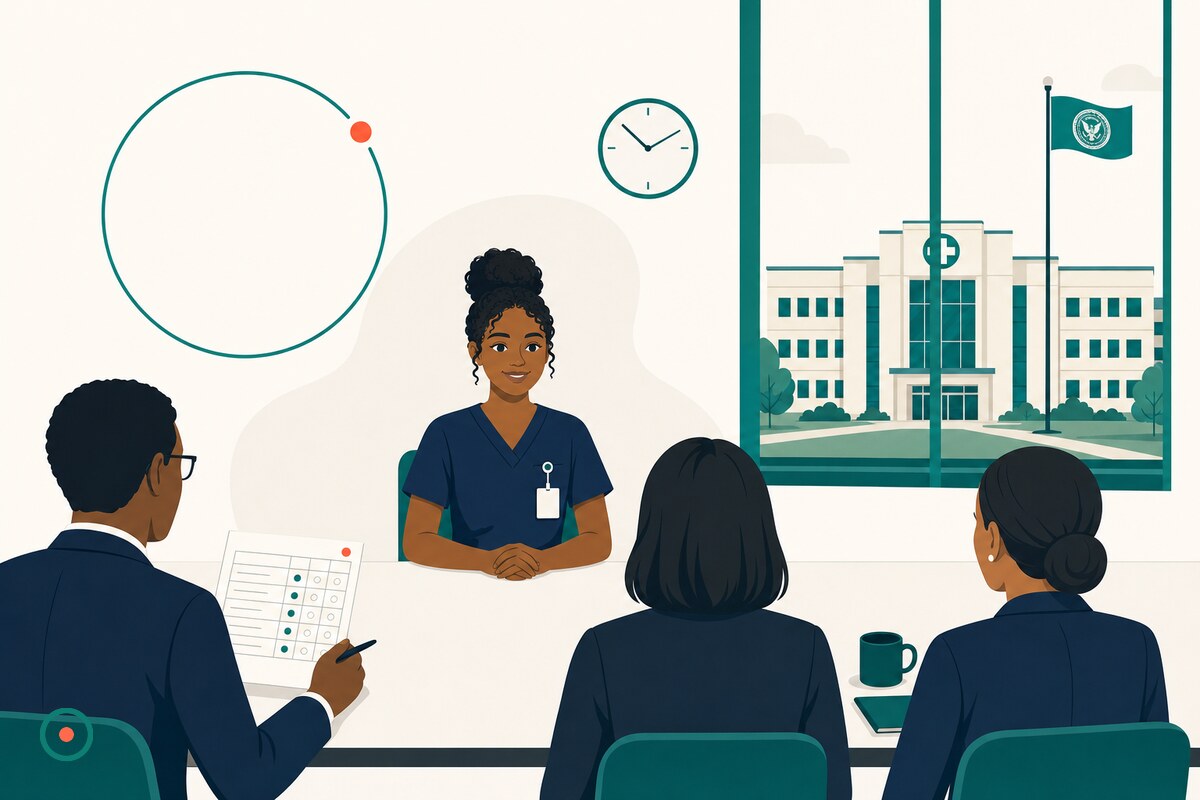
A VA nurse interview is a performance-based interview (PBI): a panel of usually two to five nurse leaders asks every candidate the same structured questions and scores each answer. Most questions are behavioral (“Describe a time when…”) and some are situational (“What would you do if…?”). Expect “Why do you want to work at the VA?”, a time you dealt with an upset patient or family member, a conflict with a coworker, a mistake you made and how you prioritize. Answer every one in STAR format, and don’t skip the result: it’s where candidates lose points.
This guide covers the two ways new grads get hired at the VA, how the interview is scored, sample answers built on VA’s I CARE values, and clinical scenarios with SBAR.
Does the VA hire new-grad RNs?
Yes, through two different routes. Know which one you applied to, because the questions about “why this program” differ.
1. Post-Baccalaureate RN Residency (PB-RNR). A 12-month residency for new BSN grads, offered at many (not all) VA medical centers. What the 2026–2027 program pages ask for:
- A BSN or entry-level MSN from a CCNE- or ACEN-accredited program, graduated within the past 12 months (or graduating soon).
- No prior RN work experience: this must be your first RN role.
- A cumulative nursing GPA of 3.0 or higher.
- U.S. citizenship, and a current, unrestricted RN license by the start date (VA San Diego asks for it 30 days before).
- A commitment to finish the full year.
Residents are paid a stipend as health professions trainees, rotate through several units with preceptors and protected learning time, and have no obligation to stay at the VA afterwards. Cohorts are small. VA San Diego takes 8 residents a year and VA Salt Lake City 10, in spring and fall groups, so expect competition. Each facility runs its own application and deadlines. Some ask for a packet with a cover letter explaining why you want to work with Veterans and your top three clinical interests.
2. RN Transition-to-Practice (RNTTP). A 12-month program for nurses in their first RN role or with less than one year of RN experience. It’s open to ADN, diploma, BSN and MSN grads from CCNE- or ACEN-accredited programs. You’re hired as a regular VA employee (a Title 38 Nurse I) onto one home unit with a preceptor and a mentor. RNTTP jobs are posted on USAJOBS, usually titled “Registered Nurse – Transition to Practice”, and availability varies by facility.
Two details new grads often miss. Your RN license can be from any U.S. state, territory or D.C., not necessarily the state you’ll work in. And if you haven’t passed NCLEX yet, some postings allow a temporary Graduate Nurse Technician appointment while you get licensed.
How does the VA hiring process work for nurses?
For an RNTTP or staff RN job on USAJOBS:
- Apply on USAJOBS with a resume and the occupational questionnaire. Title 38 nursing jobs accept a long-form resume or CV, so list your clinical rotations, capstone, hours and any CNA or tech work in detail. One 2026 posting says it plainly: “We may not make assumptions regarding your experience.”
- Qualification review and referral. After the posting closes, HR checks eligibility and sends a referral list to the hiring manager. You’ll get an email saying whether you were referred.
- Panel interview. The unit contacts referred candidates directly. In person or by video.
- Tentative job offer (TJO), then background check, fingerprints, a pre-employment physical and a drug screen.
- Final offer with a start date. Your grade and step are set from your education and experience (an ADN starts at Nurse I Level 1, a BSN at Level 2).
The VA is slower than private hospitals. One nurse posted her 2025–2026 timeline on Reddit: applied in mid-September, interviewed in early October, tentative offer in early November, start date in March. Others report two to seven months between offer and first day. Keep applying elsewhere until you have a final offer.
How is a VA nursing interview scored?
This is what makes the VA different from most hospitals, and almost no prep guide explains it.
VA Careers says PBI questions are tied to the competencies in the job announcement, and every candidate gets identical questions and the same rating process. Candidates on Reddit describe about five questions, with each panelist scoring each answer on a scale (often 1 to 5). The scores are added up, and education, Veterans’ preference and relevant experience can also factor in.
What that means for you:
- Say everything out loud. Everyone gets the same questions, and the panel scores what you actually said. If you leave a step out, they can’t give you credit for it.
- The result counts. One commenter on r/usajobs said interviewers told her the biggest reason people score low is leaving out the result, the “R” in STAR.
- Read the posting first. VA says the competencies listed there “will likely guide the interview questions”. The ones it cites most often are customer service, communication, attention to detail, interpersonal skills and problem solving.
- Use “I”, not “we”. VA’s own guidance asks for first-person statements so the panel knows what you did.
- It’s fine to pause. Take a few seconds, or ask them to repeat the question. A structured answer beats a fast one.
What questions does the VA ask new-grad nurses?
From VA Careers examples and candidate reports on Reddit, Indeed and Quizlet:
- Why do you want to work for the VA? Why with Veterans?
- Tell us about a time you dealt with an upset patient, family member or coworker. What did you do, and what was the outcome?
- A family member has questions about the care their loved one received. How would you handle it?
- Describe a time you did not communicate well with a coworker or supervisor. How did you fix it?
- Tell us about a time you had to give a supervisor bad news.
- Describe a mistake you made. What did you learn?
- How do you prioritize when several patients need you at once?
- Describe a time a patient’s condition changed. What steps did you take?
- Tell us about a time you disagreed with a team member.
- How do you manage stress during a hard shift?
Some panels add a clinical scenario or a medication question, especially for acute care units. Others, by candidates’ accounts, ask none. Prepare for both.
Sample answers built on the VA’s I CARE values
VA’s core values are Integrity, Commitment, Advocacy, Respect and Excellence (“I CARE”). They’re written into federal regulation, and most VA questions map onto one of them. Use these answers for structure, not as scripts, and replace the details with your own clinicals.
”Why do you want to work for the VA?”
This is the question candidates call the most important. Be specific: a real connection to Veterans, plus something concrete about the program.
“My grandfather was a Vietnam Veteran and got his care at the VA, and I saw how much it mattered to him that his nurses understood where he’d been. During my community health rotation, I also did screenings at a Veterans’ outreach event, and I learned how often things like hearing loss, chronic pain and PTSD sit behind a simple visit. I want to start my career in a system built entirely around that population. I’m also drawn to the Transition-to-Practice program because it puts me on one unit with a preceptor and a mentor for a full year, which is the support I want as a new nurse.”
No family connection? Say what you learned in clinicals, a volunteer role or military-adjacent work. Don’t invent one.
Integrity: “Tell us about a time you made a mistake.”
“Situation: In my med-surg clinical, I gave a patient his scheduled metoprolol and then realized I hadn’t checked his apical pulse first, which my unit required. Task: I needed to make sure he was safe and report it. Action: I checked his pulse and blood pressure right away. Both were within range. I told my instructor and the primary nurse immediately, and we documented it the way the unit required. Result: He was fine. Since then, I say each pre-check out loud at the med cart before I scan, and I haven’t missed one since. I’d rather report my own mistake in five minutes than have someone else find it later.”
Commitment: “Describe a time you went above what was expected.”
“Situation: An older patient on my capstone unit was being discharged on insulin for the first time and lived alone. Task: He needed to be safe giving it at home, and he was nervous. Action: I used teach-back over two shifts, had him draw up and give his own doses with me watching, and wrote a large-print sheet with his sliding scale and who to call. I also asked the case manager whether he qualified for a home health visit. Result: He gave his evening dose correctly without prompting before he left, and home health was scheduled for his first week.”
Advocacy: “Tell us about a time you spoke up for a patient.”
“Situation: During clinicals, a patient with a history of PTSD became agitated every time staff entered the room without knocking at night. Task: I wanted to reduce his distress without compromising his care. Action: I asked him what helped, and he said knowing who was coming in. I suggested to my preceptor that we knock, say our name and role before entering, and cluster his overnight checks. She agreed and added it to the care plan. Result: He slept for longer stretches over the next two nights and stopped refusing his 0400 vitals.”
Respect: “Describe a time you had a conflict with a coworker.”
“Situation: A tech on my unit kept taking vitals late on my patients, and my 0800 assessment was always delayed. Task: I needed the vitals on time without damaging the relationship. Action: I asked her privately what her morning looked like. She had 14 patients and started at the far end of the hall. We agreed she’d do my two highest-risk patients first and I’d take the others myself. Result: My vitals were on time for the rest of the rotation, and she started asking me to help with her heavy patients too.”
Excellence: “Tell us about a time you improved something.”
“Situation: On my clinical unit, we kept running out of supplies for wound care in the middle of the shift. Task: As a student, I couldn’t change the stocking system, but I could make it easier to see the problem. Action: I asked the charge nurse if I could keep a simple tally of what we ran out of for a week, then shared it at a huddle. Result: The unit added two items to the par level and moved the dressing kits closer to the rooms that used them most. It was small, but it saved nurses a trip to the supply room on almost every shift.”
More practice: nursing behavioral interview questions, tell me about yourself and strengths and weaknesses.
Clinical scenarios the VA may ask about
When the VA asks a situational question, it’s still scored, so use a clear order every time: keep the patient safe, assess, act, escalate, then report in SBAR. Two scenarios that fit the Veteran population well:
Scenario: a Veteran says he doesn’t see the point anymore
Suicide prevention is a top priority across VA, and nurses are often the first to hear it.
“I’d take it seriously and stay with him. I’d ask directly whether he’s thinking about killing himself and whether he has a plan, because asking doesn’t increase the risk. I’d follow the facility’s suicide risk screening process, remove anything he could use to harm himself, and make sure he isn’t left alone until he’s assessed. Then I’d notify the charge nurse and the provider right away and document his exact words. If he were an outpatient on the phone, I’d keep him on the line and connect him to the Veterans Crisis Line: dial 988 and press 1.”
Then the SBAR call:
Situation: “I’m calling about Mr. Hayes in room 3. He just told me he doesn’t see the point in going on. He says he’s thought about it but has no specific plan. I’m staying with him.”
Background: “He’s 58, admitted two days ago for a COPD exacerbation. He has a history of PTSD and depression, and his wife left last month.”
Assessment: “He’s calm but tearful. Vitals are stable. I’ve removed his belt and the cords in the room. I’m concerned about suicide risk.”
Recommendation: “Can you come assess him now? I’d like a mental health consult and orders for continuous observation until he’s evaluated.”
Scenario: alcohol withdrawal on a medical unit
“If a patient admitted for pneumonia becomes tremulous, sweaty and anxious on day two, with a heart rate of 118 and blood pressure of 162/96, I’d suspect alcohol withdrawal and ask when he last drank. I’d score him with the unit’s withdrawal tool, such as CIWA-Ar, check a glucose and put seizure precautions in place. I’d call the provider in SBAR with the score and vitals and expect orders for a symptom-triggered benzodiazepine, thiamine and fluids. Then I’d reassess on the schedule the protocol sets.”
Prioritization: who do you see first?
“First, the patient with new chest pain, because that can’t wait. Second, the patient whose oxygen saturation dropped to 88% on his usual 2 liters. Third, the 0900 IV antibiotic. Last, the discharge teaching for a stable patient. I’d ask the nursing assistant to take vitals on the stable patients while I assess the first two.”
For more practice, see situational nursing interview questions and our med-surg and psych guides.
How do you prepare for a VA nursing interview?
- Print the job announcement and highlight every competency it lists. Write one STAR story for each.
- Build five to seven flexible stories from clinicals, work and volunteering: a mistake, a conflict, an upset patient or family, a change in a patient’s condition, a time you spoke up, a time you improved something.
- Practice the result. End every answer with what happened and what you’d do the same or differently.
- Know the program you applied to: PB-RNR (rotations, trainee stipend, no service commitment) or RNTTP (one home unit, preceptor, mentor).
- Learn I CARE and the mission: “To fulfill President Lincoln’s promise to care for those who have served in our nation’s military and for their families, caregivers, and survivors.”
- Prepare your references. VA suggests telling them which competencies came up in the interview.
Dress business professional for in person and on video. See what to wear to a nursing interview. Applying to other systems too? Compare our Kaiser Permanente, Cleveland Clinic, Johns Hopkins and HCA guides, or the general nurse residency interview questions.
Is it hard to get hired at the VA as a new-grad nurse?
It can be. Residency cohorts are small and competitive, and RNTTP openings vary by facility and by year. Hiring also takes longer than at most hospitals. But the structured interview works in your favor: the questions are predictable, so preparation counts for more than at a hospital with a free-flowing interview. Apply to several facilities, check USAJOBS often, and set saved-search alerts for “Transition to Practice”.
Questions to ask at the end
VA Careers recommends coming with questions. Good ones for a new grad:
- What does a typical day look like for a new nurse on this unit?
- How long is orientation with a preceptor, and how are preceptors assigned?
- How is performance reviewed during the first year?
- What do you enjoy most about caring for Veterans here?
- Do you have any concerns about my experience that I can address?
- What are the next steps, and roughly how long does onboarding take?
More ideas: questions to ask the interviewer in a nursing interview.
Your VA nurse interview checklist
- Which program: PB-RNR (BSN or entry-level MSN, GPA 3.0, no prior RN experience) or RNTTP (ADN or BSN, less than a year of RN experience).
- A detailed resume that lists rotations, capstone and hours.
- A specific, honest “Why the VA?” answer.
- One STAR story for each I CARE value, each with a clear result.
- One or two clinical scenarios ending in an SBAR call.
- Three questions for the panel.
- A thank-you email to the panel within two days (templates here).
- Patience: plan for onboarding to take months.
Practice out loud before the panel
A VA panel reads the questions and scores what you say. There’s no back-and-forth to rescue a vague answer, which is why answers that sound fine in your head fall apart out loud, usually right before the result.
Roundly runs realistic mock nurse panels for new-grad RNs. You answer behavioral questions and clinical scenarios out loud, the panel asks follow-ups, and Roundly scores the clinical reasoning and structure of what you said, not just how smooth it sounded. It was built with nurse recruiters and hiring managers.
Practice a VA-style panel interview with Roundly →
“What questions does the VA ask new-grad nurses?”
A strong answer to this one is further down. Saying one to three people who are deciding whether to hire you is a different skill — Roundly asks this exact question in a mock VA panel, listens, and scores the clinical reasoning underneath.
Answer this one out loud →You've read the answers. Now say one out loud.
Reading a sample answer and delivering it to a panel that's deciding whether to hire you are two different skills. Roundly runs a mock VA panel that asks these exact questions, listens to your answer, and scores your clinical reasoning and structure — not just how confident you sounded.
Start a mock VA panelTakes about two minutes to set up. Finish 15 panels without an offer and we refund you.