DaVita RN Interview Questions (2026): Sample Answers
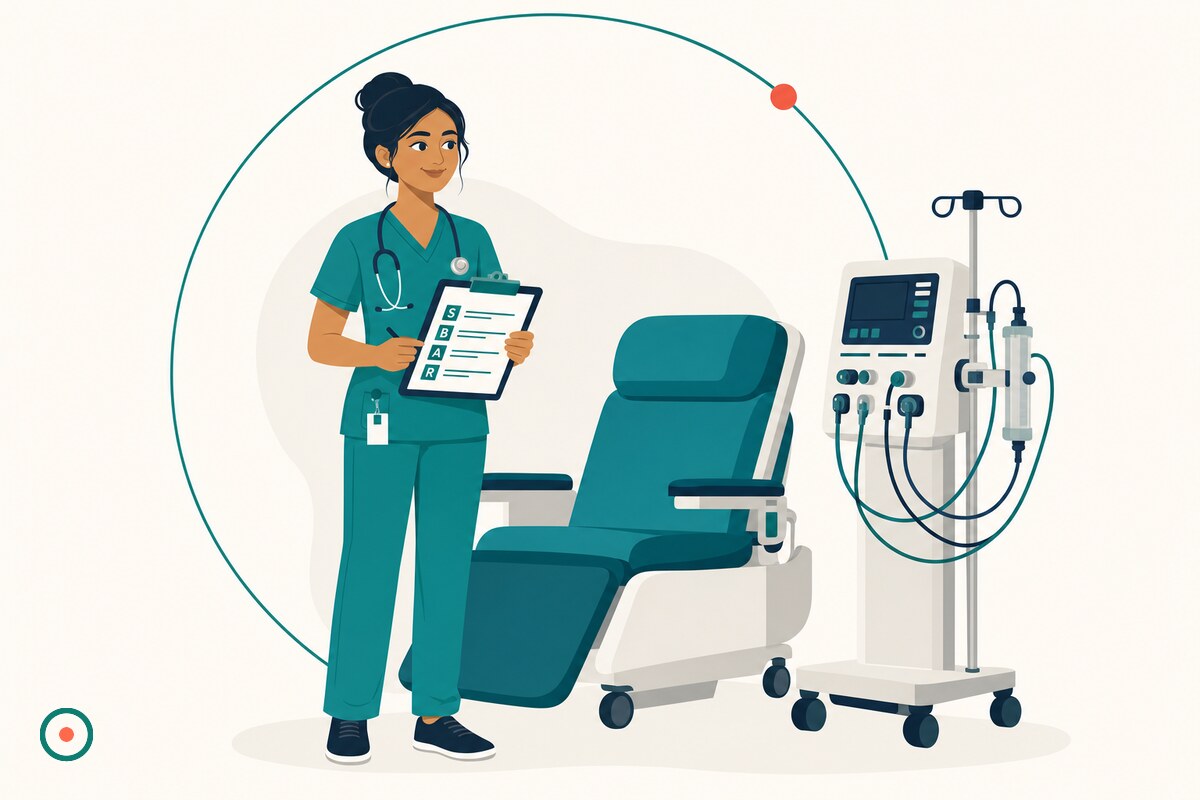
DaVita RN interviews test three things: do you fit their core values, can you keep a dialysis patient safe during treatment, and can you build long-term relationships with chronic patients. They lean heavily on core-values questions (“Why DaVita?”, your personal mission), behavioral STAR stories, and dialysis-specific clinical scenarios like intradialytic hypotension and clotted access.
Below are the questions DaVita panels actually ask, grouped into the five buckets they screen for — each with a full sample answer you can adapt. No dialysis experience? That’s fine: most DaVita new hires are trained in-house. We’ll show you how to turn “clinically ready but new to dialysis” into a strength.
Two frameworks to carry every answer
- STAR — Situation → Task → Action → Result. Use it for every behavioral question (“tell me about a time…”).
- SBAR — Situation → Background → Assessment → Recommendation. Use it for every clinical scenario; it shows structured reasoning, which is exactly what they’re scoring.
If you only memorize two things before the interview, make it these two.
What questions are asked at the DaVita nursing interview?
DaVita RN interviews (phone screen first, then a panel or one-on-one with the Facility Administrator and a Clinical Nurse Manager) draw from five buckets:
- Core values & fit — “Why DaVita?”, your personal mission, where you see yourself in 3–5 years.
- Behavioral & situational (STAR) — a major problem at work, delivering difficult news, your proudest accomplishment.
- Clinical & safety — handling intradialytic hypotension or clotting during treatment, prioritizing a busy clinic, patient education on fluid and diet.
- Teamwork & culture — low team morale, a colleague skipping protocol, early starts and long treatment days.
- Questions you ask them — patient-to-nurse ratio, the dialysis training program, a day in the life.
The rest of this guide fills every bucket with copy-ready answers.
What does the DaVita RN interview process look like?
Most candidates see a phone screen first (often with a recruiter or Facility Administrator), then an in-person or video panel with clinic leadership — typically the Facility Administrator and a Clinical Nurse Manager. Some clinics still use a short online assessment before the phone screen.
If you’re new to dialysis, ask about their paid training track (many clinics run a structured program for nurses who haven’t worked dialysis before — often called something like STAR / new-to-dialysis orientation). Training pay and length vary by clinic; get it in writing in the offer letter. The interview itself is less “prove you already run a chair” and more “prove you’ll learn safely, fit the Village, and stay.”
What are DaVita’s core values and how do they show up in the interview?
DaVita is famous for being values-first — they call their company “the Village” and frame care as the Trilogy of Care: caring for patients, each other, and the world. Their seven core values are:
- Service Excellence — serving patients and teammates first.
- Integrity — saying what you’ll do and doing what you say.
- Team — “one for all and all for one.”
- Continuous Improvement — always getting better.
- Accountability — owning your results.
- Fulfillment — meaningful work, not just a job.
- Fun — enjoying the people you work with.
Expect at least one question that maps directly to a value. The move is to name the value and prove it with a short STAR story.
”Tell me about a time you went above and beyond for a patient.” (Service Excellence)
“During my clinical rotation I had a patient who kept missing teaching about her low-sodium diet because she was overwhelmed and a little embarrassed to ask questions. So I stayed after my care was done, sat with her, and rewrote her diet sheet in plain language with examples from food she actually ate. I checked back the next shift and she’d already swapped two things on her own. That stuck with me — service excellence isn’t a grand gesture, it’s noticing what one person actually needs and following through."
"Give me an example of when you owned a mistake.” (Integrity / Accountability)
“Early in a clinical I charted a medication as given before I’d actually confirmed the second-nurse check on a high-alert drug. I caught it, told my preceptor immediately rather than quietly fixing it, and we verified the patient was safe. I’d rather flag my own error fast than let a small thing become a safety event. That’s the kind of nurse I want to be on a dialysis floor, where the margin for error is real.”
Read their values back to them in your own words and they’ll feel the fit immediately.
How do you prepare for a DaVita RN interview?
A focused prep plan that beats 90% of candidates:
- Learn the core values cold (the list above) and have one STAR story ready for each. This is the single biggest differentiator at DaVita.
- Write a 60-second “Why DaVita?” that names a value and connects it to chronic / relationship-based care. (See tell me about yourself for nursing.)
- Learn the dialysis basics so you can speak the language: a typical treatment runs ~3–4 hours, 3x/week; the access is an AV fistula, AV graft, or central catheter; the big intra-treatment risks are hypotension, cramping, clotting of the circuit/access, infection, and air embolism. You don’t need to be an expert — you need to show you understand the patient’s day.
- Script SBAR answers for the two scenarios below (hypotension, clotting) and say them out loud.
- Prepare 3–5 STAR stories flexible enough to cover problem-solving, conflict, difficult news, and proudest moment.
- Have 3 questions to ask them ready (see the last section).
- Reframe “no dialysis experience” into eagerness + teachability + chronic-care strength.
Want a one-page version to print? Use our nursing interview cheat sheet.
The “fit” questions: Why DaVita, your mission, 3–5 years
”Why DaVita?” (the question that anchors the whole interview)
A new-grad-honest version that names their actual values:
“Two reasons. First, the work itself — dialysis is relationship nursing. You see the same patients three times a week for years, so you genuinely get to know them and you can measure your impact over time. That’s the kind of nursing I want to do. Second, DaVita’s culture. The idea of a ‘Village’ and the Trilogy of Care — caring for patients, each other, and the community — matched what I was looking for, not just a job. I’m a new grad, so I’m clinically trained but new to dialysis specifically, and I was drawn to the fact that DaVita trains its nurses in-house. I want to learn this the right way, from people who do it well.”
Why it works: it names the values, shows you researched the company, and frames new-grad status as a reason you fit their training model — not a liability.
”What’s your personal mission statement?”
DaVita actually asks this. Keep it short and true:
“To give every patient the kind of care I’d want for my own family — competent, honest, and patient enough to meet them where they are."
"Where do you see yourself in 3–5 years?”
“Becoming a strong, independent dialysis nurse — confident running a full patient load, comfortable with access and complications, and the kind of teammate newer nurses can lean on. Longer term I’d love to grow into a charge or preceptor role here. I’m looking to build, not pass through.”
Avoid “using this as a stepping stone.” DaVita invests heavily in training and wants nurses who’ll stay.
Behavioral & situational questions (use STAR)
“Tell me about a major problem you faced at work and how you handled it.”
“(Situation) On a clinical, our unit was short-staffed and a patient’s discharge teaching kept getting pushed. (Task) I was responsible for making sure he understood his meds before he left. (Action) Instead of waiting for a perfect window, I broke the teaching into two short visits during med passes, used teach-back, and flagged to charge that he wasn’t ready yet so discharge held. (Result) He left able to repeat his regimen correctly, and my preceptor adopted the split-teaching approach when we’re slammed. I learned to solve the problem in the time I actually have, not the time I wish I had."
"Tell me about a time you had to deliver difficult news.”
In dialysis you’ll do versions of this constantly (a clotted fistula, a tough lab trend, missed treatments).
“A patient I cared for got a discouraging diagnosis update during my shift. (Action) After the provider spoke with him, I stayed, let him sit with it, answered his questions honestly without minimizing, and got him connected with social work and his family. (Result) He told me later that having someone just stay in the room mattered more than anything that was said. I learned that delivering hard news is mostly about presence and honesty, not having the perfect words."
"How would you handle a difficult patient or family member?”
Dialysis relationships run for years — conflict is inevitable. Answer with calm + curiosity, not control:
“(Situation) A patient’s daughter was upset that her mom’s treatment start was delayed and raised her voice at the desk. (Task) Keep the patient safe and de-escalate without arguing. (Action) I stepped aside with her, let her finish, acknowledged the wait, explained what was happening in plain language, and offered what I could control — a status update and a warm blanket for mom while we finished the prior chair. I looped charge so leadership knew. (Result) She calmed down, apologized, and stayed for the rest of treatment. Hard conversations get easier when people feel heard before they feel managed."
"What’s your proudest accomplishment as a nurse / nursing student?”
Pick something that shows persistence or patient impact, not a grade. Tie it to a DaVita value if you can.
Clinical & safety scenarios (where dialysis interviews are won — use SBAR)
This is the bucket no competitor answers well. DaVita wants to know you’ll keep a patient safe during treatment. Even as a new grad, answer with structure and you’ll stand out.
”A patient’s blood pressure drops during dialysis. What do you do?” (intradialytic hypotension)
“This is the most common dialysis complication, so I’d act fast and stay with the patient. (Situation) Mid-treatment, my patient’s BP drops to 80/45 and she’s lightheaded and nauseated. (Background) She’s on hour two of treatment with a high fluid-removal goal today. (Assessment) My read is intradialytic hypotension from too-rapid fluid removal. (Recommendation) I’d reduce or stop the ultrafiltration rate, put her in Trendelenburg / lower the head, give a fluid bolus such as normal saline per protocol, and reassess her BP and symptoms in a few minutes. I’d notify the charge nurse and provider, recheck her target weight and UF goal, and document. My priorities are recognizing it early, correcting the volume, and not removing more fluid than she can tolerate.”
The grading isn’t whether you nail every protocol number — it’s whether you recognize it, stop the harm (lower UF), restore volume, and escalate. Say the why at each step.
”What would you do if a patient’s access or the dialysis circuit started clotting?” (access clotting)
“(Situation) During treatment I notice rising venous and arterial pressures, dark or sluggish blood in the lines, and a clot forming in the drip chamber. (Background) The patient has an AV graft and is mid-treatment on heparin. (Assessment) The circuit and possibly the access are clotting. (Recommendation) I’d assess the access — check thrill and bruit — and the lines, verify the anticoagulation order was given correctly, and notify the charge nurse and provider. If the circuit is clotting, the priority is preventing blood loss: per protocol that may mean returning what blood I safely can, stopping treatment, and changing the circuit. I’d monitor the patient for symptoms and document. If I ever found a pulseless, clotted access, that’s an urgent provider call — the access is the patient’s lifeline."
"You suspect an air embolism. What’s your immediate action?”
A safety question that screens for instinct:
“I’d clamp the venous line and stop the blood pump immediately to prevent more air entering, then position the patient on their left side in Trendelenburg, give oxygen, take vitals, and call for the provider and rapid response. Air embolism is an emergency, so I’d stop the source first and get help fast."
"It’s a busy clinic and several patients need you at once. How do you prioritize?”
“Safety and acuity first, out loud. An active complication — a crashing BP, a clotting circuit, a patient in distress — comes before routine tasks like initiating a stable patient’s treatment. I’d handle the immediate safety threat, delegate what I safely can to the PCTs, and communicate with charge so nothing falls through. In a chronic clinic, predictability is your friend — but you flex the instant something’s off."
"How would you educate a patient who isn’t following their fluid or diet restrictions?”
Dialysis is chronic, so this is daily reality — answer with empathy, not lecturing.
“I’d start by understanding why, not assuming non-compliance. Maybe they don’t grasp the link between fluid gains and feeling awful during treatment, or maybe restrictions are hard with their lifestyle. I’d connect the behavior to something they care about — ‘staying off a bigger fluid pull so you don’t cramp and crash mid-treatment’ — use teach-back, set one small realistic goal, and loop in the dietitian. With chronic patients you’re building a long relationship, so it’s coaching over time, not a one-time fix.”
Teamwork & culture questions
DaVita is genuinely team-obsessed (“one for all and all for one”), and clinic days are long with early starts — they want to know you’ll show up for the team.
”How would you handle low morale on your team?”
“I’d lead with small, real things — pitching in when someone’s drowning, saying thank you out loud, and surfacing the issue respectfully to the lead rather than venting in the break room. Morale usually drops when people feel unseen or overloaded, so I’d start by being a teammate who notices."
"What if a coworker wasn’t following a safety protocol?”
“If it’s a patient-safety issue, I’d address it directly and kindly in the moment — ‘hey, let’s both confirm the access before we cannulate’ — because protocols on a dialysis floor exist for real reasons. If it kept happening or was serious, I’d escalate to the charge nurse. It’s never about getting someone in trouble; it’s about the patient."
"Are you okay with early mornings and long treatment days?”
Be honest and positive — this is a real expectation in dialysis (clinics often start before dawn).
“Yes. I researched the schedule and I know dialysis clinics start early and the days are long. I actually like the rhythm and seeing the same patients regularly. I take care of my own sleep and energy so I can be steady all the way through the last patient, not just the first.”
How do you pass a DaVita interview?
Three things separate people who get the offer:
- They make the values feel personal, not memorized. Tie each value to a real story.
- They show clinical reasoning, not bravado. New grads who say “I’d stop the UF, restore volume, and escalate” beat experienced nurses who ramble. Structure (SBAR) wins.
- They prove they’ll stay. DaVita’s training is expensive; signal you want to build a career, not pad a résumé.
And the basics: be warm and genuine (it’s a relationship job), dress professionally — see what to wear to a nursing interview — bring questions, and send a thank-you within 24 hours.
Is it hard to get hired as an RN at DaVita?
Honestly, no — for the right fit. DaVita is one of the largest dialysis providers in the country and hires a lot of RNs, including new grads, into structured training programs. Dialysis isn’t typically taught in nursing school, so they expect to train you. The interview is less about whether you already know dialysis and more about whether you fit the values, can think safely, and will stick around through the training investment. If you nail the core-values and reasoning pieces, you’re in a strong spot.
What are the hardest DaVita interview questions?
The ones that trip people up most:
- “Why DaVita specifically?” — vague answers (“I need a job,” “I want experience”) sink candidates. Name a value. (Script above.)
- “What’s your personal mission statement?” — surprises people who didn’t prep. Have one sentence ready.
- The clinical scenarios (hypotension, clotting) — new grads panic because they’ve never run a dialysis floor. Structure beats experience here.
- “Tell me about yourself” and “strengths & weaknesses” — almost guaranteed. Pre-script them: tell me about yourself and strengths and weaknesses.
- “Where do you see yourself in 5 years?” — answer it in a way that signals retention.
Quick framework notes you may be asked: the 5 C’s of interviewing are Confidence · Communication · Competence · Character · Culture-fit. The 5 hardest questions are tell me about yourself · why should we hire you · biggest weakness · describe a mistake · where in 5 years — all pre-scriptable.
What questions should you ask the DaVita interviewer?
Asking nothing reads as “not that interested.” Ask 2–3 that show you’re thinking like a teammate and a learner:
- “What does the dialysis training and orientation program look like for a new nurse here?”
- “What’s the typical patient-to-nurse ratio in this clinic?”
- “What does a great day look like for a nurse on your team?”
- “How does the team support each other on the busy, high-acuity days?”
- “What do your best nurses have in common?”
For more (and what not to ask), see questions to ask the interviewer in a nursing interview.
How to actually practice
DaVita’s clinical scenarios don’t sink new grads because they don’t know the medicine — they sink people because saying SBAR out loud, calmly, with a panel watching, is a different skill than knowing it. The fix is reps: say your “Why DaVita?”, your core-values stories, and your hypotension and clotting SBAR answers aloud, get feedback on whether the reasoning lands, and run them again until they come out steady.
That’s what Roundly does — realistic mock panels that ask these exact core-values, behavioral, and dialysis clinical questions and score your clinical reasoning, SBAR structure, and delivery, built with real nurse recruiters and hiring managers. (New to the whole process? Start with the new-grad RN interview guide.)
Practice DaVita-style mock panels with Roundly →
“Tell me about a time you went above and beyond for a patient”
You just read a strong answer to that. Saying one to three people who are deciding whether to hire you is a different skill — Roundly asks this exact question in a mock DaVita panel, listens, and scores the clinical reasoning underneath.
Answer this one out loud →You've read the answers. Now say one out loud.
Reading a sample answer and delivering it to a panel that's deciding whether to hire you are two different skills. Roundly runs a mock DaVita panel that asks these exact questions, listens to your answer, and scores your clinical reasoning and structure — not just how confident you sounded.
Start a mock DaVita panelTakes about two minutes to set up. Finish 15 panels without an offer and we refund you.