Fresenius RN Interview Questions (2026): New-Grad Sample Answers
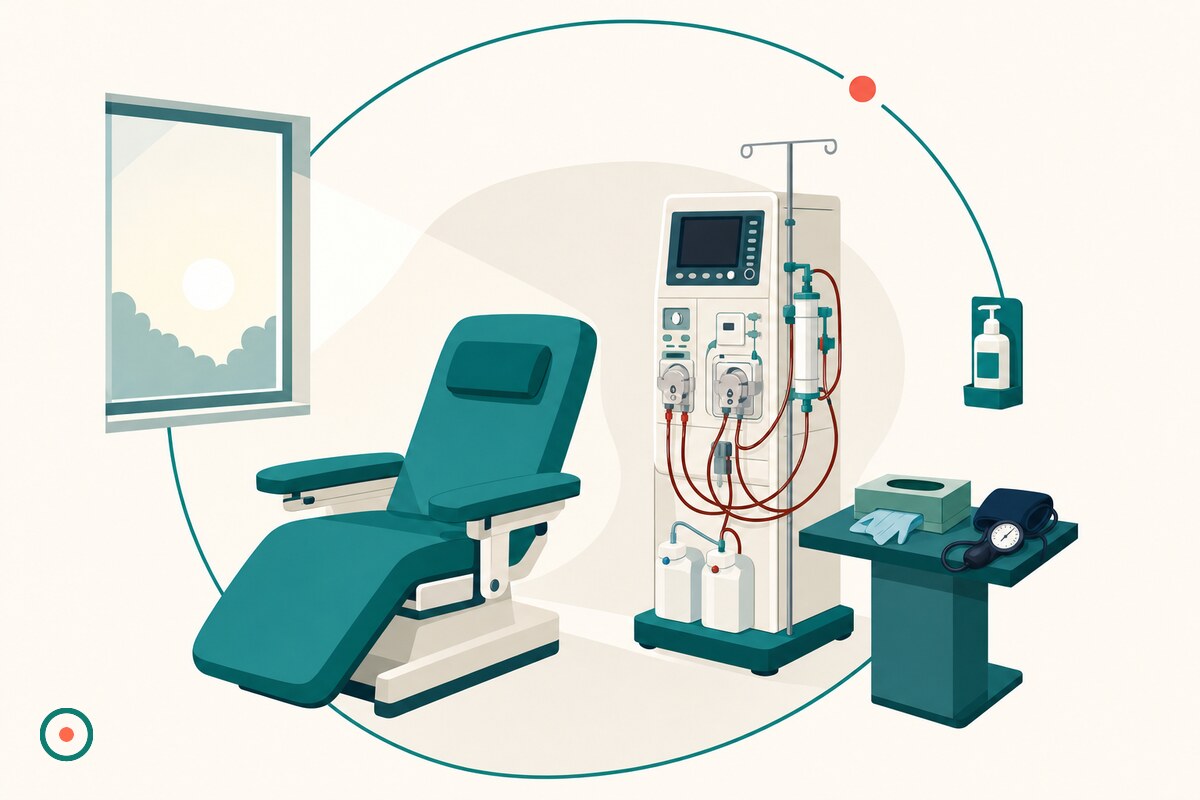
A Fresenius RN interview usually comes in two steps: a short recruiter screen, then a panel with the clinic team. Candidates describe a screen of about 20 minutes (why dialysis, tell me about yourself, your pay range, how you handle stress, a conflict with a coworker) and then a 30 to 45 minute panel, often on video, that can include the clinic manager, a regional manager, nurses and even patient care technicians. The questions are mostly behavioral, plus a few dialysis and safety questions. The one that catches people off guard is “What does infection control mean to you?” The winning prep is four or five specific STAR stories, a calm SBAR answer for a crashing blood pressure, a real “Why Fresenius?”, and an honest plan for the early mornings.
You don’t need dialysis experience. Fresenius trains most new nurses in-house, so the panel is mostly checking whether you’ll learn safely, work well with techs, and stay.
What is the Fresenius RN interview process?
Fresenius Kidney Care is the US dialysis clinic brand of Fresenius Medical Care, one of the largest dialysis providers in the world. Here is how the process usually runs, based on recent candidate reports on Reddit and Glassdoor (details vary by clinic and region):
- Online application, then an automated scheduling message. Several candidates say an automated assistant texted or emailed them to book each step within days.
- Recruiter screen, about 20 minutes, by phone or video. Expect: tell me about yourself, why Fresenius, why dialysis, your expected pay range, whether the training timeline and schedule work for you, how you handle stress, and one behavioral question like a coworker conflict.
- Manager or panel interview, about 25 to 45 minutes. Sometimes it’s two people (clinic manager plus regional manager). One September 2026 candidate described a 45-minute video panel of six: managers, nurses and technicians taking turns. Some clinics add a tour or a short shadow.
- Offer. Some candidates hear back within hours of the panel.
Some areas also run hiring events where several clinic managers interview you together in short rounds.
What training should you expect?
New nurses typically go through a classroom and floor training period of about 12 weeks (some RNs report it’s shared with patient care technicians), followed by a preceptorship with an experienced nurse. Fresenius also runs a Nurse Residency Program, “Transition to Nephrology Practice,” a 12 to 15 month program for pre-licensed and newly graduated nurses, with cohorts that start after the December and May graduation seasons. Ask your recruiter which track you’d be on and how long until you’d be the only RN on the floor.
What questions does Fresenius ask RN candidates?
The questions candidates report most often:
- Tell me about yourself.
- Why do you want to work for Fresenius? Why dialysis?
- What are your pay expectations?
- How do you handle stressful situations?
- Tell me about a time you disagreed with a coworker and how you handled it.
- Describe a challenging clinical situation and what you did.
- What does infection control mean to you?
- What does “connecting with patients” mean to you, specifically?
- Does our schedule (early starts, long days, possible on-call) work for you?
- How good are you at puzzles? (Yes, really. It’s a problem-solving question in disguise.)
Two frameworks will carry every answer:
- STAR (Situation, Task, Action, Result) for “tell me about a time” questions.
- SBAR (Situation, Background, Assessment, Recommendation) for clinical scenarios.
One candidate’s best advice: “Any question they ask, they want an actual example, not a general answer.” “I’d talk to the person” loses to a 60-second story with a real outcome.
Sample answers for the recruiter screen
”Tell me about yourself.”
Keep it to your nursing path, what you’re doing now, and why this role. Hobbies can wait.
“I just graduated with my BSN and I’m taking my NCLEX next month. My strongest rotation was on a med-surg unit with a lot of chronic kidney disease patients, and what stuck with me was how much the same patients came back, and how much teaching mattered for them. Before nursing school I worked as a CNA for two years, so I’m comfortable with long, physical shifts and working closely with techs. I’m looking for a place where I can build long-term relationships with patients and get real training in a specialty, which is why I applied here.”
For more structure, see tell me about yourself for nursing interviews.
”Why Fresenius? Why dialysis?”
Name something specific: the patient relationships, the training, and one of their values.
“Dialysis is relationship nursing. You see the same people three times a week, so you can actually watch your teaching change someone’s numbers and how they feel. I want that kind of continuity. I picked Fresenius because you train new nurses in-house with a real preceptorship, and because of your values, especially ‘reliable.’ A dialysis patient’s whole week is built around their chair time, so being a nurse who shows up and does what I say matters more here than almost anywhere."
"What are your pay expectations?”
Look up the posted range for your location before the call (many job posts list one) and give a number inside it.
“Based on the posted range for this clinic and my experience level as a new grad, I’m looking for something within that range. I care most about the training and the team, so I’m flexible as long as it’s in that band."
"How do you handle stress?”
“I slow down and prioritize. On my last clinical day, two of my patients needed me at the same time, one with a new low blood pressure and one asking for pain medication. I checked the blood pressure patient first, told the other patient I’d be back in five minutes and asked my preceptor to cover if I wasn’t, then came back as promised. Outside work I protect my sleep, which I know will matter with dialysis start times.”
Sample answers for the panel
”Tell me about a time you disagreed with a coworker.” (STAR)
This is the most reported Fresenius question. Use a specific story.
“(Situation) On a clinical rotation, a CNA and I kept clashing over the order of morning care. She liked to do all baths first, and I needed vitals and blood sugars first for my 0800 meds. (Task) We had to work the same patients all week. (Action) I asked her if we could talk for two minutes away from the patients, explained why the timing mattered for the insulin, and asked what was hard about her mornings. We agreed she’d start with my two diabetic patients’ vitals and I’d help with one bath after meds. (Result) Meds went out on time all week and she started telling me about changes before I asked. I learned that most conflicts are about workload, not personality."
"What does infection control mean to you?”
Dialysis means blood exposure and vascular access every treatment, so this question matters. Give a concrete, layered answer:
“It means protecting every patient’s access and every person in the room, every treatment. Practically: hand hygiene before and after every patient contact and between stations, gloves changed between patients, a gown and face shield whenever there’s splash risk like cannulation or taking a patient off, clean versus dirty areas kept separate, and disinfecting the chair and machine surfaces between patients. For central venous catheters, it means strict aseptic technique on the hub and watching the exit site for redness, drainage or tenderness. And it includes teaching the patient: washing their fistula arm before treatment and knowing the signs of infection to report. One missed step can mean bacteremia in someone who’s already immunocompromised."
"What does connecting with patients mean to you?”
A candidate was asked to explain this exact phrase. Show warmth and boundaries:
“It means learning who they are, not just their dry weight. Knowing their family, noticing when they’re quieter than usual, remembering what they told me last week. It also means boundaries, like not trading personal phone numbers, so I can stay their nurse for years without burning out."
"How good are you at puzzles?”
They want to see how you think, not your hobby.
“I like them, and I’m better at them when I’m patient. My approach is to start with the edges, the things I know for sure, then test one idea at a time and switch when it isn’t working. That’s how I try to approach a patient problem too: get the facts first, then work through the possibilities in order."
"Tell me about a challenging clinical situation.”
Pick a real one from clinicals where you noticed something and escalated it. Close with what you learned.
How do you answer Fresenius clinical scenarios?
New grads aren’t expected to know dialysis machines. They are expected to recognize danger, stop the harm, and escalate. Answer in SBAR and say why at each step.
”A patient’s blood pressure drops during treatment.”
“(Situation) An hour into treatment, my patient’s blood pressure drops to 82/48 and she says she’s dizzy and nauseated. (Background) She came in well above her target weight, so her fluid removal goal is high. (Assessment) This looks like intradialytic hypotension from removing fluid faster than she can tolerate. (Recommendation) I’d stay with her, lower her head and raise her legs, reduce or pause ultrafiltration, and give a saline bolus per the clinic protocol. I’d recheck her blood pressure every few minutes, tell the charge nurse, and let the provider know if it doesn’t respond. Then I’d review her target weight and teach about fluid limits between treatments."
"Your patient gets severe leg cramps during treatment.”
“Cramping often goes with too much fluid coming off too fast, so I’d check her blood pressure first, then follow the protocol: lower or pause ultrafiltration, consider a saline bolus, and help her stretch or apply warmth. I’d tell the charge nurse and look at whether her weight gain and fluid goal need adjusting."
"A patient with a central line catheter has a fever and redness at the exit site.”
“(Situation) My patient with a tunneled catheter has a temperature of 101.2°F and the exit site is red with some drainage. (Background) Catheters carry the highest infection risk of any dialysis access. (Assessment) I’m worried about an exit-site or bloodstream infection. (Recommendation) I’d get a full set of vital signs, notify the charge nurse and the provider right away, and expect orders for blood cultures before any antibiotic. I’d keep strict aseptic technique on the catheter and document what I see. If she’s hypotensive or confused, that’s sepsis and an urgent escalation."
"Your patient’s pre-treatment potassium is high.”
“High potassium can cause dangerous heart rhythms, so I’d treat it as urgent. I’d ask about symptoms like weakness or palpitations, check whether the clinic wants a rhythm strip, and notify the provider right away for orders on the dialysate bath and treatment plan. Afterward I’d do teaching on high-potassium foods, without lecturing, and loop in the dietitian."
"During cannulation, the arm starts swelling at the needle site.”
“That’s an infiltration. I’d stop, not push through it: stop the blood pump if we’re running, remove or reposition the needle per protocol with the charge nurse, apply pressure and ice, and assess the arm and the thrill and bruit. Then I’d document, tell the provider, and plan with the team for where to cannulate next time. The fistula is the patient’s lifeline, so protecting it comes first.”
For more dialysis-specific questions, see our dialysis nurse interview questions guide.
Which Fresenius values should you mention?
Fresenius Medical Care’s global values are Collaborative, Proactive, Reliable and Excellent. Its vision line is “Creating a future worth living. For patients. Worldwide. Every day.” You don’t need to recite them, but one story per value gives you a ready answer for most behavioral questions:
| Value | What it means at Fresenius | Story to have ready |
|---|---|---|
| Collaborative | ”We team up” | Working through a conflict with a CNA or tech |
| Proactive | ”We get things done” | Noticing a change and escalating early |
| Reliable | ”We do what we say” | Following through on a promise to a patient |
| Excellent | ”We exceed expectations” | Improving a small process on your unit |
Pair the value with a story, not an adjective. “I’m reliable” says little; “I told my patient I’d be back in five minutes, and I was” says a lot.
What if you have no dialysis experience?
Say so plainly, then turn it into a strength:
“I haven’t worked in dialysis yet, and I know there’s a lot to learn, especially from the techs who’ve been doing this for years. What I bring is solid assessment skills, comfort with chronic-disease teaching from my med-surg rotation, and the habit of asking when I’m not sure. I’m looking for a training program I can commit to, and I want to stay long enough to become the nurse who precepts the next new grad.”
Saying you’ll learn from the technicians matters. Several RNs say the techs know the machines far better than a new nurse at first, and the panel often includes techs.
Questions to ask at the end
Pick two or three:
- “How long is training for a new grad here, and when would I be the only RN on the floor?”
- “What does a typical day look like, start time and end time?”
- “Is there on-call or acute coverage for this role?”
- “How many patients and technicians would I usually work with on a shift?”
- “What do your best nurses here have in common?”
See more in questions to ask the interviewer in a nursing interview.
Is it hard to get hired as an RN at Fresenius?
For a prepared new grad, usually not. Fresenius hires a lot of nurses and runs formal training for nurses new to dialysis, so the bar is less “do you know dialysis” and more “will you be safe, fit the team, and stay.” Two things sink candidates: sounding uninterested (one nurse said a dialysis company almost passed on her until she called back to explain why she wanted the work) and vague answers with no example. Be honest about the early starts too. Many clinics open before dawn, and a panel would rather hear your plan than discover the problem in month two.
If you’re comparing dialysis employers, our DaVita RN interview questions guide covers that company’s values-heavy panel.
Your Fresenius interview checklist
- A 60-second “tell me about yourself” focused on your nursing path.
- A “Why Fresenius, why dialysis” answer that names one value.
- A pay number inside the posted range for your location.
- Four or five STAR stories: coworker conflict, stress, a mistake, advocating for a patient, a challenging clinical moment.
- A layered infection-control answer.
- SBAR answers for low blood pressure and a possible catheter infection.
- An honest answer about early mornings and on-call.
- Two or three questions to ask them.
- A thank-you email within 24 hours (templates here).
Practice out loud before the panel
Knowing the answers isn’t the hard part. Saying a calm SBAR for a crashing blood pressure while six people watch you on a video call is. That takes reps.
Roundly runs realistic mock nurse panels for new-grad RNs. You answer behavioral questions and dialysis-style clinical scenarios out loud, and Roundly scores the clinical reasoning and structure of what you said, not just how smooth it sounded. It was built with nurse recruiters and hiring managers.
Practice a Fresenius-style mock panel with Roundly →
“Tell me about a time you disagreed with a coworker”
You just read a strong answer to that. Saying one to three people who are deciding whether to hire you is a different skill — Roundly asks this exact question in a mock Fresenius panel, listens, and scores the clinical reasoning underneath.
Answer this one out loud →You've read the answers. Now say one out loud.
Reading a sample answer and delivering it to a panel that's deciding whether to hire you are two different skills. Roundly runs a mock Fresenius panel that asks these exact questions, listens to your answer, and scores your clinical reasoning and structure — not just how confident you sounded.
Start a mock Fresenius panelTakes about two minutes to set up. Finish 15 panels without an offer and we refund you.