Endoscopy Nurse Interview Questions (2026): New-Grad Sample Answers
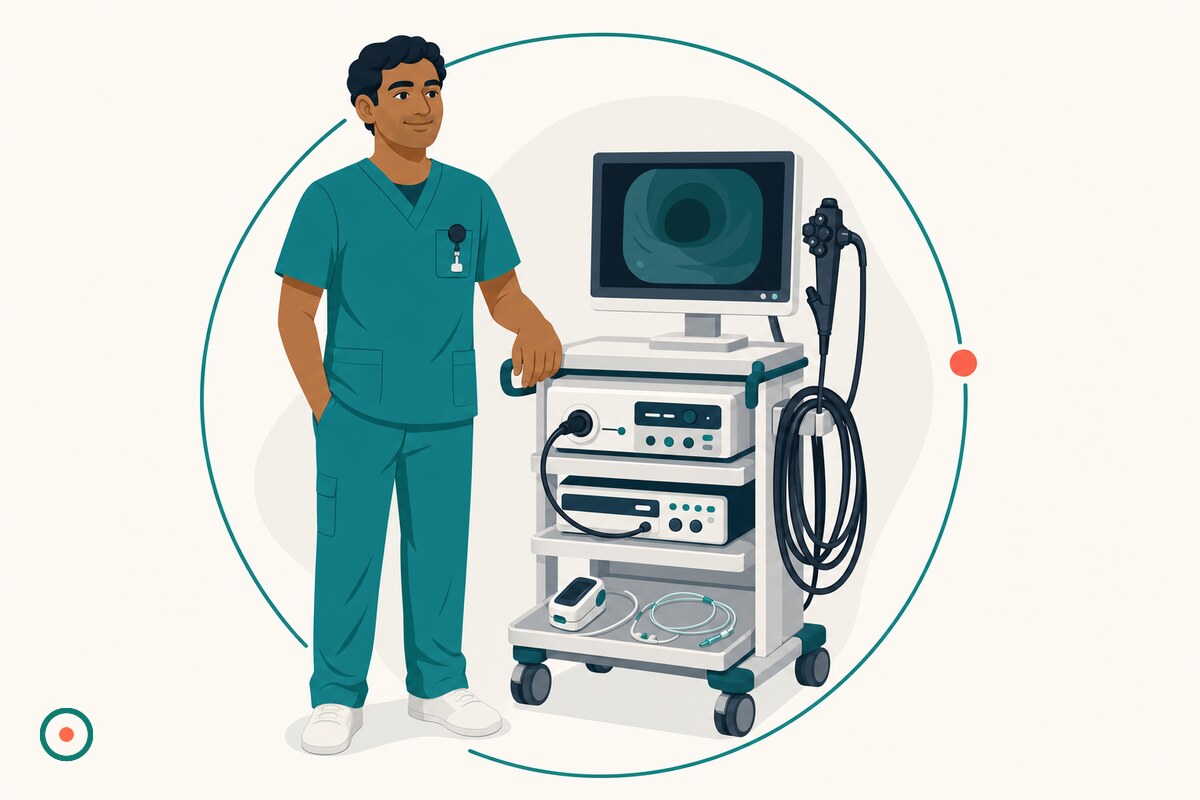
Endoscopy nurse interview questions test five things: do you understand moderate sedation well enough to keep an airway safe, can you prep a patient so the procedure is safe to start (NPO, bowel prep, anticoagulants, consent, time-out), will you recognize bleeding or perforation early and escalate with clear SBAR, do you respect scope reprocessing as patient safety rather than housekeeping, and can you keep a fast-turnover room calm and kind. GI panels know you’ve never run a colonoscopy room. They’re listening for whether you’d be safe — airway first, protocol second, ego never.
Below are the endoscopy nurse interview questions hospital GI labs and outpatient endoscopy centers actually ask, each with a copy-ready sample answer, plus the sedation and complication scenarios most online lists either skip or get wrong. For the full panel across specialties, start with our nursing interview questions hub.
Quick honesty check: Many endoscopy units prefer RNs with some acute-care, PACU, or critical-care experience because of the sedation responsibility. Some hospital GI labs and outpatient centers do hire new grads with a structured orientation, and many nurses arrive after a year or two on med-surg or in PACU. This guide prepares you for both — and for the honest “how did you get here” conversation.
What should you know for an endoscopy nurse interview?
Know the workflow and the vocabulary, so your answers sound like someone who has pictured a real procedure day.
The three phases of an endoscopy day:
- Pre-procedure — history, allergies, medications (anticoagulants, antiplatelets, insulin, GLP-1 medications), NPO status, bowel prep quality, airway and sleep apnea screening, ASA status per the unit’s tool, IV access, consent verified, ride home confirmed.
- Intra-procedure — monitoring during moderate sedation (SpO2, heart rate, blood pressure, level of consciousness, often capnography), administering sedation under the provider’s order when that’s the RN’s role, positioning (commonly left lateral for EGD and colonoscopy), suction ready, assisting with biopsies, polypectomy, or hemostasis tools, specimen labeling, time-out.
- Post-procedure — recovery to baseline, a standardized score such as the modified Aldrete, abdominal assessment, discharge teaching, discharge only to a responsible adult.
Procedures to name correctly: EGD (upper endoscopy), colonoscopy, flexible sigmoidoscopy, ERCP, EUS, PEG placement, esophageal dilation, variceal banding. You don’t need to have seen them all — you need to know which carry more risk (ERCP and therapeutic procedures more than a diagnostic EGD).
The sedation definition panels love: under moderate (“conscious”) sedation, the patient responds purposefully to voice or light touch, keeps their own airway without intervention, and ventilates adequately on their own. If they only respond to repeated or painful stimulation, they’ve drifted into deep sedation — which changes who should be managing them.
Carry SBAR (clinical), STAR (behavioral), and “airway before anything” into every answer.
How do I prepare for an endoscopy nurse interview?
Prepare in four layers: (1) sedation safety cold — the moderate-sedation definition, the drugs your unit uses (commonly midazolam and fentanyl for nurse-administered sedation; propofol is usually given by anesthesia staff, per state rules and facility policy), and the reversal agents (naloxone for opioids, flumazenil for benzodiazepines); (2) pre-script “Why endoscopy?” without sounding like “I want weekends off”; (3) rehearse 4–5 STAR stories — anxious patient, noticing a change early, speaking up, a fast-paced day you kept organized; (4) say two SBARs out loud — a desaturation during a colonoscopy and post-procedure abdominal pain that’s getting worse.
A simple game plan:
- Research the setting: hospital GI lab (inpatient bleeds, ERCP, after-hours call) or outpatient center (high-volume screening colonoscopies)? Who gives sedation — RNs or anesthesia?
- Review your clinicals: any time you monitored a sedated patient, recovered someone in PACU, gave IV push meds, or taught a patient before a procedure.
- Know the basics of scope reprocessing (see below) — it comes up more than candidates expect.
- Bring 2–3 thoughtful questions for the end.
- For the classic openers, use our new-grad RN interview guide. Recovery experience translates directly, so skim PACU nurse interview questions too.
What are the most common endoscopy nurse interview questions and answers?
”Why do you want to work in endoscopy?”
Show the honest pull and that you see the responsibility.
“I like procedural nursing where preparation decides the outcome — a good pre-procedure check, a well-monitored sedation, and clear discharge teaching make a measurable difference in a short window. On clinicals I followed a patient through a colonoscopy, and I was struck by how much of the safety work was the nurse’s: confirming prep and medications, watching the airway while the physician focused on the screen, and making sure the patient understood what to watch for at home. I also know it isn’t ‘easy outpatient work.’ It’s fast, sedation carries real risk, and GI bleeds and perforations are emergencies. That combination of pace and vigilance is what draws me."
"Why our unit?”
Never invent insider details. Use what you actually looked up.
“Because of [orientation length / your mix of screening and therapeutic cases / how you train new nurses on sedation — whatever you actually found]. I want an orientation where I learn your sedation policy and your reprocessing workflow with a preceptor before I’m independent."
"Tell me about your experience with sedated patients.”
Use real clinical moments — don’t overclaim.
“I haven’t administered procedural sedation independently, but I’ve monitored post-procedure patients during my preceptorship. In one case my patient’s oxygen saturation drifted down while she was still drowsy after an opioid. I stimulated her, had her take deep breaths, repositioned her airway, and told my preceptor. She came back up quickly and we increased her monitoring. What I took from it: sedation recovery is about watching breathing and level of consciousness, not just the number on the screen. I’d expect to complete your sedation competency and work under supervision until I’ve shown I’m safe."
"How do you prepare a patient for an endoscopy?”
Panels want a checklist, delivered calmly.
“I verify identity and procedure, review allergies and the medication list — especially anticoagulants, antiplatelets, insulin or oral diabetes meds, and GLP-1 medications, because a stomach that hasn’t emptied raises aspiration risk. I confirm NPO time and, for a colonoscopy, how the prep went. I screen the airway and ask about sleep apnea and CPAP. I check that consent is signed and that the patient can actually explain what they’re having done. I place or check IV access, get baseline vitals and level of consciousness, and confirm a responsible adult is driving them home. Anything out of line — a full breakfast this morning, a blood thinner that wasn’t held, a poor prep — goes to the provider before sedation, not after."
"What is moderate sedation, and how do you monitor it?”
Define, then describe monitoring and the warning signs.
“Moderate sedation means the patient responds purposefully to voice or light touch, keeps their own airway, and breathes adequately without help. I monitor oxygen saturation, heart rate, blood pressure, respiratory rate and effort, and level of consciousness at the intervals our policy sets, and I use capnography where it’s available, because it shows hypoventilation before the oxygen saturation falls. Warning signs I’d act on: snoring or noisy breathing, a flattening capnography waveform, falling SpO2, the patient only responding to a firm shake, or a heart rate or blood pressure change from baseline. If the patient is sliding toward deep sedation, I tell the physician and we stop adding sedation."
"What are the reversal agents, and what do you watch for after giving one?”
“Naloxone reverses opioids like fentanyl; flumazenil reverses benzodiazepines like midazolam. I’d give them per order or protocol. The key nursing point is that both can wear off before the sedative does, so the patient can re-sedate. After reversal I’d keep the patient on monitoring for longer — our policy would set the window — and I’d watch for pain or agitation after naloxone and seizure risk with flumazenil, especially in patients on long-term benzodiazepines."
"How are endoscopes cleaned between patients?”
This is where many candidates go vague. Be specific.
“Reprocessing starts at the bedside: right after the procedure, the scope gets pre-cleaned — the outside wiped and the channels suctioned — so debris doesn’t dry inside. Then it gets a leak test, manual cleaning with brushing of the channels, and high-level disinfection or sterilization following the manufacturer’s instructions for that scope, then drying and proper storage. Flexible GI scopes are classed as semicritical, so high-level disinfection is the minimum. Duodenoscopes used for ERCP have extra scrutiny because their design is harder to clean, and the FDA has asked facilities to take extra measures. My part as a nurse is never skipping the bedside pre-clean, never using a scope I can’t trace as reprocessed, and speaking up if something looks off."
"How do you handle a very anxious patient before a procedure?”
“I slow down for a minute even when the schedule is tight. I ask what they’re most worried about — often it’s pain, embarrassment, or ‘what if they find cancer.’ I explain in plain words what they’ll feel, that they’ll be monitored the whole time, and what happens if they’re uncomfortable. I make sure they’ve had a chance to ask the physician their questions before consent. Anxiety is also clinical information: a patient who is panicking may need more sedation, so the team should know."
"Tell me about a time you worked in a fast-paced environment.”
Use STAR and show organization, not rushing.
“S: On my med-surg preceptorship we had three admissions and a discharge in one hour. T: I had to keep my existing patients safe while getting new ones settled. A: I prioritized by acuity — I assessed the patient with new chest discomfort first, delegated vitals on the stable admission to the tech, and kept a running checklist so nothing fell through during the discharge. I told my preceptor what I’d deferred so she knew. R: Everyone was assessed within the hour and nothing was missed at handoff. In endoscopy, I’d rely on the same habits: a checklist for each patient, and saying out loud when something needs to wait.”
What clinical scenario questions do endoscopy interviews ask?
Use a think-out-loud structure: what I see → what worries me → what I do first → who I tell (SBAR) → what I document. For more practice with this format, see our situational nursing interview questions.
”Your patient with COPD desaturates to the low 80s during a colonoscopy. What do you do?”
“Airway first. I check the probe and waveform quickly so I’m not chasing a false reading, then stimulate the patient — say their name, a firm shoulder squeeze — and open the airway with a chin lift or jaw thrust. I increase oxygen per protocol and tell the physician right away: ‘SpO2 82, patient snoring, responding only to firm stimulation.’ I’d ask to pause further sedation. If they don’t improve fast, I call for help, support breathing with a bag-valve mask, and get reversal agents ready per order. With COPD, I’m also thinking about how much oxygen they normally need — but in an acute desaturation I treat the hypoxia first."
"During an EGD, the physician takes biopsies of an ulcer and it starts bleeding. How do you help?”
“Bleeding after biopsy is common and often stops on its own, but I’d be ready to escalate. I’d make sure suction is working and the patient’s head and airway are protected — blood in the upper GI tract is an aspiration risk under sedation. I’d ask the physician what hemostasis tool they want and get it ready per their preference and our setup, and I’d watch heart rate, blood pressure, and level of consciousness. If the patient became tachycardic or hypotensive, I’d say it out loud, check IV access, and follow the physician’s orders and our bleeding protocol. Afterward I’d document what was done and make sure recovery knew to watch for ongoing bleeding."
"Forty minutes after a colonoscopy with polyp removal, your patient’s abdominal pain is getting worse and their belly is firm. What do you do?”
“Some cramping from the air used during the procedure is normal, but pain that’s getting worse with a firm, distended abdomen is not — perforation is on my list. I’d reassess vitals, looking for tachycardia, fever, or low blood pressure, check the abdomen, and keep the patient NPO. Then SBAR to the physician now: ‘S: Mr. Lee, post-colonoscopy with polypectomy, has worsening abdominal pain, 8 out of 10, up from 3. B: Procedure done at 10:15, two polyps removed, otherwise healthy. A: Abdomen firm and distended, heart rate 112 from a baseline of 78, BP stable. I’m concerned about perforation. R: Please come evaluate now; do you want imaging or labs? I’m keeping him NPO and on monitoring.’ He doesn’t go home until the physician has evaluated him."
"A patient arrives for an EGD and tells you he ate a full breakfast two hours ago. What do you do?”
“I don’t start sedation. A full stomach raises aspiration risk, so I’d tell the physician and anesthesia if they’re involved, and explain to the patient why we can’t simply go ahead. I’d keep it non-judgmental — prep instructions are confusing — and make sure the instructions for the rescheduled procedure are clear, using teach-back."
"After ERCP, your patient develops severe upper abdominal pain radiating to the back. What are you thinking?”
“Post-ERCP pancreatitis is a known complication, along with perforation and bleeding. I’d assess vitals and pain, keep the patient NPO, and notify the physician with SBAR right away. I’d expect orders such as labs or imaging, and I’d keep monitoring closely. I wouldn’t call severe new pain ‘just gas’ after ERCP."
"Tell me about a time you spoke up for patient safety.”
“S: During clinicals, my patient was about to go for a procedure and I noticed his consent listed a different procedure than the one on the schedule. T: I needed to stop the process without causing panic. A: I told my preceptor and the charge nurse, and we contacted the provider before he left the unit. R: The schedule had a typo; the consent was corrected and reviewed with the patient before he went. It taught me that the time-out exists because everyone assumes someone else checked.”
Can a new graduate become an endoscopy nurse?
Yes, but be realistic about the route. Some hospital GI labs and outpatient endoscopy centers hire new grads into a structured orientation, especially for pre-procedure and recovery work. Many units, though, want a year or more of acute-care, PACU, or critical-care experience first, because monitoring moderate sedation requires confident airway and assessment skills.
If you’re asked about certification, be accurate: the CGRN credential from the American Board of Certification for Gastroenterology Nurses requires two years full-time (or 4,000 hours part-time) of GI/endoscopy experience as an RN within the past five years. It’s a later goal, not something a new grad can claim. Membership and education through the Society of Gastroenterology Nurses and Associates (SGNA) is a reasonable thing to mention if you’ve actually looked into it.
A strong answer sounds like:
“I know many endoscopy nurses come from PACU or med-surg, and I’m open to whichever path builds the skills you need. What I’d bring from day one is careful pre-procedure checking, solid IV and assessment basics, and the habit of escalating early. Long term, I’d like to work toward the CGRN once I have the required GI experience.”
If the job is in an outpatient clinic rather than a procedure unit, our clinic nurse interview questions cover that setting. If a med-surg year is your likely first step, prepare with med-surg nurse interview questions.
What questions should you ask in an endoscopy interview?
Ask questions that show you’re thinking about safety and learning:
- “Who administers sedation here — RNs, anesthesia, or both depending on the case?”
- “What does orientation look like for sedation monitoring, and how is competency signed off?”
- “What’s the case mix — mostly screening colonoscopies, or a lot of therapeutic and ERCP work?”
- “How are nurses involved in scope reprocessing here?”
- “Is there on-call for after-hours GI bleeds?”
- “What do your strongest new hires do differently in their first three months?”
For more options, see questions to ask the interviewer in a nursing interview.
Mistakes that weaken an endoscopy interview answer
- Treating sedation as routine. “They’re just sleepy” is not an answer. Always say what you’d monitor and what you’d do if it changed.
- Giving more sedation to a patient who “isn’t responding.” If a patient seems unresponsive, assess the airway and breathing first — that’s a safety problem, not a dosing problem.
- Inventing credentials. Name only certifications you hold or are actually working toward.
- Calling reprocessing “someone else’s job.” Bedside pre-cleaning is often the nurse’s step, and infection safety is everyone’s job.
- Discharging on the clock instead of criteria. Recovery is based on a standardized score and return to baseline, not because the next patient is waiting.
- Skipping the escalation. Every clinical answer should say who you’d tell and when.
How to prepare for endoscopy nurse interview questions in one evening
- Say the moderate-sedation definition and the two reversal agents out loud until it takes under 20 seconds.
- Practice two SBARs: desaturation during a colonoscopy, and worsening pain after polypectomy.
- Write three STAR stories: an anxious patient, a time you spoke up, a fast-paced shift you kept organized.
- Walk through reprocessing from bedside pre-clean to storage in five steps.
- Prepare your honest path sentence about experience and the CGRN, so you don’t ramble.
For more behavioral structure, see nursing behavioral interview questions. If the panel goes deep on reasoning, review critical thinking nursing interview questions.
Endoscopy nurse interview FAQ
Do endoscopy interviews include a skills or rhythm test?
Sometimes. Some units ask you to read a basic rhythm strip, walk through monitoring a sedated patient, or explain what you’d do with a falling SpO2. Talk through your steps and say you’d follow the unit’s sedation policy.
Do I need ACLS for an endoscopy job?
Many units that use moderate sedation require ACLS (often within a set time after hire) along with BLS. Check the posting and say honestly whether you hold it or when you’ll complete it.
Is endoscopy different from OR nursing?
Yes. Endoscopy RNs usually focus on sedation monitoring, assisting with scope procedures, and recovery rather than a sterile surgical field. If you’re comparing, our OR nurse interview questions show how differently those panels think.
How long should my answers be?
About 60 to 90 seconds for behavioral stories and one to two minutes for clinical scenarios. Offer to go deeper: “I can walk through the airway steps in more detail if that’s helpful.”
Practice saying the sedation scenario out loud
Reading a good desaturation answer is one skill. Giving it while three people watch you — chin lift, oxygen, tell the physician, pause sedation, get help — is another. The candidates who do well aren’t the ones who memorized drug names. They’ve practiced saying: “here’s what I see, here’s what worries me, here’s what I do first, and here’s who I tell.” Pick two scenarios tonight and say them out loud, timed.
“Tell me about a time you worked in a fast-paced environment”
You just read a strong answer to that. Saying one to three people who are deciding whether to hire you is a different skill — Roundly asks this exact question in a mock Endoscopy panel, listens, and scores the clinical reasoning underneath.
Answer this one out loud →You've read the answers. Now say one out loud.
Reading a sample answer and delivering it to a panel that's deciding whether to hire you are two different skills. Roundly runs a mock Endoscopy panel that asks these exact questions, listens to your answer, and scores your clinical reasoning and structure — not just how confident you sounded.
Start a mock Endoscopy panelTakes about two minutes to set up. Finish 15 panels without an offer and we refund you.