Home Health Nurse Interview Questions (2026): Copy-Ready Sample Answers
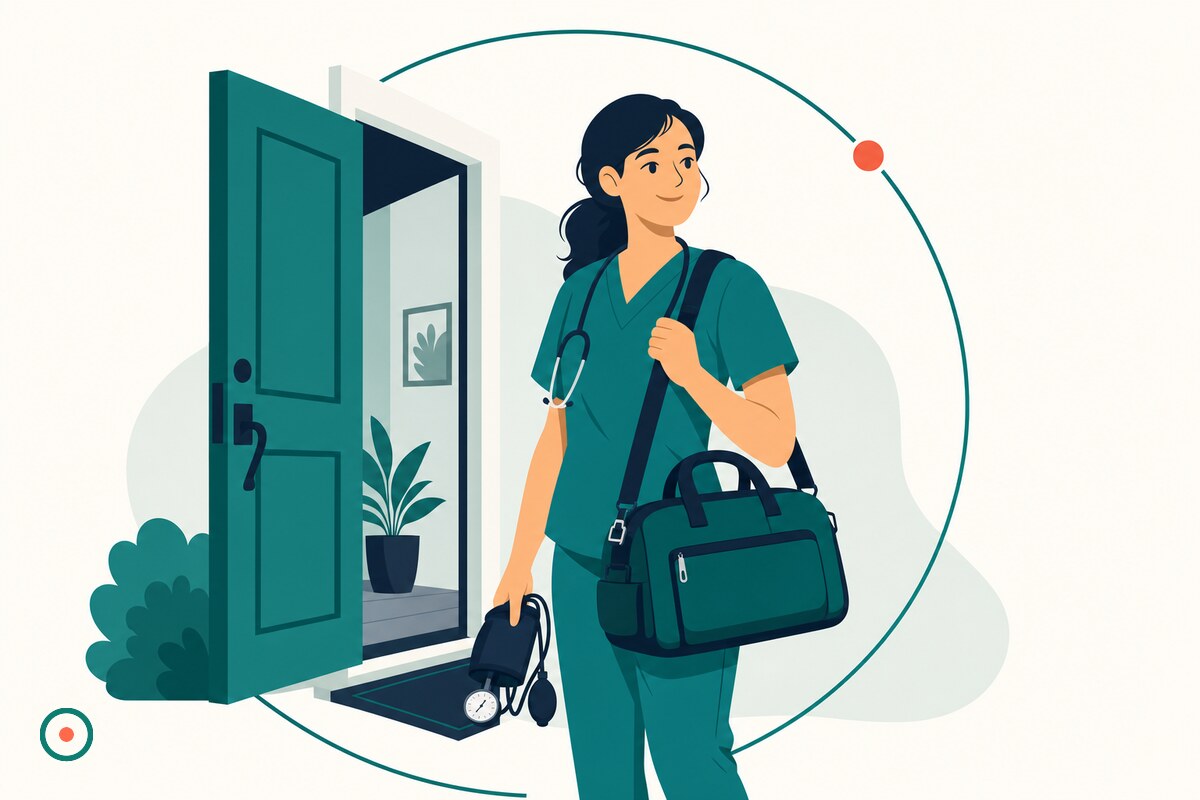
Home health interviews test five things you don’t face on a hospital floor: solo clinical judgment with no MD down the hall, reading a home for safety, navigating patients and families on their turf, hitting visits while charting at the point of care, and protecting your own boundaries. Panels already know you care. They’re scoring whether your reasoning out loud would keep someone safe when you’re alone in a living room — not whether you can recite a brochure.
Below are the home health nurse interview questions panels actually ask, each with a copy-ready sample answer — including a solo hypotensive visit, unsanitary-home judgment, medication refusal, productivity without fake dollar figures, and the new-grad “I’ve never managed a patient alone in someone’s house” conversation. Want the whole panel on one page? Grab our nursing interview cheat sheet.
Quick disambiguation: This guide is for the home health RN — skilled nursing, assessments, wound care, teaching, care-plan management, OASIS-aware documentation. It is not for the home health aide (HHA) or caregiver, even though search results constantly mix the two.
What should you know for a home health nurse interview?
Be fluent in field vocabulary so your answers sound like a home health RN, not a floor nurse who watched one ride-along.
Day-in-the-life building blocks:
- Autonomy — you are often the only clinician in the home. Assess fully, escalate early, never let pride stop a call.
- Home as the unit of care — fall hazards, lighting, pets, clutter, caregivers, and whether the plan of care is realistic in that house.
- Skilled visits — wound care, IV / infusion support, teaching, post-acute transitions, chronic disease follow-up. Name which caseload the posting describes.
- Documentation — point-of-care charting; OASIS and the plan of care drive care and compliance. Accuracy and narrative alignment matter — don’t invent proprietary “test item” tricks in an interview.
- Team — physician / APP, PT/OT/ST, MSW, HHA, scheduler, on-call. Home health is a relay, even when you’re alone in the driveway.
- Logistics — territory travel, visit windows, acuity-first reprioritization when a patient crashes mid-route.
Tools to name: SBAR, STAR, teach-back, plan of care, on-call / triage line, oasis-aware assessment habits, wound staging basics, infection + personal safety judgment.
Carry SBAR (clinical), STAR (behavioral), and escalate-early autonomy into every answer.
How do I prepare for a home health nurse interview?
Prepare in four layers: (1) solo-visit fundamentals cold — when you’d call 911 vs. the physician vs. the office; (2) pre-script “Why home health?” (panels screen hard for autonomy vs. “I just want weekends off”); (3) rehearse 4–5 STAR stories from clinicals — advocacy, conflict, safety, calm under pressure; (4) say SBAR out loud so you don’t freeze on “walk me through what you’d do alone.”
A simple game plan:
- Research the agency: intermittent skilled nursing vs. private duty, territory, EMR, orientation weeks.
- Review home safety, med reconciliation, wound basics, and escalation paths — not a fake OASIS quiz.
- Know the philosophy: home health is skilled clinical work in the community, not “easy visits.”
- Bring 2–3 thoughtful questions (see questions to ask the interviewer).
- Plan your outfit (see what to wear to a nursing interview).
For the full new-grad panel arc, use our new-grad RN interview guide.
What are the most common home health nurse interview questions and answers?
”Why do you want to work in home health?”
Have two layers: the honest pull, and the hard parts you already see.
“I like the continuity — you actually see whether teaching stuck, whether the wound is trending, whether the home can support the plan. Autonomy appeals to me because it demands judgment, not because it means less oversight. I know the hard parts: windshield time, documentation load, unpredictable homes, and days that rearrange when someone declines. I want that combination: clinical precision and presence in someone’s real life. I’m not looking for a soft landing — I’m looking for skilled nursing where the environment is part of the assessment."
"Why this agency / this team?”
Never invent insider details. Use what you actually researched.
“Because of [the new-grad orientation / mentorship / territory model / EMR support you actually looked up]. I want preceptor-backed onboarding where I earn independence on visits and documentation — not a sink-or-swim first week alone with a full caseload."
"How do you make clinical decisions without a physician on-site?”
“I assess fully, use my scope and standing orders / care plan, and escalate early with SBAR. Alone doesn’t mean unsupported — it means I’m responsible for noticing and calling. I’d rather over-communicate a change than drive away from a patient who needed intervention. Pride is not a clinical tool."
"Walk me through arriving for a visit and finding the patient hypotensive, pale, and dizzy. You’re alone.”
Situation: “Routine visit; patient is pale, dizzy, BP low, weak.”
Background: “I’d know recent vitals baseline, meds (especially antihypertensives / diuretics), last intake, wounds or infection risk, and any new symptoms — chest pain, SOB, neuro changes.”
Assessment: “Focused assessment: ABCs, full vitals, orthostatics if safe, mental status, glucose if indicated, skin, lungs, cardiac symptoms. Decide acuity: unstable → 911; concerning but stable → call physician / triage with SBAR and stay until directed.”
Recommendation: “Activate EMS if indicated, notify the office / on-call, document timeline and response, and don’t leave an unstable patient alone. Solo practice is structured escalation, not improvising heroics."
"How do you assess a patient’s home for safety?”
“I treat the home as part of the assessment: trip hazards, lighting, bathroom access, stairs, pets, smoke detectors, oxygen safety, medication storage, and whether a caregiver can actually carry out the plan. I’d teach, document, and loop in therapy / social work when the environment is the barrier — not just write ‘noncompliant’ and leave.”
What clinical scenario and family questions do home health interviews ask?
”You walk into a home that’s unsanitary — clutter, pests, no reliable water. What do you do?”
Situation: “The environment itself threatens infection control and safe care.”
Task: “Keep the patient safe, stay professional, and escalate resources — without shaming.”
Action: “I’d complete what care I can safely, use PPE / hand hygiene workarounds per policy, document objective findings, and escalate to the clinical manager and social work for home supports or alternative settings. If my safety or the patient’s is immediately at risk, I’d leave and call the office — never force a visit that puts either of us in danger.”
Result: “Environment is a care barrier, not a character flaw. Panels want judgment + escalation, not a lecture."
"A patient refuses necessary medication. How do you handle it?”
“I’d explore why — side effects, cost, misunderstanding, fear — then teach with teach-back and involve the physician / care team if the refusal creates real risk. Adults can refuse; my job is informed refusal, documentation, and advocacy — not coercion. If the family is pressuring against the plan, I stay on the patient’s goals and the ordered plan of care."
"A family wants you to give a medication that isn’t on the home med list / has no valid order. What do you do?”
“I don’t administer what isn’t ordered and reconciled. I’d explain the safety reason plainly, offer to call the physician to clarify, and document. Home health autonomy never overrides med safety."
"How do you promote independence when the family wants you to ‘just do everything’?”
“I’d name the goal: skilled nursing that builds capability, not dependence. I’d teach the patient and caregiver with teach-back, set clear visit expectations, and loop in therapy when function is the gap. Kindness without enabling is part of the skill."
"Tell me about a time you dealt with an upset family member.” (STAR)
Pull a clinicals story. Acknowledge emotion → clarify facts → teach or escalate → document. Land a calm result. Soft skills without a clinical spine won’t carry a home health panel.
How should a new grad answer home health nurse interview questions?
Panels hire judgment habits and train the caseload. Own the gap; don’t fake field hours.
What they want to hear:
- Honest transferables — med safety, assessment, escalation, teaching from clinicals
- Respect for autonomy — you’ll call early; you want preceptor time
- Willingness to learn documentation, routing, and agency protocols
- Reliable logistics — driver’s license, territory realism, time management
- Self-care plan that isn’t “I just don’t take it home”
Sample “Why home health as a new grad?” answer
“I don’t have a home-health visit log, and I won’t pretend I do. What I do have is calm assessment, med-safety habits, and a real reason to be here — not ‘I want easier shifts’ in a role that will chew that up. I want orientation where I ride with a preceptor, learn point-of-care charting and OASIS-aware documentation, and earn independence on visits. Day one I can assess a change, escalate with SBAR, teach a caregiver with teach-back, and stay professional in someone’s living room. Independence in the field is earned. That’s the onboarding I want.”
Lean on new grad RN interview questions and RN interview questions for classic openers.
What behavioral STAR answers work in a home health interview?
”Home health has visit targets and lots of travel. How would you manage your day?”
“I’d plan by acuity and geography together — unstable or new admissions first, then cluster routes. I’d build buffer for traffic, call ahead when I’m delayed, and chart at the point of care so documentation doesn’t pile up at midnight. If a patient crashes mid-day, acuity wins over the perfect route, and I’d communicate with the office so the schedule flexes honestly."
"When and how do you complete documentation?”
“As close to the visit as possible — ideally in the home or immediately after — while details are accurate. I’d keep narrative aligned with what I assessed and taught. For OASIS and the plan of care, I’d prioritize accuracy and consistency over speed, ask questions during orientation, and never invent answers I’m unsure about. Clean documentation protects the patient and the agency."
"How do you maintain professional boundaries in someone’s home?”
“Warm and boundaried. I’m a guest and a licensed clinician — not family, not a household fixer for every non-clinical need. I follow through on what I promise, hand off what belongs to social work or therapy, and protect time off. Boundaries are how I keep showing up trustworthy."
"How do you cope when patients decline or you’re carrying heavy cases alone?”
“I use the team — manager, peers, EAP if needed — and I keep a real life off shift. Success in home health is noticing change early and advocating, not carrying every outcome alone. Isolation is a risk in field work; connection is part of safety.”
For universal openers, pre-script tell me about yourself and strengths and weaknesses.
What are the 5 C’s of an interview?
Commonly Confidence, Competence, Communication, Character, and Chemistry (fit). In home health: competence is solo judgment; communication is SBAR to a physician who isn’t in the room; character is honesty about safety and documentation.
What are the 6 C’s of nursing interview questions?
Care, Compassion, Competence, Communication, Courage, and Commitment. In home health: courage is leaving an unsafe visit and calling it in; competence is the hypotensive solo scenario; commitment is sustainable caseload habits.
What are the 5 hardest interview questions?
Usually Why home health?, walk me through a solo emergency, unsafe / unsanitary home, medication / family refusal, and why should we hire you with no field experience? Pre-script those five before anything else.
What questions should you ask the home health panel?
Pick three to four:
- “What does orientation and mentorship look like for a new grad / new-to-home-health RN?”
- “What’s a typical daily or weekly visit expectation, and how are acuity and geography balanced?”
- “Which EMR do you use, and how is OASIS / plan-of-care documentation supported in the first 90 days?”
- “What does on-call / after-hours triage look like when a patient declines at 8 p.m.?”
- “How does the team escalate unsafe home environments or caregiver gaps?”
- “What does success look like at 30-60-90 days here?”
More phrasing: questions to ask the interviewer. Send a thank-you within 24 hours.
Home health RN vs. HHA / private duty — don’t mix the answers
Search results lump them. Skilled home health RN is intermittent skilled nursing, care plans, OASIS-aware documentation, and clinical escalation. HHA / caregiver is personal care under a different scope. Private duty may be shift-based and continuous. If the posting is skilled intermittent, don’t answer like a live-in aide — and don’t let the panel think you confuse the two.
Comparing nearby specialties? hospice nurse interview questions for comfort-focused home visits, or clinic nurse interview questions for ambulatory care.
A printable home health nurse cheat sheet
- STAR behavioral, SBAR clinical.
- Why home health: autonomy + hard parts. Two versions (experienced / new grad).
- Solo emergency: assess → 911 vs. call → stay → document.
- Home safety: environment is part of the assessment; escalate SW / therapy.
- Med refusal: explore why → teach-back → document informed refusal → loop MD.
- Productivity: acuity + geography; chart at point of care; no fake dollar claims.
- OASIS / POC: accuracy and narrative alignment; ask in orientation — don’t invent.
- New grad: they hire safety habits and train the caseload.
- Boundaries: guest + clinician; connection beats isolation.
How to actually practice
Home health answers sink new grads when they freeze on the order: assess → decide escalate path → teach the caregiver → document — or when “Why home health?” sounds like “I want easier hours.” The fix is reps out loud until the clinical and the logistics both sound steady.
That’s what Roundly does — realistic mock panels that ask these home health, solo-visit, and behavioral questions and score your clinical reasoning, SBAR structure, and delivery, built with real nurse recruiters and hiring managers. Practice your home health panel out loud →
“Tell me about a time you dealt with an upset family member”
You just read a strong answer to that. Saying one to three people who are deciding whether to hire you is a different skill — Roundly asks this exact question in a mock Home Health panel, listens, and scores the clinical reasoning underneath.
Answer this one out loud →You've read the answers. Now say one out loud.
Reading a sample answer and delivering it to a panel that's deciding whether to hire you are two different skills. Roundly runs a mock Home Health panel that asks these exact questions, listens to your answer, and scores your clinical reasoning and structure — not just how confident you sounded.
Start a mock Home Health panelTakes about two minutes to set up. Finish 15 panels without an offer and we refund you.