Oncology Nurse Interview Questions (2026): Copy-Ready Sample Answers
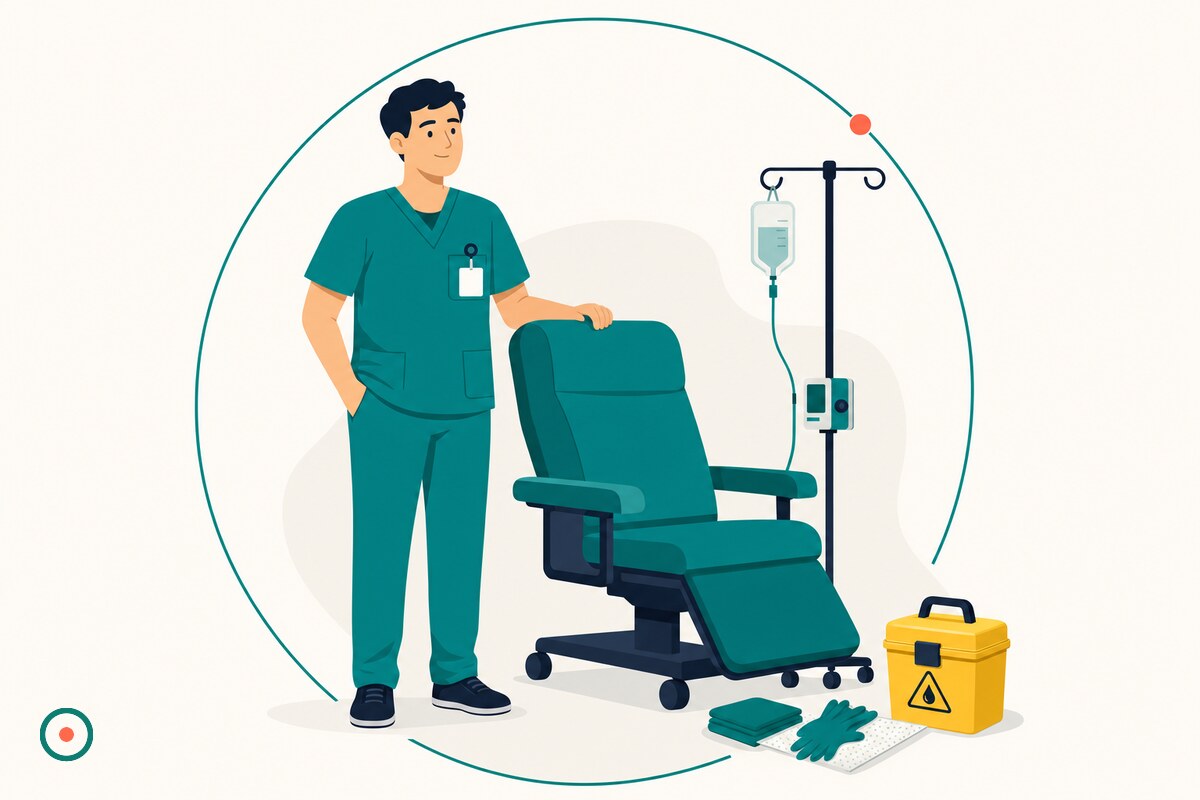
Oncology interviews test four things: can you keep hazardous-drug administration safe, catch a reaction or neutropenic fever before it becomes a code, talk to patients and families without flattening the truth, and stay emotionally durable without shutting down. Panels already know you care. They’re scoring whether your reasoning out loud would keep a patient safe on a busy infusion day — not whether you can recite a chemo textbook.
Below are the oncology nurse interview questions panels actually ask, each with a copy-ready sample answer — including chemo verification, infusion reactions, febrile neutropenia, and the new-grad “I haven’t hung chemo independently yet” conversation. Want the whole panel on one page? Grab our nursing interview cheat sheet.
What should you know for an oncology nurse interview?
Be fluent in oncology vocabulary so your answers sound like an oncology RN, not a med-surg transplant who watched one chemo.
Day-in-the-life building blocks:
- Hazardous-drug safety — independent double-check, two patient identifiers, PPE (chemo-tested gown, double gloves, eye protection), closed-system transfer devices, spill kit location, yellow chemo waste, and never recapping or crushing hazardous meds.
- Labs before you hang — ANC / neutrophils, platelets, hemoglobin, creatinine, LFTs, electrolytes. A beautiful order set does not override a critical lab.
- Infusion vs. inpatient — outpatient infusion is high-volume ports, reactions, and teaching; inpatient oncology is neutropenia, mucositis, pain, sepsis watch, and harder conversations. Name which you’re interviewing for.
- Access — peripheral vs. port-a-cath vs. PICC; blood return before vesicants; what you’d do if you lost blood return mid-infusion.
- Symptom science — nausea, mucositis, diarrhea, neuropathy, pain, fatigue. Panels want assessment + escalate, not a drug list you memorized the night before.
- Team — oncologist / APP, pharmacist (your best friend on chemo), infusion techs, social work, palliative, chaplain. Oncology is a relay.
Tools to name: SBAR, teach-back, USP <800> / facility hazardous-drug policy, ONS/ONCC chemo-immunotherapy education (pathway, not a fake credential), spill kit, emergency hypersensitivity protocol, febrile-neutropenia pathway.
Carry SBAR (escalation), STAR (behavioral), and stop-the-line safety into every clinical answer.
What are the most common oncology nurse interview questions and answers?
“Why do you want to work in oncology?”
Have two layers: the honest pull, and the hard parts you already see.
“I want work that’s both technically precise and human. Oncology is one of the few specialties where a missed lab, a skipped double-check, or a dismissed fever actually changes whether someone survives the week — and where families remember how you told them the truth. I don’t romanticize it. People die, days run long, and chemo is unforgiving of sloppy technique. I want that combination: hazardous-drug safety, symptom management, and being a steady person in the worst week of someone’s life. I’m not here because ‘cancer is inspiring.’ I’m here because the work is specific and I want to get good at it.”
“Why this unit / infusion center?”
Never invent insider details. Use what you actually researched.
“Because of [the residency / ONS-supported chemo education / the mix of solid tumor vs. heme / the infusion volume you actually looked up]. I want a preceptor-backed onboarding where I earn independence on monitoring and teaching before I independently hang hazardous drugs — not a sink-or-swim first week.”
“Walk me through how you safely verify and administer chemotherapy.”
This is the signature technical question. If you haven’t hung chemo independently, say so, then show the process you’d follow with a preceptor.
“I wouldn’t hang a hazardous drug from memory. I’d confirm the order against the treatment plan and the patient’s identifiers — two IDs, allergy, height/weight/BSA if the dose depends on it, and today’s labs (ANC, platelets, creatinine, whatever this regimen is gated on). Independent double-check with another chemo-competent RN: right drug, dose, route, rate, sequence. PPE on before I spike or connect — chemo gown, double gloves, eye protection — and a closed system if that’s the policy. Blood return before a vesicant. Educate the patient on what they’ll feel and which symptoms mean call now. Stay for the high-risk window of a first dose. Document, dispose in chemo waste, and I know where the spill kit is. If any piece doesn’t match — lab, dose, access, consent — I stop. A delayed infusion beats a wrong one.”
“What labs would make you hold a chemo infusion?”
“Depends on the regimen, but I don’t hide behind ‘I’d ask pharmacy’ without naming the obvious holds. For myelosuppressive chemo: ANC below the protocol threshold, platelets too low for that drug, or a hemoglobin the provider hasn’t addressed. Creatinine up on a renally cleared agent. LFTs for drugs that care. Electrolytes that would make this infusion dangerous. I’d hold, call the provider and pharmacist with the number and the trend, and I would not ‘just start it because the chair is waiting.’”
“How do you support a patient and family after a hard diagnosis or scan?”
“I don’t fill silence with false hope, and I don’t dump a textbook on them. I’d sit down, use the words the provider already used, and ask what they heard — people miss half of a cancer conversation. I’d answer what I can in my scope, write down the next step (labs, port, first infusion, who to call at 2 a.m.), and offer social work / chaplain / palliative as support, not as a death sentence. If they’re asking me for a prognosis the oncologist hasn’t given, I don’t freelance. I get the right person in the room.”
“How do you explain treatment in plain language?”
“Teach-back, not a lecture. ‘We’re giving a medicine that targets fast-dividing cells — that’s why hair, mouth, and blood counts take a hit. Your job this week is fever, bleeding, and not being able to keep fluids down — those are call-nows.’ Then: ‘Can you tell me what you’d do if you spiked a 100.4 at home?’ If they can’t, I haven’t taught it.”
What clinical scenario questions do oncology interviews ask?
This is where oncology interviews are won. Stop the line first, then escalate with SBAR.
“A patient develops hives, flushing, and throat tightness 10 minutes into a first-dose chemo or monoclonal. What do you do?”
Signature infusion-center emergency — don’t keep the rate going to “see if it settles.”
“Stop the infusion, don’t flush the hazardous drug through, and stay with them. I’d call for help — another RN plus the provider/APP — while I assess ABCs, vitals, work of breathing, and whether this is a mild infusion reaction vs. anaphylaxis. Maintain IV access with a compatible flush per protocol, get the emergency meds in the room (diphenhydramine, steroids, epinephrine if airway/hemodynamics), and follow the hypersensitivity pathway. SBAR: ‘Ms. Patel, 54, first rituximab, minute 10, urticaria, flushing, new throat tightness, BP 88/52, HR 124, sats 93% — infusion stopped, I’m concerned for anaphylaxis, I need you now and I’d anticipate epi IM.’ After they’re stable: document times, lot, rate, what was given, and the allergy so the next chair doesn’t repeat it. I never leave them to ‘go start the next patient.’”
“Your patient’s ANC is 400 and they spike 38.4°C. Walk me through it.”
Febrile neutropenia is a time-to-antibiotic problem, not a “monitor and see.”
“That’s febrile neutropenia until the workup says otherwise. I’d stay with them, full set of vitals, look for a source without delaying care — lung, line, abdomen, skin, mucositis — and I’d get them on the pathway: blood cultures from line and periphery if policy says so, labs, and antibiotics on the clock. No rectal temps, no fresh flowers lecture instead of action. SBAR: ‘Mr. Chen, day 8 after chemo, ANC 400, T 38.4, HR 118, BP 96/60 — I’m concerned for neutropenic sepsis, I need orders for cultures and empiric antibiotics now.’ As a new grad I escalate early. The cost of calling too soon is small; the cost of waiting for ‘maybe it’s just a virus’ is not.”
“You lose blood return while infusing a vesicant. What now?”
Extravasation drill.
“Stop immediately. I don’t flush to ‘see if it picks up.’ I’d aspirate what I can, leave or remove the line per vesicant protocol, mark and assess the site, notify the provider, and get the antidote / warm-or-cold pack that this drug actually uses — vesicant instructions are not one-size. Photograph per policy, document, and watch for evolving injury. Then we figure out whether treatment continues through new, verified access. A blown site is a safety event, not an inconvenience.”
“A patient on the phone (or in chair) reports a fever of 101 after chemo two days ago. What do you ask?”
“I’d follow the after-hours / telephone protocol and get a structured history: last chemo and which drugs, known nadir timing, ANC if we have it, how high the fever, duration, chills, rigors, cough, line redness, mouth sores, diarrhea, urine, dizziness, urine output, and whether they look ‘not themselves.’ Any neutropenic patient with fever is ED / clinic now, not ‘take Tylenol and call in the morning.’ If they’re hypotensive, confused, or in respiratory distress, that’s EMS, not a next-day slot. I’d document the call and loop the covering provider.”
“Platelets are 8,000 and the patient has a nosebleed that won’t quit. What do you do?”
“Bleeding precautions are already in play — no IM, no razors, fall risk, no unnecessary sticks — but active bleeding plus that count is a now. Direct pressure, sit them up leaning forward for epistaxis, vitals, and SBAR for platelets / ENT / hold anticoagulation if any. I wouldn’t send them walking to the cafeteria ‘until the order kicks in.’”
“A family member wants you to ‘do everything’ and the patient has just declined further chemo. How do you handle it?”
“The patient is the decision-maker if they have capacity. I’d acknowledge the family’s fear, restating what the patient said without taking a side in the hallway, and I’d get the provider in the room for a goals-of-care conversation rather than arguing ethics at the chair. My job is to keep the patient safe and heard, not to win the family over. I’d offer palliative / social work as extra support for all of them.”
What behavioral STAR answers work in an oncology interview?
“Tell me about a time you managed a stressful or emotional shift.”
“Situation: A patient I’d been teaching all week declined quickly, and the family was in the room. Task: Keep the patient safe and the family informed without freezing. Action: I called for help, stuck to ABCs and SBAR, used the same words the provider used, and stayed until the family had a next step. Result: The team moved fast; afterward I debriefed with my preceptor instead of driving home with it in my chest. Oncology needs presence, not a performance of being unbreakable.”
“How do you prevent compassion fatigue and burnout?”
Don’t say “I just don’t take it home.” They will not believe you.
“I treat it as a safety skill, not a personality trait. On shift I take the actual breaks, I ask for help before I get sharp with a family, and I use the debrief when we lose someone — even a five-minute hallway version. Off shift I keep one non-nursing thing that’s real (sleep, a person, a workout), and I would use EAP or peer support rather than white-knuckling it. A burned-out nurse misses fevers. I’d rather look ‘too serious about recovery’ than quietly deteriorate.”
“Tell me about a time you advocated for a patient.”
“Situation: A patient was booked as a ‘quick infusion’ but reported new chest tightness during pre-chemo vitals. Task: Not rubber-stamp them into the chair. Action: I held the start, flagged the provider with SBAR before we spiked anything, and asked for a fuller look. Result: The infusion didn’t start that hour; they got evaluated. Protecting the schedule never beats protecting the patient — especially with a vesicant in your hand.”
“Tell me about a mistake.”
“I once almost proceeded on a ‘looks fine’ lab before noticing the ANC had dropped below that protocol’s hold. I stopped, showed the number to my preceptor, and we held pending the provider. Speaking up early — including about my own almost-error — is the habit I want in oncology. Hazardous drugs don’t forgive ‘I didn’t want to slow the chair.’”
“Tell me about a conflict with a coworker.”
“Situation: Another nurse wanted to keep a mild-looking reaction going ‘because this drug always flushes people.’ Task: Keep the patient safe and the working relationship intact. Action: I pulled us off the chair-side argument, stated the symptoms and the protocol, and asked the charge/provider to see them now. Result: We stopped, treated, and later agreed the protocol isn’t optional. Direct, private when possible, patient-first.”
How should a new grad answer oncology nurse interview questions?
Panels know most new grads have not independently mixed or hung chemo. Do not fake an ONS/ONCC chemo-immunotherapy certificate or an OCN. Own the transferrable skills and the training path:
- Med safety + independent double-checks from any acute rotation
- Sepsis / deterioration recognition (neutropenic fever is sepsis with a name)
- PPE, aseptic technique, port/central-line respect
- Willingness to complete facility chemo education before independence
Sample “Why oncology as a new grad?” answer
“I don’t have a chemo-hanging log, and I won’t pretend I do. What I do have is med-safety habits, calm assessment, and a real reason to be here — not ‘I like helping people’ in a specialty that will chew that up. I want a residency or preceptorship where I watch, then second-check, then administer under competency, after your ONS-aligned chemo/immunotherapy training. Day one I can monitor, teach fever precautions, catch a bad lab, and escalate a reaction. Independence on hazardous drugs is earned. That’s the onboarding I want.”
Lean on our new grad RN interview questions and RN interview questions guides for the classic panel openers.
What are some common questions asked in an oncology interview?
The ones that actually decide the offer are rarely “what’s your greatest strength?” They are:
- Why oncology (and why here)
- Walk me through chemo verification
- Infusion reaction / anaphylaxis
- Neutropenic fever
- Extravasation / lost blood return
- Holding chemo for labs
- Hard conversation with a family
- Compassion fatigue
- A mistake you caught
- Questions for them (staffing, chemo competency, death debriefs)
If you’re interviewing for outpatient infusion, add port access, first-dose monitoring, and chair-flow prioritization. If it’s inpatient heme/onc, add sepsis, mucositis, transfusions, and longer-stay family dynamics. Pediatric oncology is its own panel — see pediatric nurse interview questions for developmental and family-centered pieces, then add chemo safety on top.
What are the 6 C’s of nursing interview questions?
A common framing: Care, Compassion, Competence, Communication, Courage, and Commitment. Some panels use 5 C’s: Confidence, Communication, Competence, Character, Culture-fit. In oncology, courage is holding a chemo; competence is labs + PPE + reaction management; communication is teach-back and honest bad-news support; compassion is staying present without making the patient’s grief about you.
What are the 10 most common interview questions and answers for nurses?
You’ll still get the classics — tell me about yourself, why nursing, strengths/weaknesses, conflict, a mistake, stress, why this unit, where in 5 years, prioritization, and questions for us. Answer them with oncology examples when you can.
What are the 5 hardest interview questions?
“Why oncology?” — two layers; past “cancer is inspiring.”
“Walk me through chemo.” — process + hold points; don’t fake hangs.
“Why hire you with no oncology experience?”
“How do you handle death / burnout?” — a real system, not toughness.
“A time you failed.” — own it.
“Why should we hire you with no oncology experience?”
“You’re hiring trainability in a high-risk specialty. I’m coachable, I ask before I guess, I already treat double-checks as non-negotiable, and I’m committed to oncology — not using your infusion chairs as a stepping stone to something else. You can teach the regimens; I bring the safety habits and a reason to stay.”
What is your 3 weaknesses’ best answer?
“I’m still building speed with oncology-specific skills I haven’t done independently — so I ask early and double-check instead of guessing on a hazardous drug. I can take a hard family conversation home with me; I’m practicing a real debrief instead of pretending it doesn’t stick. And I sometimes try to do too much myself on a heavy chair-day — I’m practicing calling for help before my assessment gets sloppy, because that’s safety.”
What questions should you ask the oncology panel?
Pick three to four:
- “What does chemo / immunotherapy competency look like here, and how long before a new grad independently hangs hazardous drugs?”
- “What’s a typical assignment — chairs per nurse in infusion, or patients on the floor — and how are you staffed for reactions?”
- “Where’s the spill kit and hypersensitivity cart, and when did the team last drill a reaction?”
- “How does the team support staff after a death or a long decline?”
- “Which regimens or populations would I see most in the first 90 days?”
- “What does success look like at 30-60-90 days on this unit?”
More phrasing: questions to ask the interviewer. Send a thank-you within 24 hours, and dress the part with what to wear to a nursing interview. Don’t lead with salary.
Infusion center vs. inpatient oncology — don’t mix the answers
Search results lump them. Outpatient infusion is volume, ports, first-dose monitoring, teaching, and getting people home safely. Inpatient oncology is neutropenia, pain, complications, transfusions, and longer relationships. If the posting says infusion, don’t tell a med-surg sepsis story as if it were a chair. If it’s a heme/onc floor, don’t talk like your whole job is hanging a 30-minute mAb.
Comparing nearby specialties? ICU nurse interview questions if the unit is onc ICU, or clinic nurse interview questions if it’s a cancer-clinic RN role that’s more rooming and inbox than chemo.
A printable oncology nurse cheat sheet
- STAR behavioral, SBAR clinical.
- Why oncology: specific + the hard parts. Two versions.
- Chemo: IDs, labs, independent double-check, PPE, blood return, teach-back, spill kit. Hold if it doesn’t match.
- Reaction: stop, stay, ABCs, protocol meds, SBAR, document.
- Febrile neutropenia: fever + low ANC = now. Cultures and antibiotics, not ‘wait and see.’
- Extravasation: stop, don’t flush, drug-specific next steps.
- New grad: they hire safety habits and train the hangs.
- Burnout: a system, not a slogan.
How to actually practice
Oncology answers sink new grads when they freeze on the order: hold the drug → assess → escalate → document. The fix is reps out loud until SBAR and stop-the-line are automatic.
That’s what Roundly does — realistic mock panels that ask these oncology, infusion, and behavioral questions and score your clinical reasoning, SBAR structure, and delivery, built with real nurse recruiters and hiring managers. Practice your oncology panel out loud →
“Tell me about a time you managed a stressful or emotional shift”
You just read a strong answer to that. Saying one to three people who are deciding whether to hire you is a different skill — Roundly asks this exact question in a mock Oncology Nurse panel, listens, and scores the clinical reasoning underneath.
Answer this one out loud →You've read the answers. Now say one out loud.
Reading a sample answer and delivering it to a panel that's deciding whether to hire you are two different skills. Roundly runs a mock Oncology Nurse panel that asks these exact questions, listens to your answer, and scores your clinical reasoning and structure — not just how confident you sounded.
Start a mock Oncology Nurse panelTakes about two minutes to set up. Finish 15 panels without an offer and we refund you.