PICU Nurse Interview Questions (2026): New-Grad Sample Answers
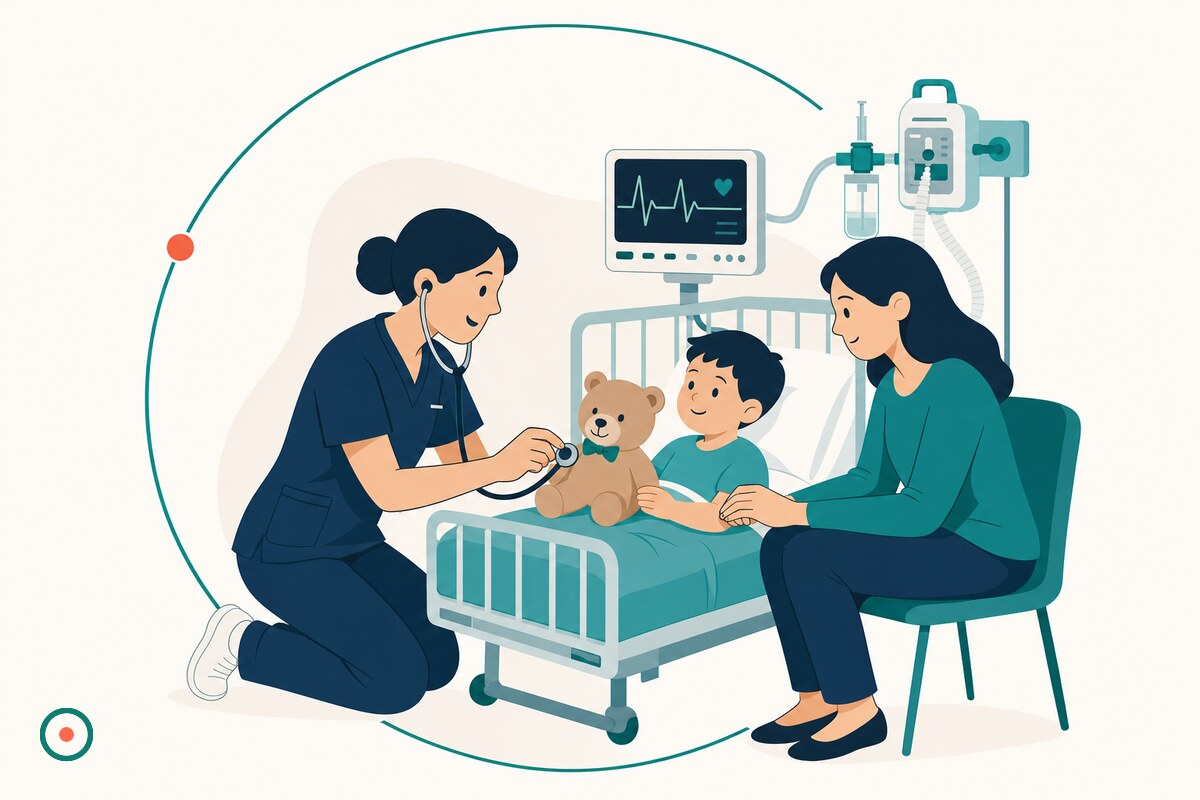
A PICU nurse interview mixes three kinds of questions: why pediatric critical care (and why this unit), behavioral questions about pressure, teamwork and families, and, on many units, a pediatric scenario such as a child in respiratory distress or early shock. New grads aren’t expected to know PICU medicine yet. The panel wants to see that you recognize a sick child early, call for help fast, respect weight-based dosing, and can stay calm with a frightened parent at the bedside.
This guide covers how PICU new-grad hiring works in 2026, the questions panels ask, sample answers you can adapt, and four scenarios with SBAR.
Do PICUs hire new-grad nurses?
Yes, more often than many students think, but usually through a residency or a structured pathway. A few examples from 2026 job postings:
- St. Louis Children’s at CoxHealth (Springfield, Missouri) posts a Pediatrics/PICU Graduate Nurse Resident role with no prior experience required, BLS within 90 days and PALS within one year of hire.
- Corewell Health’s Helen DeVos Children’s Hospital (Grand Rapids) hires new grads straight into its PICU/PCICU. It accepts an ADN with a BSN within five years and asks for PALS within one year. The unit holds an AACN Beacon Award.
- Gundersen Health runs a “New Graduate Pathway to Pediatrics/PICU”: you spend about a year in preparatory departments first, then move to peds/PICU and get PALS within six months of the transfer.
- Cleveland Clinic Children’s requires PALS within one year for nurses in its children’s hospitals.
So the pattern is: no PICU experience needed, BLS on hire, PALS within the first months to a year (a few units want it on hire), and a long precepted orientation. If you already hold PALS, say so. It shows commitment.
Many units pair the interview with a shadow shift. Treat the shadow as part of the interview: be on time, ask good questions, and don’t touch patients unless invited. Some units also hand you a short case study and ask how you’d prioritize.
How is a PICU interview different from an adult ICU or peds floor interview?
The questions overlap with our ICU and pediatric nurse guides, but PICU panels listen for four things in particular:
- Children compensate, then crash. A child keeps a normal blood pressure until late. Tachycardia, a rising respiratory rate, delayed capillary refill, cool hands and a change in behavior come first. Say that in your answers.
- Everything is weight-based. Doses, fluids and drips are in mg/kg or mcg/kg/min. A tenfold error is one of the most feared events in a PICU, and nurses on Reddit who interview candidates say they listen for attention to detail with calculations.
- The family is at the bedside. Parents are part of the care team, often 24 hours a day. Family-centered care isn’t a buzzword here; it’s the job.
- Grief is part of the unit. Panels want to know how you’ll cope with a child’s death or a non-accidental injury case, and that you have a plan for your own stress.
Common PICU nurse interview questions
From candidate reports on Reddit and allnurses, and from PICU postings:
- Why do you want to work in the PICU? Why pediatrics?
- Tell me about a time you handled a high-stress or emergency situation.
- Tell me about a time a patient’s condition changed. What did you notice first?
- How do you keep medication doses safe for children?
- How would you support a parent who is angry or terrified?
- How would you cope with the death of a child in your care?
- Tell me about a conflict with a coworker and how you handled it.
- Tell me about a time you went above and beyond for a patient.
- You have no ICU experience. Why should we hire you?
- Where do you see yourself in five years?
Some units add clinical questions: respiratory distress, septic shock, DKA, a post-op child, or “which of these patients do you see first?”
Sample answers to the core questions
Replace the details with your own clinicals. Panels hear the same textbook answers all day; a specific memory beats a polished script.
”Why do you want to work in the PICU?”
“I like kids” isn’t enough, and PICU nurses say so openly. Tie your answer to something you saw and to the kind of nursing PICU is.
“During my pediatric rotation, a toddler with RSV went from mild retractions to head bobbing and grunting over about an hour. My preceptor noticed it before the monitor did, called the rapid response team, and the child went to the PICU. I followed up the next day and saw how the PICU nurse was managing the high-flow, the feeds and a very scared mom all at once. That mix of close assessment and family care is exactly what I want to learn. I’m applying here because your residency gives new grads a long precepted orientation, and I want to build my critical care foundation with that support.”
If you did your capstone in a PICU, lead with it. If you didn’t, use whatever pediatric exposure you had: a peds rotation, camp nursing, a pediatric tech or CNA job, coaching.
”Tell me about a time a patient’s condition changed.”
“Situation: On my capstone unit, a 6-year-old two days after an appendectomy was quieter than usual and didn’t want to watch TV, which his mom said wasn’t like him. Task: His vitals were still in range, but I didn’t like the change. Action: I rechecked a full set of vitals: heart rate had climbed from about 100 to 132, his cap refill was three seconds and his temperature was 38.6. I told my preceptor right away, and we called the resident in SBAR. Result: He was started on a sepsis workup and fluids and was much brighter by the evening. I learned to take a parent’s ‘he’s just not himself’ seriously and to look for the trend, not just whether a number is in range."
"How do you keep medication doses safe for children?”
This one is almost guaranteed. Show a system, not just “I’m careful”.
“I start with an accurate weight in kilograms, and I check that it’s the weight documented on the order. For every medication, I calculate the dose myself and compare it with the safe range in the reference before I give it. If a dose looks ten times too high or too low, I stop and call the pharmacist or provider. I never round off by guessing. For high-alert drugs and drips, I use the pump’s drug library and get an independent double check, the way the unit policy requires. In clinicals, I caught an acetaminophen order written for the child’s weight in pounds instead of kilograms. I held it, told my instructor, and the order was corrected before it was given.”
Only use that last sentence if something like it really happened to you. Don’t invent a near miss.
”How would you support a parent who is angry or terrified?”
“Situation: A father on my peds rotation shouted at the nurses because his daughter’s IV had been restarted three times. Task: I needed to calm things down and keep her care moving. Action: I didn’t argue. I said, ‘You’re right, that’s a lot for her, and I’d be upset too.’ Then I asked what would help. He wanted to hold her for the next attempt and to know who was coming. I told my preceptor, she asked the vascular access team to bring the ultrasound, and we let him hold his daughter. Result: The line went in on the first try, and he thanked the team before we left. Most of the time the anger is fear, and giving a parent a job helps."
"How would you cope with the death of a child?”
Be honest. The panel isn’t looking for “it won’t bother me”.
“I know it will be hard, and I don’t think it should feel easy. In the moment, I’d focus on what that family needs: privacy, time to hold their child, and whatever memory-making the unit offers. Afterward, I’d use the debrief and talk with my preceptor or the unit’s support resources rather than carrying it home alone. Outside work, I protect my sleep and exercise, and I have people I can talk to. I’d also want to learn from the nurses here how they look after themselves over a long career."
"Why should we hire you with no ICU experience?”
“You’re right that I haven’t worked in an ICU yet. What I bring is a strong pediatric foundation from my rotations, a habit of trending vital signs instead of just recording them, and I already hold PALS [only if true]. I ask for help early, and I’m comfortable saying ‘I don’t know, let me find out.’ Your residency is built for new grads, and I want to grow with this unit for the long term.”
On the five-year question, PICU nurses on Reddit give the same advice: don’t mention leaving for CRNA school or another specialty. Talk about becoming a strong bedside PICU nurse, a preceptor, or working toward the CCRN (Pediatric), which AACN opens after 1,750 hours of direct pediatric critical care in two years.
For more behavioral practice, see nursing behavioral interview questions, tell me about yourself and strengths and weaknesses.
PICU clinical scenarios with SBAR
When a panel gives you a scenario, use the same order every time: stay with the child, assess (airway, breathing, circulation), act within your scope, call for help, report in SBAR, reassess. Say out loud what you’d expect the provider to order. You won’t be scored on knowing exact doses as a new grad, but you will be scored on recognizing danger and escalating.
Scenario 1: an infant in worsening respiratory distress
“A 3-month-old with RSV bronchiolitis is on high-flow nasal cannula. Her respiratory rate is 72, she has subcostal retractions, nasal flaring and grunting, and her SpO2 has dropped to 88%.”
“Grunting and falling saturations in an infant worry me, because babies tire quickly. I’d stay with her, reposition her to open the airway and suction her nose, since congestion alone can make a big difference in an infant. I’d check that the high-flow is set and connected correctly and call the respiratory therapist. I’d look at her color, her heart rate and how alert she is, and I’d hold her feeds, because she’s breathing too fast to feed safely. Then I’d call the provider.”
Situation: “I’m calling about Ava in bed 6, a 3-month-old with RSV. Her work of breathing has increased over the last 30 minutes and her sat is 88% on high-flow.”
Background: “She was admitted yesterday. She was stable on her current settings with sats of 94% until this afternoon.”
Assessment: “Respiratory rate 72, heart rate 178, new grunting, subcostal retractions and flaring. I’ve suctioned and repositioned her with little change. RT is at the bedside. I’m worried she’s tiring.”
Recommendation: “Can you come evaluate her now? I’d like to discuss increasing her respiratory support and getting a blood gas. I’ve made her NPO for now.”
Scenario 2: early septic shock
“A 4-year-old with a fever has a heart rate of 160, cap refill of four seconds, cool hands and feet, and is hard to wake. Blood pressure is 76/40.”
“This child is in shock, and the blood pressure tells me it’s decompensated. For a 4-year-old, hypotension is a systolic under 70 plus twice the age, so under 78. I’d call for help immediately, put her on oxygen and the monitor, and make sure she has IV or IO access. I’d get her weight in kilograms, because the fluids are weight-based. I’d expect orders for blood cultures, labs and early antibiotics, and fluid boluses of 10 to 20 mL/kg, and I’d reassess her heart rate, perfusion, liver edge and lung sounds after every bolus. If she develops crackles or her liver gets bigger, I’d stop and tell the provider, because that can mean fluid overload.”
The Surviving Sepsis Campaign’s pediatric guidelines suggest up to 40 to 60 mL/kg in 10 to 20 mL/kg boluses in the first hour where intensive care is available, with reassessment after each one. You don’t need the number to get the job, but knowing it shows you’ve prepared.
Scenario 3: DKA and a new headache
“A 10-year-old in DKA has been on IV fluids and an insulin drip for four hours. She now says her head hurts more and she’s getting confused. Her heart rate has dropped from 120 to 70.”
“A new or worsening headache, confusion and a falling heart rate during DKA treatment are warning signs of cerebral edema, and it’s an emergency. I’d call the provider and the charge nurse right away, raise the head of the bed to 30 degrees, keep her head midline and check her neuro status and glucose. I’d expect an order for hypertonic saline or mannitol and possibly a reduced fluid rate, and the treatment shouldn’t wait for a CT. I’d keep doing hourly or more frequent neuro checks after that.”
Bonus point if you mention that pediatric DKA protocols don’t give an insulin bolus. The ISPAD guideline starts the insulin infusion at 0.05 to 0.1 units/kg/hour, an hour after fluids begin.
Scenario 4: which patient do you see first?
“You have three patients: a 2-year-old post-op who is crying and says his tummy hurts, an 8-year-old with asthma whose sat has dropped from 95% to 90% and who is speaking in two-word sentences, and a teenager asking for a discharge update.”
“The 8-year-old first, because she’s showing signs of worsening asthma and a falling saturation, and that’s an airway and breathing problem. I’d assess her, apply oxygen per protocol, get RT and call the provider for treatment. Next, the 2-year-old, because his pain needs to be assessed with an age-appropriate scale like FLACC, and I want to rule out a complication. The discharge update can wait, and I’d let the teenager know when I’ll be back.”
More scenario practice: situational nursing interview questions and critical thinking interview questions. Interviewing for a cardiac, neonatal or pediatric burn unit too? See our CVICU, NICU and burn unit nurse interview guides.
How do you prepare for a PICU nurse interview?
- Know your pediatric vital sign ranges for infants, toddlers, school-age kids and teens, and the hypotension rule (under 70 plus twice the age for ages 1 to 10).
- Review PALS basics: the pediatric assessment triangle (appearance, work of breathing, circulation to the skin), and the difference between respiratory distress and failure and between compensated and hypotensive shock.
- Practice one dosing calculation out loud, in mg/kg, so you can talk through a safety check without freezing.
- Build five STAR stories: a change in condition, a hard family conversation, a conflict, a mistake, and a time you went above and beyond.
- Research the unit: bed count, whether it takes cardiac patients or has a separate cardiac ICU, Magnet or Beacon status, and the residency length.
- Plan for the shadow shift if there is one. Bring questions and notice how the nurses help each other.
Dress business professional, or follow the unit’s instructions for a shadow (what to wear to a nursing interview). If the PICU job is part of a hospital-wide program, our nurse residency interview questions and new-grad RN interview questions guides cover the general round.
Questions to ask the PICU panel
- How long is orientation for new grads, and how are preceptors assigned?
- What does a typical assignment look like for a new nurse after orientation?
- What patient population does the unit see most: respiratory, trauma, post-op, cardiac?
- How does the unit support nurses after a death or a very hard case?
- When do new grads usually take PALS here, and does the hospital provide the class?
- What do the strongest new grads on this unit have in common?
More ideas: questions to ask the interviewer in a nursing interview.
Your PICU interview checklist
- A specific, honest “Why PICU?” story, not “I love kids”.
- Five STAR stories, each with a clear result.
- A dosing-safety answer: weight in kg, independent calculation, double checks, stop and question.
- Two scenarios you can talk through out loud, each ending in an SBAR call.
- Pediatric vital sign ranges and the 70 + 2 × age rule.
- Your BLS card, and PALS if you have it.
- Three questions for the panel.
- A thank-you email within 24 hours (templates here).
Practice the scenarios out loud
A PICU scenario answer is easy to think and hard to say. Under pressure, most new grads skip the assessment, jump to an intervention, or forget to say who they’d call. The only fix is saying it out loud until the order is automatic.
Roundly runs realistic mock nurse panels for new-grad RNs. You answer behavioral questions and clinical scenarios out loud, the panel asks follow-ups, and Roundly scores the clinical reasoning and structure of what you said, not just how smooth it sounded. It was built with nurse recruiters and hiring managers.
Practice a PICU panel interview with Roundly →
“Tell me about a time a patient's condition changed”
A strong answer to this one is further down. Saying one to three people who are deciding whether to hire you is a different skill — Roundly asks this exact question in a mock PICU panel, listens, and scores the clinical reasoning underneath.
Answer this one out loud →You've read the answers. Now say one out loud.
Reading a sample answer and delivering it to a panel that's deciding whether to hire you are two different skills. Roundly runs a mock PICU panel that asks these exact questions, listens to your answer, and scores your clinical reasoning and structure — not just how confident you sounded.
Start a mock PICU panelTakes about two minutes to set up. Finish 15 panels without an offer and we refund you.