Public Health Nurse Interview Questions (2026): New-Grad Sample Answers
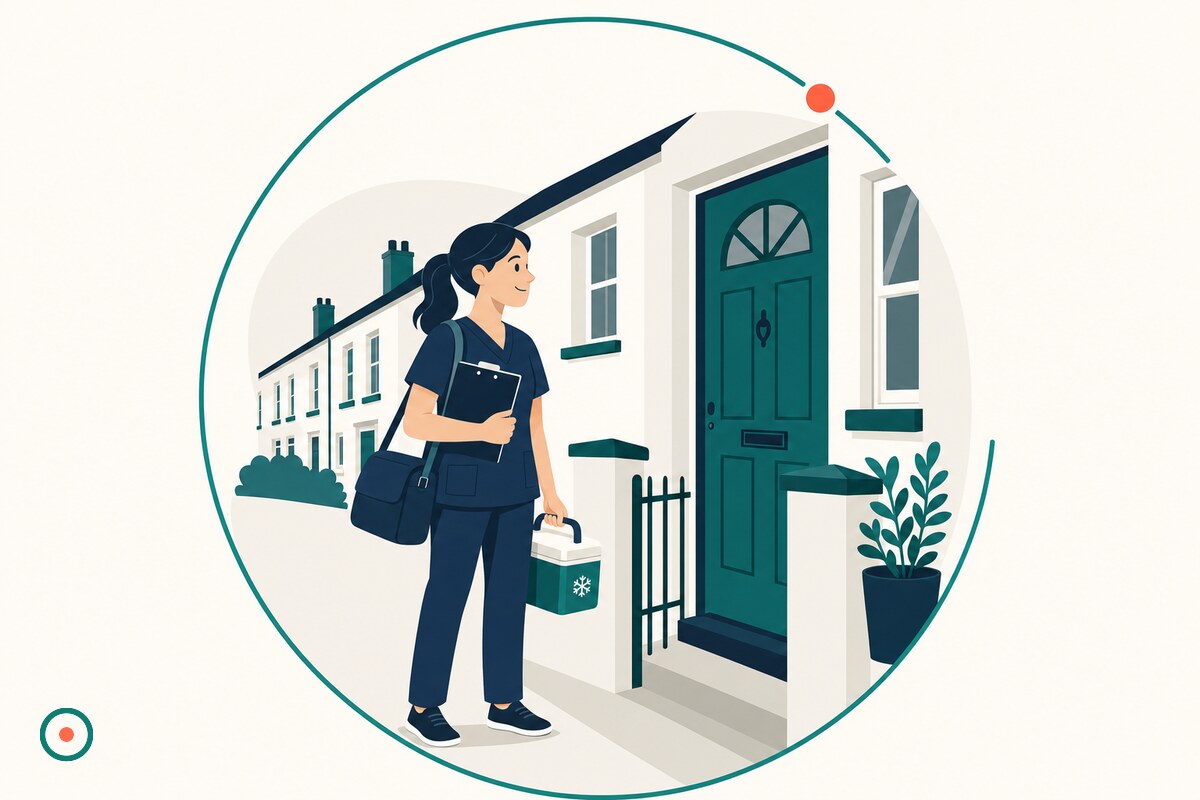
Public health nurse interview questions test five things: do you think about the whole community and not only the patient in front of you, can you build trust with people who don’t trust the system, will you follow public health law and protocol (reporting, confidentiality, cold chain) even when it’s inconvenient, can you manage a caseload on your own out in the field, and can you teach health information in plain language. Health department panels know a new grad hasn’t run a TB caseload or staffed a mass vaccination clinic. They’re listening for judgment, respect, and whether you’d follow the protocol and call your supervisor at the right moment.
Below are the public health nurse interview questions county and city health departments actually ask, each with a copy-ready sample answer, plus the field scenarios most online lists skip entirely. For the full panel across specialties, start with our nursing interview questions hub.
Quick honesty check: Public health nursing is one of the few specialties where many agencies hire new grads directly, often into an entry-level “Public Health Nurse I” class that is designed as a training level. But requirements vary by state and county: some require a BSN (New York’s PHN 1, for example), and California requires a separate Public Health Nurse certificate from the Board of Registered Nursing. Read the posting carefully before you interview.
What does a public health nurse do?
Know the job before you walk in, because the most common new-grad mistake is answering as if it’s a hospital role. Real public health nurse postings describe work like this:
- Communicable disease control — receiving and reporting notifiable diseases, case investigation, contact tracing, and outbreak support with the epidemiology team.
- Tuberculosis follow-up — testing contacts and providing directly observed therapy (DOT), often through home visits, so patients finish treatment.
- Immunizations — running vaccine clinics, managing vaccine inventory, and keeping vaccines at the right temperature (the “cold chain”).
- Home visiting — maternal-child visits, newborn and postpartum assessments, parenting and growth-and-development teaching, and chronic-disease follow-up.
- Health education and outreach — health fairs, school and community presentations, and public messaging in plain, culturally fitting language.
- Case management and referrals — connecting people to housing, food, insurance, mental health, and substance use services.
- Emergency preparedness — staffing emergency dispensing sites and working within an Incident Command structure during outbreaks or disasters.
The mental shift panels want to hear: in a hospital, your patient is the person in the bed. In public health, your patient is also the community — the household contacts, the school, the zip code with the low vaccination rate.
How do I prepare for a public health nurse interview?
Prepare in four layers:
- Learn the department. Read its website and, if it has one, its community health assessment or improvement plan. Know two or three local priorities (for example, maternal health, TB, overdose prevention, or immunization rates).
- Pre-script “Why public health?” — specific, not “I want a Monday-to-Friday schedule.”
- Rehearse 4–5 STAR stories: a patient who didn’t trust you, a teaching moment that worked, a time you followed a rule that wasn’t popular, an organized busy day, and a time you worked with a non-nursing partner (social worker, interpreter, school staff).
- Say two scenario answers out loud: a TB patient missing DOT and a vaccine refrigerator out of range. Both are covered below.
Bring your clinicals: a community health rotation, a vaccine clinic, a school or shelter placement, home visits, or teaching you did on discharge. If your interview includes the standard openers, our tell me about yourself guide and new-grad RN interview questions cover them.
What are the most common public health nurse interview questions and answers?
”Why do you want to work in public health nursing?”
Show that you understand prevention and population thinking, then make it personal and true.
“During my community health rotation I did home visits with a public health nurse, and one family stuck with me. The mother had diabetes she was managing alone, the baby was behind on vaccines, and nobody in the hospital system would have seen either problem until it was an emergency. In one visit the nurse checked the baby, taught the mom about her glucose meter, scheduled the vaccines, and connected them to a food program. I realized I want to work upstream — where good nursing prevents the admission instead of managing it. I also know the job is a lot of documentation, reporting, and follow-up on people who don’t call back, and I’m comfortable with that."
"Why our health department?”
Never invent insider details. Use what you actually found.
“I read your [community health assessment / improvement plan], and [maternal health / immunization rates / TB follow-up — whatever you actually found] stood out as a priority. That lines up with what I enjoyed most in school. I’d also value starting at the Public Health Nurse I level with supervision, because I want to learn your protocols and reporting systems properly before I carry a full caseload."
"Tell me about your experience working with diverse or underserved populations.”
The panel is listening for respect, curiosity, and practical steps — not a speech about diversity.
“In clinicals I cared for patients from several language backgrounds, and the biggest lesson was to use a professional interpreter every time, even when a family member offered to translate, because family members often soften or skip things. I ask what the person already knows and what matters to them before I start teaching. With one patient who had been dismissed by the health system before, I spent the first ten minutes just listening. By the end he was asking me questions about his medications. Trust came from not rushing him."
"How would you handle a client who refuses services or doesn’t follow the plan?”
Show that you look for the reason before you push the rule.
“I’d want to understand why first. Refusal is often about something practical — cost, transportation, work hours, childcare, fear, or a bad past experience. I’d ask open questions, listen, and then problem-solve the barrier: a different visit time, a clinic closer to home, a referral for transportation. I’d make sure they understand the risks in plain language and respect their right to decide. If the refusal affects other people — for example, someone with infectious TB not taking treatment — that’s different, and I’d follow the department’s protocol and involve my supervisor."
"How would you prioritize a caseload of home visits?”
“Risk first. I’d sort by who could be harmed by a delay: a newborn with possible jaundice or poor feeding, a postpartum mom with a concerning depression screen, or a TB patient due for DOT comes before a routine follow-up. Then I’d plan visits geographically so I’m not crossing the county twice, confirm appointments the day before, and keep a running list of what’s due for each client. If I couldn’t safely fit everything in, I’d tell my supervisor early instead of quietly dropping a visit."
"How do you explain health information to people with low health literacy?”
“Plain words, short sentences, one or two key points per visit, and teach-back. For example, instead of ‘adhere to the regimen,’ I’d say ‘take one pill every morning with breakfast,’ then ask, ‘Can you show me how you’ll remember to take it?’ I use pictures or the department’s materials in the client’s preferred language, and I never assume someone understood because they nodded."
"What does confidentiality mean in public health?”
“It means I protect people’s health information the same way I would in a hospital, and in public health that includes things that can carry real stigma — TB, sexually transmitted infections, HIV status, immigration worries. I only share what’s needed with people who need to know, I never confirm a case to a neighbor or employer, and when I do contact tracing I don’t reveal who the source case is. Reporting a notifiable disease to the health department is required by law and is part of how we protect the community, and that’s different from sharing it with someone who has no role in the person’s care."
"Tell me about a time you worked with someone outside of nursing to solve a problem.”
Use STAR and pick a real partner: a social worker, case manager, teacher, or interpreter.
“S: On my med-surg preceptorship, a patient was ready for discharge but had no working refrigerator for his insulin. T: I needed a safe discharge, not just a signed form. A: I told my preceptor and called the case manager, who found a community program that could help, and I taught the patient how to store insulin safely in the meantime. R: He went home with a plan instead of coming back in a week. That’s the part of public health I’m drawn to — the social side of the problem is often the clinical problem."
"How do you stay current in public health?”
Be specific and honest about sources you actually use.
“I follow CDC updates for immunization schedules and health advisories, and I’d follow our state health department’s alerts and any training the department requires. I’d also ask my supervisor which local data reports matter most for this program, because public health priorities are local.”
What scenario questions do public health nurse interviews ask?
Use a think-out-loud structure: what I see → what worries me → what I do first → who I tell (SBAR) → what I document. For more practice with this format, see our situational nursing interview questions.
”Your TB patient on directly observed therapy has missed three visits this week. What do you do?”
“Missed doses in active TB matter for the patient and the community, so I’d act quickly but start with curiosity. I’d try to reach him by phone and by a home visit, and when I find him, ask what’s getting in the way — side effects like nausea, work schedule, transportation, or stigma. I’d check for side effects that need a provider, like yellow skin or eyes, dark urine, or vision changes, depending on his medications. Then I’d problem-solve: a visit time before his shift, or a different location, if the program allows it. And I’d tell my supervisor with SBAR: ‘S: Mr. Ortiz has missed three DOT doses this week. B: He’s on treatment for active pulmonary TB, two months in. A: He reports nausea and a new work schedule; no jaundice. R: I’d like the provider to review his nausea, and I’m proposing a 6 a.m. visit time. Do we need to look at next steps under our protocol if he keeps missing doses?’ Everything gets documented, because missed doses affect his treatment plan."
"You arrive at the vaccine clinic and the refrigerator’s data logger shows 11°C overnight. What do you do?”
This is a classic public health question, and the right answer is very specific.
“Refrigerated vaccines should be stored between 2°C and 8°C, so this is a temperature excursion. I don’t give those vaccines and I don’t throw them away. I notify the vaccine coordinator or my supervisor right away, label the affected vaccines ‘Do not use — temperature excursion,’ and keep them separated at the correct temperature, moving them to a backup unit if this one can’t be fixed. I document the details: date, time, the minimum and maximum temperatures, how long it was out of range, and the lot numbers. Then the coordinator or I contact the manufacturer or the state immunization program, who decide whether the vaccines are still usable. I’d also check the basics — power, door seal, thermostat — so it doesn’t happen again. If any of those doses had already been given, the patients might need to be revaccinated, so that information matters too."
"A parent tells you she isn’t going to vaccinate her baby because she read vaccines cause autism. How do you respond?”
“I’d keep the conversation open instead of arguing. I’d thank her for telling me and ask what she’s read and what worries her most, because the fear is real even when the information isn’t. Then I’d share one clear message: large studies have not found a link between vaccines and autism, and the diseases vaccines prevent can be serious for babies. I’d offer reliable materials and ask what would help her decide. If she still declines, I’d respect that, document the conversation per policy, and make sure she knows she can come back anytime. A parent who feels respected is more likely to return."
"On a postpartum home visit, you notice bruises on the toddler and the mother seems afraid of her partner. What do you do?”
“First, safety — mine and the family’s. I’d stay calm, assess what I can, and not confront the partner. If anyone is in immediate danger, I’d leave and call 911. If not, I’d try to speak with the mother privately and offer domestic violence resources in a way that’s safe for her. The bruises on the toddler, if they’re suspicious, mean I’m a mandated reporter: I’d report to child protective services as my state’s law requires and tell my supervisor the same day. I’d document objectively — what I saw, where, the size, and what was said in the person’s own words — without guessing at causes."
"You get a call that three children at the same daycare have vomiting and diarrhea. What’s your role?”
“This could be an outbreak, so I’d follow the department’s outbreak protocol and loop in my supervisor and the epidemiology team early. My role would likely be gathering information: how many are sick, symptom onset times, what they ate, whether staff are sick, and whether any children need medical care now. I’d give the daycare clear guidance from our protocol on handwashing, cleaning, and excluding sick children and staff until they meet return criteria. I’d document every call carefully, because the timeline is what helps epidemiology find the source."
"You’re on a home visit and the situation feels unsafe — someone is shouting and there are weapons visible. What do you do?”
“I leave. No visit is worth my safety. I’d say something neutral like ‘I’ll reschedule, I’ll call you,’ get to my car, move to a safe place, and call my supervisor. If anyone is in danger, I call 911. Then I’d document what happened and follow the department’s field safety policy — for example, rescheduling with a partner or at a clinic instead of the home."
"Tell me about a time you had to follow a rule that someone didn’t like.”
“S: In clinicals, a visitor wanted to know a patient’s diagnosis and said he was family. T: The patient hadn’t listed him and I couldn’t verify who he was. A: I politely told him I couldn’t share information, offered to let the patient know he was asking, and told my preceptor. R: He was frustrated, but the patient later told us she didn’t want him to know. It showed me why privacy rules exist — and in public health, with diagnoses like TB or HIV, that matters even more.”
Can a new graduate become a public health nurse?
Yes — public health is one of the more realistic specialties for new grads, but the requirements are set by states and agencies, not by one national rule.
- Entry-level classes exist for new grads. Many county job classes have a “Public Health Nurse I” or entry level that is explicitly a training class, where staff may have limited or no directly related experience and work under a more senior PHN or supervisor.
- A BSN is often required or preferred. New York, for example, requires a baccalaureate degree in nursing plus New York RN licensure for Public Health Nurse 1. Other agencies hire ADN-prepared RNs into related community roles. Check each posting.
- California has a separate PHN certificate. To use the title, you need an active California RN license and a BSN or entry-level master’s whose program included public health nursing coursework and at least 90 hours of supervised clinical experience in public health settings, plus at least seven hours of child abuse and neglect training. Since January 2025 the certificate no longer needs renewal as long as your RN license is active.
- Certification is a later goal. The Certified in Public Health Nursing (CPHN) credential from the National Board of Public Health Examiners requires an active RN license plus public health nursing experience: at least one year (full-time) with a BSN or higher, or two years with an associate degree or diploma. A new grad shouldn’t claim it — but naming it as a goal shows you’ve done your homework.
A strong answer sounds like:
“I know I’m starting at the training level, and that’s what I want: your protocols, your reporting systems, and supervised field visits before I carry a full caseload. What I bring from day one is solid assessment skills, patient teaching with teach-back, and the habit of telling my supervisor early when something isn’t right. Long term, I’d like to earn the CPHN once I have the required experience.”
If the posting is in a school or clinic setting instead of a health department, our school nurse interview questions and clinic nurse interview questions cover those panels. Home visiting overlaps heavily with home health nurse interview questions, so skim that too.
What questions should you ask in a public health nurse interview?
Ask questions that show you’re thinking about safety, learning, and the community:
- “Which programs would I be assigned to first — immunizations, TB, maternal-child home visiting, or communicable disease?”
- “What does orientation look like, and how long before I carry my own caseload?”
- “How do nurses stay safe on home visits — is there a check-in system or partner visits?”
- “What are the department’s top health priorities this year?”
- “How are nurses involved in emergency response or mass vaccination events?”
- “What do your strongest new nurses do differently in their first six months?”
For more options, see questions to ask the interviewer in a nursing interview.
Mistakes that weaken a public health interview answer
- Answering like it’s a hospital job. Talk about prevention, families, and communities — not only the patient in front of you.
- Lecturing instead of listening. “I’d educate them on why they’re wrong” loses points. Ask about barriers first.
- Treating protocol as optional. Reporting, confidentiality, and cold chain rules are law or policy, not suggestions.
- Promising to “handle it alone.” Public health nurses work with supervisors, epidemiologists, social workers, and partners. Name who you’d call.
- Inventing credentials. Only name certifications you hold or are working toward.
- Ignoring your own safety. Every home-visit answer should include a plan for leaving if it’s unsafe.
How to prepare for public health nurse interview questions in one evening
- Read the department’s website and write down two local health priorities.
- Practice two scenario answers: a TB patient missing DOT and a vaccine refrigerator out of range.
- Write three STAR stories: a client who didn’t trust you, a teaching moment with teach-back, and a time you followed an unpopular rule.
- Prepare your honest path sentence about the training level, BSN or certificate requirements in your state, and the CPHN as a later goal.
- Say your “Why public health?” answer out loud until it’s under 90 seconds.
For more behavioral structure, see nursing behavioral interview questions.
Public health nurse interview FAQ
Is a public health nurse interview a panel interview?
Often, yes. Government agencies commonly use structured panel interviews where every candidate gets the same questions and is scored on a rating sheet. Answer each question fully, even if it feels similar to one you already answered — each panelist may be scoring a different question.
Do I need a car for public health nursing?
Many field roles involve home visits, so postings often ask for a valid driver’s license and reliable transportation. Check the posting and answer honestly.
Is public health nursing the same as community health nursing?
They overlap. “Community health nurse” is sometimes used for clinic or nonprofit roles, while “public health nurse” usually means a health department role with legal duties like disease reporting and investigation. The interview questions are very similar.
How long should my answers be?
About 60 to 90 seconds for behavioral stories and one to two minutes for scenarios. It’s fine to say, “I’d follow the department’s protocol here — I can walk through the steps if that’s helpful.”
Practice saying the scenario out loud
Reading a good TB or vaccine-refrigerator answer is one skill. Saying it calmly while a panel scores you is another. The candidates who do well have practiced the same pattern until it’s automatic: “here’s what I see, here’s what worries me, here’s what I do first, and here’s who I tell.” Pick two scenarios tonight and say them out loud, timed.
“Tell me about a time you worked with someone outside of nursing to solve a problem”
You just read a strong answer to that. Saying one to three people who are deciding whether to hire you is a different skill — Roundly asks this exact question in a mock Public Health panel, listens, and scores the clinical reasoning underneath.
Answer this one out loud →You've read the answers. Now say one out loud.
Reading a sample answer and delivering it to a panel that's deciding whether to hire you are two different skills. Roundly runs a mock Public Health panel that asks these exact questions, listens to your answer, and scores your clinical reasoning and structure — not just how confident you sounded.
Start a mock Public Health panelTakes about two minutes to set up. Finish 15 panels without an offer and we refund you.