Transplant Nurse Interview Questions (2026): New-Grad Sample Answers
A transplant nurse interview usually has three parts: why transplant (and why this unit), behavioral questions about precision, teaching and teamwork, and often a clinical scenario such as a new kidney that suddenly stops making urine, a missed tacrolimus level or a fever in a patient on immunosuppressants. Nobody expects a new grad to know transplant medicine. The panel wants to see that you treat urine output and lab trends as vital signs, give immunosuppressants exactly on time, take every small sign of infection seriously, and call the transplant team early.
This guide covers how transplant units hire new grads in 2026, the questions panels ask, sample answers you can adapt, and four scenarios with SBAR.
Do transplant units hire new-grad nurses?
Yes. Most hire through a residency, and many transplant units are surgical floors or step-down units. Examples from postings in late 2026:
- Cleveland Clinic posts a New Grad RN Resident – Transplant Specialty Care job on G101, a 34-bed unit for kidney, pancreas, liver and intestine transplants. It accepts an ADN or BSN and asks for BLS. A second posting covers J8-2, a 24-bed heart and lung transplant step-down unit that also cares for patients waiting for a heart on inotrope drips. That one asks for ACLS within the first year.
- Banner University Medical Center Phoenix is hiring new grads into its Transplant PCU for kidney and liver recipients, through Banner’s New Nurse Experience residency. New grads are expected to stay on the unit for at least 12 months.
- OU Health in Oklahoma City hires RN residents into its 32-bed Surgical Transplant unit (liver, kidney and pancreas, from med-surg to step-down acuity).
- Yale New Haven lists a 2026 new-grad residency on its Transplant Unit.
The pattern: no transplant experience needed, BLS on hire, ACLS on higher-acuity units, and a precepted residency. If the job is a hospital-wide program, our nurse residency interview questions cover the general round, and the Cleveland Clinic and Banner Health guides cover those two hiring processes.
What about certification? The Certified Clinical Transplant Nurse (CCTN) exam from the American Board for Transplant Certification needs 24 months of RN experience, including 12 months caring for solid organ transplant patients. A new grad can’t have it. Saying it’s your two-year goal shows you’ve done your homework.
How is a transplant interview different from a med-surg or ICU interview?
The questions overlap with our PCU nurse interview questions and ICU nurse interview questions, but transplant panels listen for four things:
- Timing is a safety issue. Tacrolimus has a narrow therapeutic range. The trough level is drawn shortly before the dose, then the dose is given. Draw it after the dose and the level is useless; give it late and the level drifts. Panels want a nurse who is precise about times without being told.
- Infection hides. Immunosuppressed patients may not mount a big fever or white count. A low-grade temp, a new cough or a red line site is worth a call.
- The graft has vital signs too. For a new kidney, hourly urine output and the creatinine trend matter as much as blood pressure. Rejection is often silent and shows up first as a rising creatinine.
- Teaching never stops. Recipients go home on lifelong medications, lab schedules and infection precautions. Most of your shift is teaching, and teach-back is how you prove it worked.
There’s also an emotional side: patients who waited years, families who donated a kidney, and the knowledge that someone else’s loss made the transplant possible. Panels listen for respect and calm.
Common transplant nurse interview questions
From candidate reports on Reddit, allnurses and Glassdoor, and from transplant unit postings:
- Why do you want to work in transplant?
- What do you know about our unit and the organs we transplant?
- What do you know about immunosuppressants and why timing matters?
- How would you teach a new recipient about their medications?
- Tell me about a time you caught a change in a patient’s condition.
- Tell me about a time you made or nearly made a medication error.
- How would you handle a patient who says they’ve been skipping doses?
- Tell me about a time you supported a stressed family.
- How do you stay organized with many time-critical tasks?
- Where do you see yourself in two years?
One nurse who was invited to a heart transplant unit panel was told on Glassdoor’s community board to expect mostly behavioral questions (“tell me about yourself,” “a time you went above and beyond”). New grads on Reddit report the same. Prepare STAR stories first and the clinical basics second.
Sample answers
”Why transplant?”
Name a real moment, show you understand the work, and connect it to this unit.
“On my med-surg rotation I cared for a man two days after a kidney transplant. Every hour we checked his urine output together, and he cried the first time it went over 200 mL because he’d been on dialysis for six years. I liked that the nursing was so measurable: the numbers told you right away if something was wrong. I also liked the teaching. Before he left he could explain every pill to me. Your unit takes kidney and liver recipients from right after surgery to discharge, and that whole arc is the nursing I want to learn.”
If you did a dialysis rotation, use it. Knowing what life on dialysis looks like is a strong reason to want to work in kidney transplant.
”How would you teach a new recipient about their medications?”
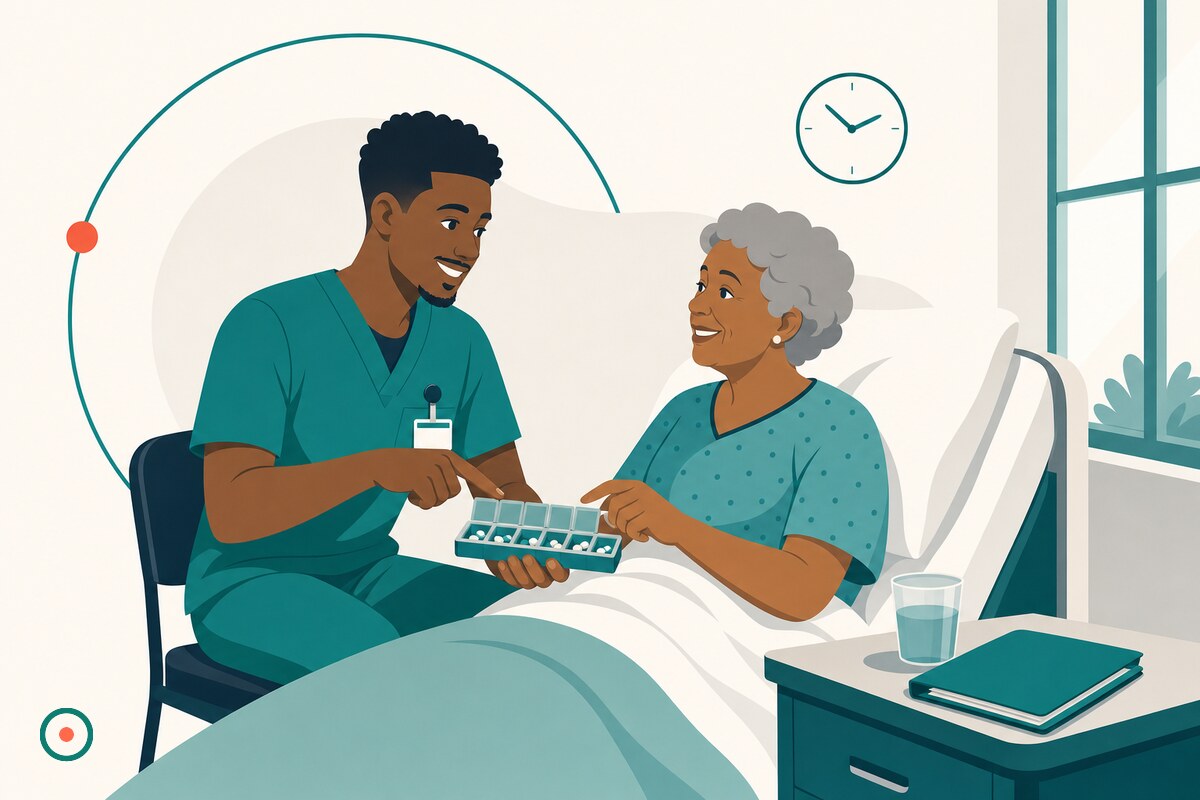
“I’d start before discharge day, not on it. I’d find out what they already know and how they like to learn, then teach one thing at a time: what each medication is for, when to take it, what happens if they miss a dose, and the side effects to report. For tacrolimus I’d stress the same times every day, getting labs drawn before the morning dose, and avoiding grapefruit. I’d use teach-back each shift and have them set up their own pill box with me watching. If a family member helps at home, I’d include them. And if they still struggled, I’d ask for the transplant pharmacist or coordinator before discharge, not after."
"Tell me about a time you nearly made a medication error.” (STAR)
Situation: “In my last semester I had a patient with a 9 a.m. dose of a time-critical medication.” Task: “I was responsible for preparing it with my preceptor.” Action: “When I scanned it, the barcode system flagged a different strength from the order. I stopped, checked the order and the MAR, and called pharmacy with my preceptor. The wrong strength had been loaded in the drawer.” Result: “The patient got the right dose on time, pharmacy fixed the drawer, and I learned that a scanner alert is a reason to stop, never something to override.”
On a transplant unit, that’s exactly the habit they want.
”What would you do if a patient told you they’d been skipping doses?”
“I’d thank them for telling me, because honesty is what keeps the graft safe. Then I’d ask why without judging: cost, side effects, forgetting, or not believing they need it anymore. Each one has a different fix. I’d tell the transplant team and coordinator, because they may want a level drawn, and I’d ask social work or pharmacy to help if cost is the problem. I’d document what the patient told me in their own words.”
Transplant scenarios with SBAR
Clinical rounds in transplant interviews are usually about recognizing a problem and escalating, not about managing it alone. Always say “per our protocol” and “I’d call the transplant team.” More practice: situational nursing interview questions.
Scenario 1: the new kidney stops making urine
“Your patient is 12 hours after a kidney transplant. Urine output has been 150 to 200 mL an hour. This hour it’s 15 mL. What do you do?”
“A sudden drop like that is an emergency. It can mean a blocked catheter, but it can also mean a clot in the graft’s blood supply, which is most likely in the first couple of days. I’d check the Foley tubing for kinks and the bag position, look at the urine for clots, check vital signs and the incision, and bladder scan if our protocol allows. I would not flush the catheter without the transplant team’s order. Then I’d call the transplant team right away, not at the next round, because they may want an urgent ultrasound.”
S: “I’m calling about Ms. Lopez in bed 12, 12 hours after a deceased-donor kidney transplant. Her urine output dropped suddenly to 15 mL this hour.”
B: “She’d been making 150 to 200 mL an hour since surgery.”
A: “The catheter isn’t kinked and I don’t see clots. Blood pressure is 118/70, down from 142/80, heart rate 96. Her incision is dry.”
R: “Can you come see her now? Do you want an ultrasound and an order to flush the catheter?”
Scenario 2: the tacrolimus level
“It’s 8:55. Your patient’s tacrolimus is due at 9:00, and the lab hasn’t drawn the trough yet. What do you do?”
“I’d get the level drawn first, either by calling the lab or drawing it myself if that’s our process, and then give the dose right after. A level drawn after the dose isn’t a trough, so the team would be dosing off a wrong number. If the draw would delay the dose a lot, I’d call the transplant team or pharmacist rather than guess. I’d also check his last level, potassium, glucose and creatinine, and ask about tremor or headache, because those can mean the level is too high.”
Scenario 3: the low-grade fever
“A kidney recipient three weeks out is admitted with a temperature of 100.4°F and says he feels ‘off.’ His creatinine is higher than his baseline. What are you thinking?”
“Two things: infection and rejection. Immunosuppressed patients can be very sick with only a small fever, so I take it seriously. I’d do a full set of vitals and look for a source: lungs, urine, line sites, the incision. I’d check whether the graft is tender, his weight and his urine output. Then I’d call the transplant team with all of it, expecting cultures and possibly a level and further workup per their protocol. I wouldn’t wait to see if the fever climbs.”
Scenario 4: which patient do you see first?
“You have three patients: a liver recipient on post-op day one whose drain output doubled in the last hour and whose heart rate went from 88 to 118, a kidney recipient asking for her discharge teaching, and a patient waiting for a heart on an inotrope drip who wants help to the bathroom.”
“The liver recipient first. A jump in drain output with a rising heart rate can mean bleeding. I’d check his blood pressure, the drain color, his abdomen and mental status, and call the surgical team now. I’d ask the charge nurse for help so the patient on the inotrope isn’t left waiting. He needs a nurse or tech with him to walk, with his line and monitor managed safely. The discharge teaching is important, but it can wait 20 minutes, and I’d tell her when I’ll be back.”
Questions to ask the transplant panel
- Which organs come to this unit, and which go to the ICU after surgery?
- How long is orientation, and does it include both day and night shift?
- What does a typical assignment look like for a new grad?
- How do nurses work with the transplant coordinators and pharmacists?
- Does the unit support the CCTN after two years?
- What do the strongest new grads here have in common?
More ideas: questions to ask the interviewer in a nursing interview.
How do you prepare for a transplant nurse interview?
- Learn the big immunosuppressant classes (for example tacrolimus, mycophenolate, steroids), and for tacrolimus: trough before the dose, common side effects, grapefruit.
- Know the signs of rejection and infection for a kidney recipient, and why they can look alike.
- Practice the urine output scenario until you say “call the transplant team now” without thinking.
- Build five STAR stories: a change in condition, a medication safety catch, a teaching moment, a conflict, and a hard family conversation.
- Research the unit: which organs it takes, its acuity (floor or step-down), and the residency length.
Dress business professional (what to wear to a nursing interview). For the general round, read our new-grad RN interview questions.
Your transplant interview checklist
- An honest, specific “Why transplant?” story.
- A medication-teaching answer that ends with teach-back.
- One immunosuppressant you can explain out loud.
- Two scenarios that end in an SBAR call: a urine output drop and a fever.
- Five STAR stories, each with a clear result.
- Your BLS card, and ACLS if you have it.
- Three questions for the panel.
- A thank-you email within 24 hours (templates here).
Practice the scenarios out loud
Transplant scenarios are easy to read and hard to say. Under pressure, most new grads start fixing the catheter, forget to say who they’d call, or give the dose before the level. Saying it out loud until the order is automatic is the only fix.
Roundly runs realistic mock nurse panels for new-grad RNs. You answer behavioral questions and clinical scenarios out loud, the panel asks follow-ups, and Roundly scores the clinical reasoning and structure of what you said, not just how smooth it sounded. It was built with nurse recruiters and hiring managers.
Practice a transplant unit panel interview with Roundly →
“Why transplant?”
A strong answer to this one is further down. Saying one to three people who are deciding whether to hire you is a different skill — Roundly asks this exact question in a mock Transplant panel, listens, and scores the clinical reasoning underneath.
Answer this one out loud →You've read the answers. Now say one out loud.
Reading a sample answer and delivering it to a panel that's deciding whether to hire you are two different skills. Roundly runs a mock Transplant panel that asks these exact questions, listens to your answer, and scores your clinical reasoning and structure — not just how confident you sounded.
Start a mock Transplant panelTakes about two minutes to set up. Finish 15 panels without an offer and we refund you.