SICU Nurse Interview Questions (2026): New-Grad Sample Answers
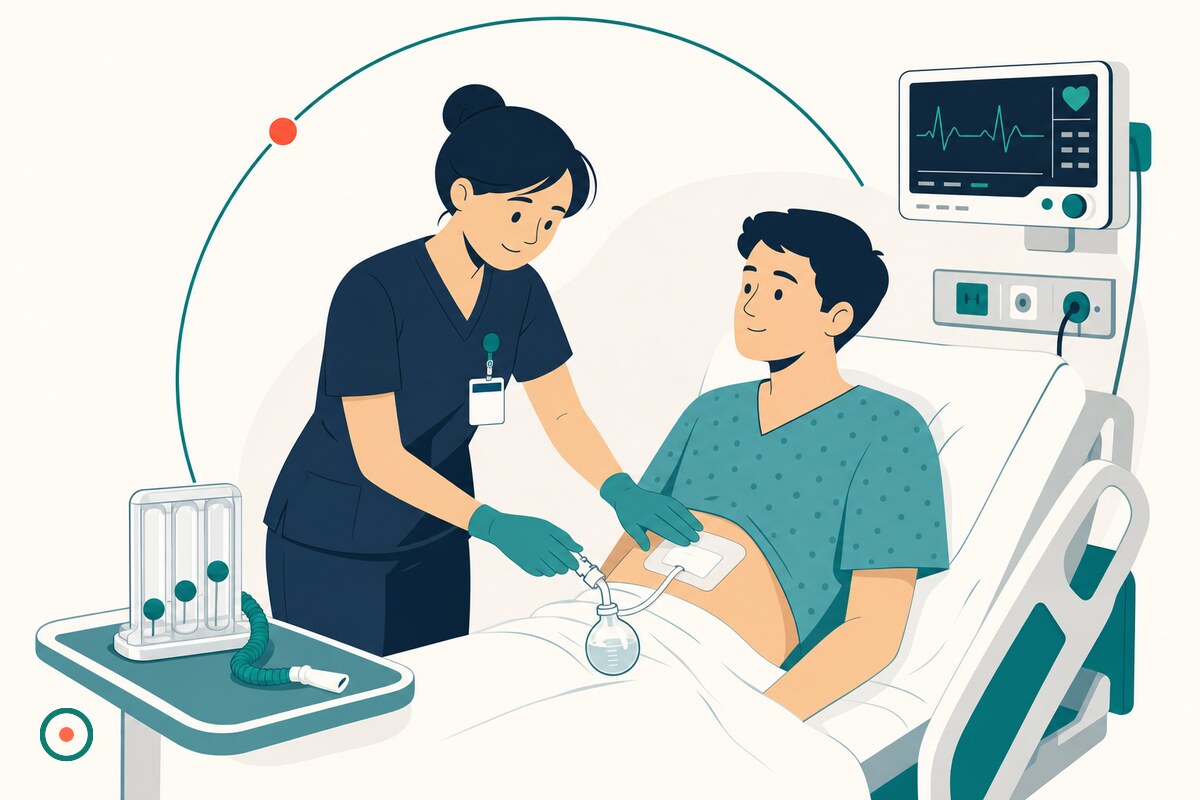
A SICU nurse interview usually has three parts: why the surgical ICU (and why this unit), behavioral questions about stress, teamwork, families and mistakes, and a clinical scenario about a patient after surgery or trauma: a drain that suddenly fills with blood, a chest tube that comes out, a tight abdomen with falling urine output, or a fresh admission from the OR. Nobody expects a new grad to manage a trauma alone. The panel wants to see that you spot bleeding and other post-op problems early, know what to do first, call the surgical team with SBAR, and stay calm with frightened families.
This guide covers how surgical ICUs hire new grads in 2026, what makes a SICU interview different from a general ICU one, the questions panels ask, sample answers you can adapt, and five scenarios with SBAR.
What does SICU mean?
SICU stands for surgical intensive care unit. It cares for adults who are critically ill after major surgery or injury: trauma, abdominal and vascular surgery, transplants, neurosurgery and spine cases, and sometimes head and neck surgery. Some hospitals call it a STICU (surgical trauma ICU) or a shock/trauma unit.
Do SICUs hire new-grad nurses?
Yes, almost always through a residency. Examples from postings in fall 2026:
- Johns Hopkins Hospital (Baltimore) hires new grads into its 18-bed SICU, which includes four cardiac surgery beds. As a Level 1 trauma center, the unit takes abdominal transplants (liver, kidney, pancreas), trauma, vascular, general and GI surgery, and orthopedic and spine cases, with ventilators, drips, hemodynamic monitoring and CRRT. New grads join a year-long accredited residency. The posting also asks for 120 hours of adult ICU clinical practicum in nursing school, so check this kind of requirement before you apply.
- Cleveland Clinic Fairview Hospital (Cleveland) posts a New Grad RN Resident – Surgical ICU role on nights. The unit cares for heart, vascular, trauma, neuro, orthopedic, pulmonary and GI surgical patients and lists ventriculostomies, ICP monitoring, CRRT, balloon pumps and PA catheters. It accepts an ADN or BSN and asks for BLS, with ACLS on hire or within the first year.
- Maine Medical Center (Portland, Maine), the state’s only Level I trauma center, hires new grads into its SICU on nights, with patients ranging from multi-system trauma and burns to brain injury, vascular and GI surgery.
- ChristianaCare (Newark, Delaware) places new grads in its Surgical ICU (Shock/Trauma) through a critical care residency that starts with several weeks on a step-down unit before ICU orientation.
The pattern: no RN experience needed, BLS on hire, ACLS soon after, a precepted residency of about a year, and nights or rotating shifts. If the job sits inside a hospital-wide program, our nurse residency interview questions cover the general round. Applying to one of these systems? See the Johns Hopkins RN interview guide or the Cleveland Clinic RN interview guide.
On certification: the CCRN from AACN needs 1,750 hours of direct care of acutely or critically ill patients in the past two years, with 875 of them in the most recent year. Orientation hours where you only shadow don’t count, so “CCRN once I’m eligible” is the honest answer.
SICU vs MICU vs ICU: what’s the difference?
“ICU” is the umbrella. Large hospitals split it by patient type (newborns go to a separate unit with its own neonatal ICU interview questions):
- SICU: patients after an operation or injury. Problems come from the surgery itself: bleeding, drains and wounds, chest tubes, pain, infection at the surgical site, and blood clots.
- MICU: patients critically ill from a disease, like septic shock, respiratory failure or DKA. Our MICU nurse interview questions cover that unit.
- CVICU: heart surgery patients. See the CVICU nurse interview questions.
Smaller hospitals often run one mixed ICU, and the core skills are the same everywhere, so also read our ICU nurse interview questions. What changes in a SICU interview is what the panel listens for:
- Bleeding is the first worry. A rising heart rate, falling pressure, and more or brighter drain output after surgery should make you think of bleeding before anything else.
- Tubes and drains. JP drains, chest tubes, NG tubes, Foleys, sometimes ventriculostomies. You don’t need to manage them all yet, but you should know what normal looks like and when to call.
- The surgical team is part of every call. Who you call first (the surgery resident, the ICU team, or both) is unit-specific. Saying “I’d follow our escalation policy and call the surgical team” shows you get it.
- Recovery matters too. Pain control, early mobility, incentive spirometry, clot prevention and nutrition all count, because they decide how fast patients leave the unit.
Many SICU patients arrive straight from the OR and have just left the recovery room, so the PACU nurse interview questions are useful practice for the “first hour after surgery” questions.
Common SICU nurse interview questions
From ICU interview threads on Reddit, the ICU question lists that rank in search, and SICU job postings:
- Why the SICU, and why our hospital?
- What do you know about the patients on our unit?
- How would you recognize bleeding after surgery?
- Tell me about a time you caught a patient getting worse.
- How do you take a handoff from the OR or anesthesia?
- How do you manage a patient’s pain while watching for oversedation?
- Tell me about a time you disagreed with a provider or a team member.
- How would you support the family of a trauma patient?
- How do you prioritize two unstable patients?
- Where do you see yourself in two years?
Most new-grad ICU panels mix behavioral questions with one or two “what would you do” scenarios. Build your STAR stories first, then practice the scenarios out loud.
Sample answers
”Why the SICU?”
Name a real moment, show you understand the work, and tie it to this unit.
“In my ICU capstone I cared for a man after an emergency bowel resection. Over two days I watched him go from a ventilator and two drips to sitting in a chair, and I saw how much of that came from the nurse: catching a drop in his urine output early, managing his pain so he could breathe deeply, and getting him moving. I like that kind of fast, visible recovery, and I like working closely with the surgical team. Your SICU takes trauma and transplant patients, and your residency gives new grads a full year with a preceptor. That’s where I want to learn."
"Tell me about a time you caught a patient getting worse.” (STAR)
Situation: “On my surgical floor preceptorship, a patient was one day out from a hip replacement.” Task: “I was assigned to her with my preceptor.” Action: “At my 0800 check her heart rate was 112, up from the 80s, and she was more anxious and a little short of breath, with a saturation of 91%. Her pain was controlled, so pain didn’t explain it. I told my preceptor right away, and we called the provider with SBAR and said we were worried about a pulmonary embolism.” Result: “She was worked up for a PE quickly and treated. I learned to ask ‘what else could this be?’ instead of blaming a fast heart rate on pain."
"How do you take a handoff from the OR?”
“I’d have the room ready before the patient arrives: monitor, suction, oxygen, and pumps. At the bedside I’d connect the monitor first, then listen to the handoff without interrupting if I can: the procedure, how it went, blood loss, fluids and blood given, lines and drains, airway, pain medication, and anything the surgeon wants watched. Then I’d do my own head-to-toe and check every drain, dressing and line, mark the drain levels, and ask questions before anesthesia leaves. If something doesn’t match the report, I’d say so right then."
"How would you support the family of a trauma patient?”
“Trauma families didn’t have time to prepare, so I’d start with the basics: who I am, what all the equipment is, and what will happen in the next few hours. I’d be honest within my scope and make sure the surgeon or provider updates them, with a social worker or chaplain if they want one. I’d check what they understood, because people in shock forget a lot. And I’d find out who the main contact is, so updates go to one person and the family isn’t getting different stories.”
SICU scenarios with SBAR
SICU scenario questions test what you’d do first and who you’d call, not whether you can fix it alone. Say “per our protocol” and “I’d call the surgical team.” For more practice, try our situational nursing interview questions and critical thinking nursing interview questions.
Scenario 1: the post-op bleed
“Your patient is six hours out from a liver resection. His JP drain has put out 300 mL of bright red blood in the last hour. Heart rate went from 92 to 124 and blood pressure from 128/74 to 94/58. What do you do?”
“I think he’s bleeding. I’d stay with him and call the surgical team and the charge nurse right away. While they come, I’d check his airway and mental status, a full set of vitals, his dressing and abdomen, and confirm I have good IV access, ideally two large-bore lines. I’d expect orders for a CBC, coags and a type and crossmatch, fluids or blood, and I’d make sure the blood bank knows. I’d keep him NPO in case he goes back to the OR. I’d watch his urine output and keep trending the drain, the heart rate and the pressure every few minutes.”
S: “This is the SICU nurse for Mr. Lopez in bed 4. I think he’s bleeding.”
B: “He’s six hours post liver resection. At 1400 his heart rate was 92 and pressure 128/74.”
A: “Now he’s 124 and 94/58, and his JP put out 300 mL of bright red blood in the last hour. He’s awake but pale.”
R: “Can you come and see him now? I’d like a CBC, coags and a type and cross, and do you want blood or fluids started?”
Scenario 2: the chest tube that comes out
“Your trauma patient with a chest tube for a pneumothorax turns in bed, and the tube pulls out of his chest. What do you do?”
“I’d cover the site right away with a sterile occlusive dressing taped on three sides, so air can escape but isn’t sucked back in, unless our policy says otherwise. I’d call for help and have someone page the provider while I stay with him. Then I’d watch his breathing, saturation, heart rate and pressure, and his trachea and breath sounds. If he gets more short of breath, his pressure drops or I can’t hear breath sounds on that side, I’d call a rapid response, because that could be a tension pneumothorax. I’d get supplies ready for a new chest tube.”
If the panel changes it to “the tubing disconnects from the drainage box,” the answer changes too: put the end of the tube into a bottle of sterile water to restore the water seal, don’t clamp it, and get a new system.
Scenario 3: the tight abdomen
“Your patient had a large abdominal surgery after a car crash and got a lot of fluid and blood in the OR. Now her abdomen is tense, her urine output dropped to 10 mL an hour, and the ventilator’s peak pressures are rising. Her bladder pressure is 22. What do you do?”
“I’m worried about abdominal compartment syndrome. A bladder pressure over 20 with new organ problems, like her kidneys and her lungs here, fits the definition. I’d first make sure the reading is accurate: patient flat, transducer zeroed at the right level, measured at end-expiration. Then I’d call the surgical team right away with the number and the trend, because the fix is often surgical. Meanwhile I’d check her Foley isn’t kinked, make sure her sedation and pain are adequate, and keep trending her pressure, urine output and vent pressures.”
That answer uses the World Society of the Abdominal Compartment Syndrome definition: intra-abdominal pressure of 12 or higher is intra-abdominal hypertension, and a sustained pressure over 20 with new organ dysfunction is compartment syndrome. Panels won’t expect the society’s name. They want you to connect the tense belly, the falling urine and the vent pressures.
Scenario 4: the fresh trauma admission who is cold
“A trauma patient arrives from the OR after surgery for a bleeding spleen. His temperature is 95.2°F, he’s still oozing from his IV sites, and his blood gas shows acidosis. What worries you?”
“Hypothermia, acidosis and bleeding together are what’s called the lethal triad in trauma: each one makes the others worse. I’d start warming him right away with a warming blanket and warmed fluids or blood if ordered, and I’d tell the team the oozing is new, because it can mean his blood isn’t clotting. I’d expect labs like coags, a CBC and a repeat gas, and possibly blood products. I’d keep watching his drains, dressings and vitals closely and recheck his temperature often.”
Scenario 5: which patient do you see first?
“Your new patient is rolling in from the OR. At the same time, your other patient, two days after a knee replacement, calls to say she’s suddenly short of breath and her chest hurts. What do you do?”
“I’d go to the patient who is short of breath first. Sudden shortness of breath and chest pain two days after orthopedic surgery could be a pulmonary embolism, and she’s getting worse right now. I’d ask the charge nurse or another nurse to receive the OR patient and start the monitor while I assess her: vitals, saturation, lung sounds and her legs. I’d put her on oxygen per protocol and call the provider or a rapid response. As soon as she’s safe with help at the bedside, I’d go take the full handoff on my new patient.”
Questions to ask the SICU panel
- What patients do you see most: trauma, transplant, general surgery, neuro?
- How long is orientation, and when do new grads take fresh post-ops or trauma admissions?
- Who do nurses call first for a surgical patient: the surgical team or the ICU team?
- What does a typical assignment look like, one patient or two?
- How does the unit support new grads after a hard trauma or a death?
- Does the unit support the CCRN or trauma courses once nurses are eligible?
More ideas: questions to ask the interviewer in a nursing interview.
How do you prepare for a SICU nurse interview?
- Know the signs of bleeding after surgery and say them in order: heart rate up, pressure down, drain output up and brighter, urine output down, patient restless or pale.
- Learn the chest tube basics: what to do if it comes out and what to do if it disconnects.
- Practice one OR handoff out loud with the items you’d want to hear.
- Build five STAR stories: catching a change in condition, a safety catch, a conflict, a hard family conversation, and a time you asked for help.
- Research the unit: beds, trauma level, the most common surgeries, shifts and how long the residency is. If it takes burn patients, read our burn unit nurse interview questions. If it takes transplants, read the transplant nurse interview questions.
Dress business professional (what to wear to a nursing interview). For the general round, read our new-grad RN interview questions.
Your SICU interview checklist
- An honest, specific “Why the SICU?” story.
- A clear answer on how the SICU differs from the MICU.
- The post-op bleed scenario, ending with an SBAR call.
- Chest tube out vs. chest tube disconnected.
- One prioritization answer where you go to the unstable patient and ask for help with the other.
- Five STAR stories, each with a clear result.
- Your BLS card, and ACLS if you have it.
- Three questions for the panel.
- A thank-you email within 24 hours (templates here).
Practice the scenarios out loud
SICU scenarios sound simple on paper. Under pressure, most new grads forget to call the surgical team, treat a fast heart rate as pain, or try to fix a chest tube before covering the site. Saying the answers out loud until the order is automatic is the fix.
Roundly runs realistic mock nurse panels for new-grad RNs. You answer behavioral questions and clinical scenarios out loud, the panel asks follow-ups, and Roundly scores the clinical reasoning and structure of what you said, not just how smooth it sounded. It was built with nurse recruiters and hiring managers.
Practice a SICU panel interview with Roundly →
“Why the SICU?”
A strong answer to this one is further down. Saying one to three people who are deciding whether to hire you is a different skill — Roundly asks this exact question in a mock SICU panel, listens, and scores the clinical reasoning underneath.
Answer this one out loud →You've read the answers. Now say one out loud.
Reading a sample answer and delivering it to a panel that's deciding whether to hire you are two different skills. Roundly runs a mock SICU panel that asks these exact questions, listens to your answer, and scores your clinical reasoning and structure — not just how confident you sounded.
Start a mock SICU panelTakes about two minutes to set up. Finish 15 panels without an offer and we refund you.